
Display Glass Door — Cold Storage Merchandising
Glazed display doors for cold storage merchandising — beverage warehousing, dairy showrooms, produce display, retail cold rooms. Insulated glass with anti-condensation heating and thermal-break aluminium framing.
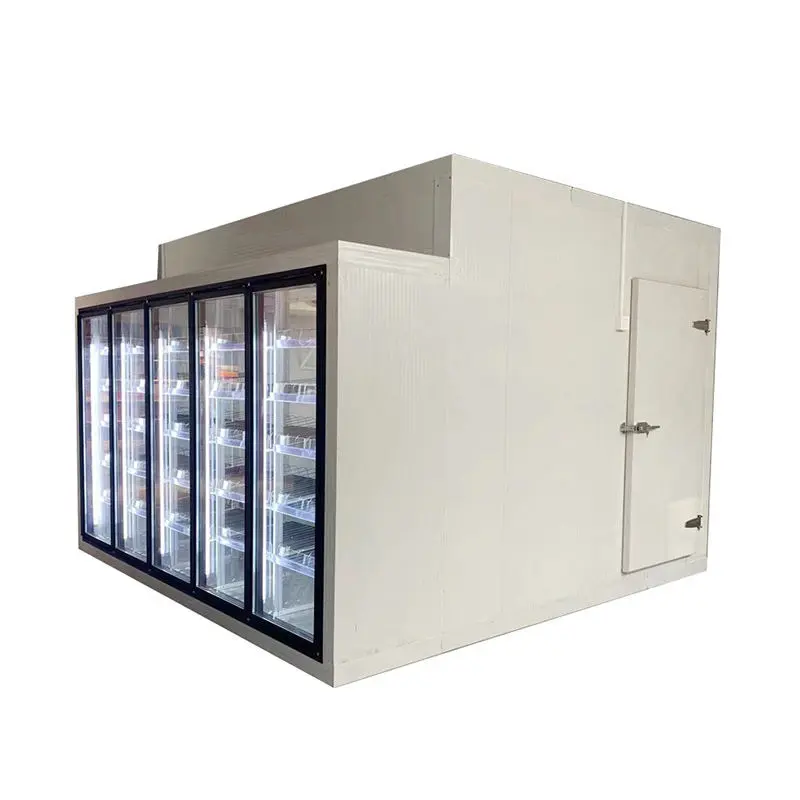
Glazed display doors for cold storage merchandising — beverage warehousing, dairy showrooms, produce display, retail cold rooms. Insulated glass with anti-condensation heating and thermal-break aluminium framing.
Why glass doors matter for cold storage merchandising
For pure product storage where visibility doesn’t matter, solid insulated doors are the correct choice — cheaper, better insulated, longer service life. But a growing set of cold storage applications specifically need product visibility through the door:
Beverage warehousing. Distribution centres for premium beverage brands — beer, wine, imported soft drinks — increasingly use glass-fronted cold rooms to showcase inventory during buyer visits. The visual impact of walking past hundreds of chilled bottles behind glass is a genuine sales tool for premium brand positioning.
Dairy processing showrooms. Cheese producers, artisanal dairy operations, and specialty food processors host buyer visits, retailer tours, and consumer showroom experiences. Glass doors turn a cold storage room into a marketing asset — visitors see the product range without disrupting cold-chain operations.
Retail cold storage. Premium retail formats (specialty grocers, upmarket beverage retailers, artisanal food shops) use walk-in glass-fronted cold rooms as storefront features. Customers see the full inventory; staff access the room from behind for restocking without customer-side disruption.
Produce ripening and quality assessment. Fruit ripening rooms and quality assessment areas benefit from visual inspection through the door — operators can check colour development, ripeness progression, and pack condition without opening the door and disrupting the atmosphere.
Ice cream and frozen dessert production. Production facilities frequently use glass display doors to show product flow through freezing tunnels and storage chambers — visible operations are a quality signal to visiting buyers and regulatory inspectors.
The engineering — insulated glass units for cold-side service
The critical component of any display glass door for cold storage is the insulated glass unit (IGU) that provides both visibility and thermal isolation. Standard commercial glass — the single-pane glass used in office building interior partitions — is completely inadequate for cold storage service. Two panes of glass separated by an air or gas-filled cavity, correctly assembled, provides the thermal performance cold storage requires.
Our display glass doors use double-glazed IGUs (triple-glazed available for extreme cold applications) with:
- Low-E (low-emissivity) coating — invisible metallic coating on the interior surface of one glass pane reflects heat back toward its source, improving thermal performance by 40-60% compared to uncoated glass
- Argon gas fill — argon between the panes has lower thermal conductivity than air, reducing heat transfer through the IGU
- Warm-edge spacer — the spacer that separates the two panes at the edges is a specialised low-conductivity material that reduces edge heat transfer (a common weakness of standard IGUs)
- Butyl and silicone dual seal — the perimeter seal that keeps argon inside and moisture outside uses two layers for redundancy — critical for 15+ year IGU service life
Anti-condensation heating — essential for cold-side service
The critical failure mode of standard glass doors in cold storage service is condensation on the exterior (warm-side) glass surface. Warm humid ambient air contacts the cold outer glass, forms visible moisture beads, and either drips down to pool on the floor or eventually damages the frame seal.
Our display glass door uses a low-wattage heating element around the glass edges and along the frame to prevent condensation formation:
- Perimeter frame heater — 30-80 W depending on door size, maintains frame surface above dew point
- Anti-fog glass coating (optional) — invisible surface treatment prevents temporary fogging during humidity spikes
- Air curtain compatibility — for high-humidity ambient environments, air curtain integration prevents warm humid air from contacting the cold glass
Net energy consumption is modest — 30-80 W per door is negligible compared to the refrigeration savings from eliminated condensation-related seal failures.
Aluminium framing with thermal break
Frame construction on any display glass door for cold storage matters enormously — most heat transfer through the door happens at the frame, not through the glass. Our frame design uses aluminium extrusion with a thermal break:
- Warm-side aluminium extrusion — visible from outside, houses the door hardware
- Insulating thermal break — polyamide or PVC layer that prevents heat transfer from warm-side to cold-side frame surfaces
- Cold-side aluminium extrusion — visible from inside, holds the IGU and gasket
The thermal break eliminates the “cold bridge” that would otherwise transfer heat through continuous aluminium frame construction — significantly improving overall door thermal performance and preventing cold-side frame condensation.
Available in swing, sliding, or fixed panel configurations
Our display glass door for cold storage is available in three base configurations:
Swing door configuration. Traditional hinged door with glass IGU replacing the standard PUF panel. Cold-storage-rated hinges support the additional glass weight; full-perimeter gasket and heated frame prevent air leakage. Most common for smaller openings and moderate traffic.
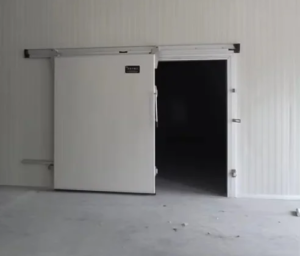
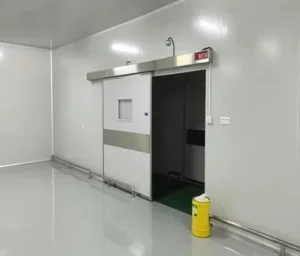
Sliding door configuration. For wider openings or high-traffic merchandising applications. Aluminium extrusion overhead track supports the glass door weight; 3D closing movement produces hermetic seal despite the glass construction.
Fixed glass panel configuration. Glass panels installed as part of the cold room wall structure without door functionality. Used for merchandising visibility where product access happens through a separate door. Panels use the same IGU and thermal break construction as the doors.
LED lighting integration
Every display glass door for cold storage includes provisions for integrated LED lighting — the difference between a functional cold storage window and a genuine product display feature:
- Perimeter LED strips — mounted around the interior of the door frame, illuminate the products behind the glass
- Overhead LED bars — mounted at the top of the door interior, provide primary product illumination
- Colour-tunable options — warm white for meat and cheese displays, cool white for beverage and produce, RGB for special events
LEDs are low-heat sources compared to fluorescent or incandescent lighting — no significant addition to chamber cooling load, and their long service life matches the door’s operating lifetime.
Built to run, season after season.
Double-glazed insulated glass units
Two panes of glass separated by argon gas-filled cavity, with Low-E coating and warm-edge spacer. Delivers 40-60% better thermal performance than uncoated single-pane glass. Triple-glazed available for extreme cold applications (below −18°C).
Anti-condensation heating
Low-wattage perimeter frame heating (30-80 W depending on door size) maintains frame surface above dew point, preventing condensation on the warm-side glass. Essential for reliable operation in high-humidity ambient environments — Indian summer conditions especially.
Thermal-break aluminium framing
Aluminium extrusion frame with polyamide or PVC thermal break layer between warm-side and cold-side surfaces. Eliminates the "cold bridge" that would otherwise transfer heat through continuous aluminium construction. Significantly improves overall thermal performance.
Low-E coating on interior surface
Invisible metallic coating on one interior glass surface reflects infrared radiation back toward its source. Standard industry approach for high-performance IGUs — improves thermal performance without affecting visible light transmission or product appearance.
Argon gas fill
Cavity between glass panes filled with argon rather than air — argon has lower thermal conductivity, reducing heat transfer through the IGU. Standard on all our IGUs; krypton fill available for maximum thermal performance in extreme applications.
Available in swing, sliding, or fixed panel
Swing configuration for smaller openings and moderate traffic; sliding configuration for wider openings and high-traffic merchandising applications; fixed panel configuration for merchandising visibility without door functionality (product access through separate door).
LED lighting integration
Integrated perimeter LED strips and overhead LED bars illuminate products behind the glass. Colour-tunable options — warm white for meat and cheese, cool white for beverage and produce, RGB for special promotions. Low-heat operation, long LED service life.
Full-perimeter EPDM gasket
Same cold-storage-rated EPDM sealing gasket as our solid insulated doors — full-perimeter compression seal when closed. Special profile accommodates thicker IGU without leaving gaps at glass-to-frame interface. Standard for all glass door variants.
15+ year IGU service life
Butyl and silicone dual perimeter seal on the IGU retains argon and prevents moisture ingress for 15+ years typical service life. Standard IGUs fail visibly within 5-8 years by losing argon or fogging internally. Our specification ensures long-term performance.
Specifications
| Type | Double-glazed insulated display door |
|---|---|
| Opening widths | 800 mm to 2,400 mm (custom to 3,000 mm) |
| Opening heights | 1,800 mm to 2,400 mm typical |
| Glass unit type | IGU (Insulated Glass Unit) |
| Glazing configuration | Double-glazed standard, triple-glazed for freezer |
| Glass thickness | 4 mm outer, 4 mm inner (6 mm optional) |
| Cavity fill | Argon (krypton for extreme cold) |
| Cavity spacer | Warm-edge low-conductivity |
| Low-E coating | Standard on interior surface |
| Frame material | Aluminium extrusion with thermal break |
| Thermal break | Polyamide or PVC |
| Anti-condensation heating | 30-80 W (variant dependent) |
| Frame gasket | Full-perimeter EPDM |
| Configurations | Swing, sliding, fixed panel |
| Operating temperature | -25°C to +8°C |
| LED lighting | Integrated (optional) |
| IGU service life | 15+ years typical |
| Custom sizes | Available on request |
Where it's used.
- Beverage warehousing display
- Premium beverage distribution
- Dairy processing showrooms
- Cheese production facilities
- Retail cold storage
- Specialty grocery cold rooms
- Fruit ripening visualization
- Ice cream production display
- Frozen dessert showrooms
- Buyer visit merchandising
Product questions, answered.
Can I use regular commercial glass doors for cold storage?
No. Standard commercial glass doors — the type used in office building interior partitions — have single-pane glass and no anti-condensation features. In cold storage service, they immediately develop condensation on the warm side, quickly fog internally, and fail within months. Purpose-built display glass doors for cold storage use double-glazed insulated glass units with Low-E coatings, anti-condensation heating, and thermal-break framing — all essential for reliable operation.
What's the difference between chiller and freezer glass door specifications?
Freezer applications require significantly more thermal isolation. Chiller rooms (0°C to +8°C) work well with double-glazed IGUs and standard 30-50 W anti-condensation heating. Freezer rooms (-18°C to -25°C) require triple-glazed IGUs (three panes of glass, two argon cavities), enhanced Low-E coatings, and 60-80 W heating. Freezer glass doors cost approximately 40-60% more than equivalent chiller doors — the additional thermal performance is essential for reliability.
Do I really need anti-condensation heating on the glass?
Yes, in Indian ambient conditions absolutely. Summer humidity levels routinely exceed 70% RH, and warm humid ambient air contacting cold outer glass forms visible condensation within minutes. Without anti-condensation heating, glass doors either fog constantly (destroying merchandising value) or develop chronic frame condensation that damages the seal system. The 30-80 W heating consumption is minor compared to the operational reliability it delivers.
What's the largest size I can supply for display walls?
Individual glass doors up to 2,400 mm width and 2,400 mm height standard, with custom sizes to 3,000 mm width available. For larger display walls, we combine multiple doors and fixed panels — up to 10+ metres span is common in retail cold storage storefronts and beverage brand showrooms. Multi-panel walls require coordinated frame design during specification. Very large custom installations engineered per project.
Can I use these doors for freezer applications with ice cream displays?
Yes — freezer display glass doors are specifically engineered for ice cream production display rooms, frozen product showrooms, and seafood displays. Triple-glazed IGUs and enhanced anti-condensation heating handle the −18°C to −25°C operating range reliably. Common application in premium ice cream production facilities where product visibility during buyer visits is a marketing asset.
What LED lighting options are available?
Standard integrated options include perimeter LED strips (around the interior door frame), overhead LED bars (mounted at top of door interior), and colour-tunable options — warm white (3000K) for meat and cheese displays, cool white (5000K) for beverage and produce, RGB for special promotional events. LEDs are low-heat sources — no significant addition to chamber cooling load. Custom lighting configurations available for specific merchandising requirements.
How long do the insulated glass units actually last?
Our IGUs are specified for 15+ years typical service life through butyl and silicone dual perimeter sealing. Standard commercial IGUs fail visibly within 5-8 years by either losing argon fill (thermal performance degrades) or developing internal fogging (aesthetic failure). Our specification ensures long-term performance appropriate for cold storage service life. IGU replacement possible if failure eventually occurs, without complete door replacement.
What's the typical delivery and installation timeline?
Standard sizes ship in 6-8 weeks from order confirmation due to specialised IGU procurement lead time. Custom sizes and multi-panel display walls run 8-12 weeks depending on complexity. Installation typically takes 2-3 days per door for mechanical work plus additional time for LED lighting and electrical connections. Total project timeline from order to operational: 8-10 weeks standard, 10-14 weeks for custom or multi-panel installations.
Every Prime Coil display glass door for cold storage combines merchandising visibility with the thermal performance and reliability that cold storage requires — a combination that standard commercial glass doors cannot deliver. Send us your facility layout and merchandising requirements, and we come back with the right specification, delivered price, and installation timeline within 2 working days.
Tell us your daily requirement.
Share your output target, product and ambient conditions — we'll specify the machine and the plant around it.