
Plate Ice Machine
Food-grade plate ice from 500 kg to 75 tonnes a day, with no moving parts in the ice-making circuit.
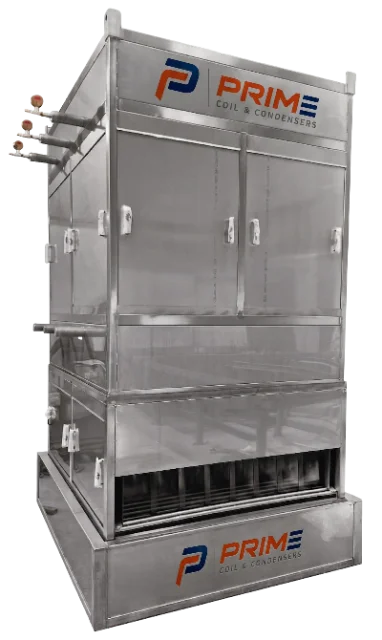
Food-grade plate ice from 500 kg to 75 tonnes a day, with no moving parts in the ice-making circuit.
Plate ice forms as a thin sheet on vertical freezing plates, then harvests and breaks into irregular chips. That geometry gives it a high surface-to-mass ratio — so it pulls heat out of product faster than block or tube ice, without the bruising that comes from sharp-edged alternatives.
Because the ice is dry, sub-cooled and free-flowing, it stores and conveys cleanly. Prime builds every machine in-house on an ammonia platform, with food-grade contact surfaces and a harvest cycle tuned to your product and handling method.
Built to run, season after season.
Stainless steel pillow plates
Laser welded in-house on plate that stays thin enough for fast heat transfer while withstanding full operating pressure.
Complete hygienic construction
Full stainless steel throughout the water and ice path, suitable for direct food contact and washdown.
No moving parts
Nothing rotates or cuts inside the ice-making circuit, which removes the wear items that normally define an ice machine's service life.
Capacity to 75,000 kg/day
From 500 kg/day up to 75 tonnes per day in a single unit, with larger duties met by machines in parallel.
Works with all refrigerants
Ammonia, Freon and glycols, in DX, gravity or pumped systems — so the machine fits the plant you already have.
Adjustable ice thickness
Set to suit the application: thinner for fast release and high throughput, thicker for slower melt in transport.
Access from all sides
Every face is reachable for inspection and cleaning without dismantling adjacent equipment.
Seawater option
Available for marine and coastal installations where fresh water is not practical.
Specifications
| Capacity range | 500 – 75,000 kg/day per unit |
|---|---|
| Ice type | Plate ice — hard, dry, non-clumping |
| Ice thickness | 4mm — adjustable |
| Plate material | Stainless steel, laser-welded pillow plate |
| Casing / construction | Full stainless steel |
| Refrigerants | Ammonia (R-717), Freon, Glycol |
| System types | DX, gravity, pumped (liquid overfeed) |
| Defrost / harvest | Hot gas release cycle |
| Water supply | Potable fresh water; seawater option available |
| Control | Good — PLC make and whether HMI is standard |
| Power supply | 415V, 3 phase, 50 Hz |
Where it's used.
- Fisheries & seafood processing
- Food processing
- Poultry & meat chilling
- Dairy
- Concrete cooling
- Chemical processing
- Pharmaceuticals
- Retail & ice vending
Product questions, answered.
What is the difference between plate ice and flake ice?
Plate ice is thicker, harder and drier. It melts more slowly, does not clump in storage, and survives handling and transport, which is why it is preferred for fish holds and concrete cooling. Flake ice is thinner and softer, chills faster on contact, and suits display and short-distance use. Plate ice machines also have no moving parts in the ice circuit, so they need far less maintenance than a flake ice drum.
How much ice storage do I need?
Ice production is continuous but consumption usually is not. Storage is sized on peak daily draw and how it is spread across the day — a fishing harbour taking its entire requirement in a two-hour window needs far more storage than a poultry plant drawing steadily across a shift. Share your usage pattern and we will size the machine and the store together.
Can the machine run on seawater?
Yes, a seawater option is available for marine and coastal installations. Specify it at the enquiry stage, as it affects material selection throughout the water circuit.
Does ice quality drop as the machine ages?
It should not. Because there are no moving parts in the ice-making circuit and the construction is entirely stainless steel, these machines deliver their designed capacity after years of operation. The variable that does matter is water quality — hard or high-solids water leaves scale on the plate surface and reduces heat transfer, so water treatment should be specified with the machine, not after.
Which refrigerant should I use?
Ammonia is the most efficient choice and is standard for large plants. Freon suits smaller installations, or sites where an ammonia plant room is not practical. Glycol is used where the machine runs off an existing chilled-liquid circuit. The machine itself works with all three.
Industrial plate ice machines in full stainless steel construction, producing hard, dry, food-grade plate ice from 500 kg/day to 75,000 kg/day in a single unit. Works with ammonia, Freon and glycols in DX, gravity or pumped systems.


Tell us your daily requirement.
Share your output target, product and ambient conditions — we'll specify the machine and the plant around it.