Category Natural Refrigerant · NH₃

Ammonia Refrigeration Systems.

Ammonia (R-717) remains the most efficient refrigerant available for large-scale industrial cooling, and it carries zero ozone depletion potential and zero global warming potential. Its high latent heat means a smaller heat-transfer surface does…

Ammonia Systems
About this range

Ammonia Systems.

Ammonia (R-717) remains the most efficient refrigerant available for large-scale industrial cooling, and it carries zero ozone depletion potential and zero global warming potential. Its high latent heat means a smaller heat-transfer surface does the same work — which is why every serious cold storage, ice plant and food processing line in India still runs on NH3.

Prime Coil & Condensers designs and manufactures the complete ammonia range in-house: evaporative condensers, air cooling units, plate ice machines, falling film chillers, ice banks, pressure vessels, liquid ammonia pumps and shell & tube heat exchangers. Every unit is fabricated, welded and tested at our own facility, then delivered from concept to commissioning.

Choosing the right ammonia equipment for your process

Most ammonia enquiries start with one of three questions: how much heat has to be rejected, how cold the product has to get, and how the liquid reaches the evaporator. The answers point to different equipment, and getting the combination right matters more than any individual component's rating.

Heat rejection

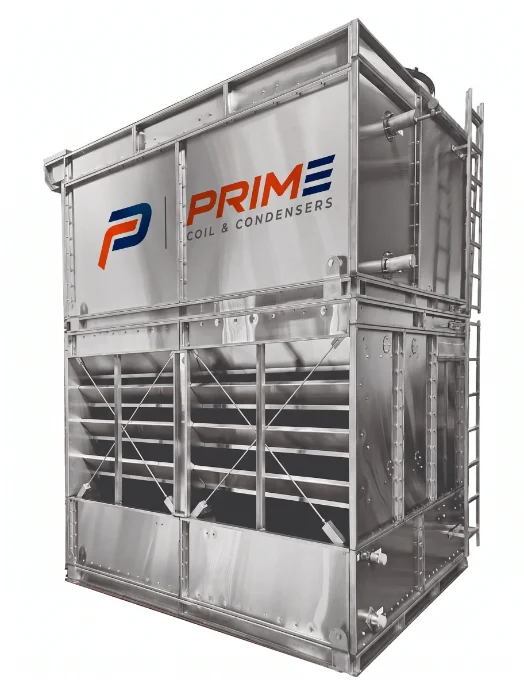
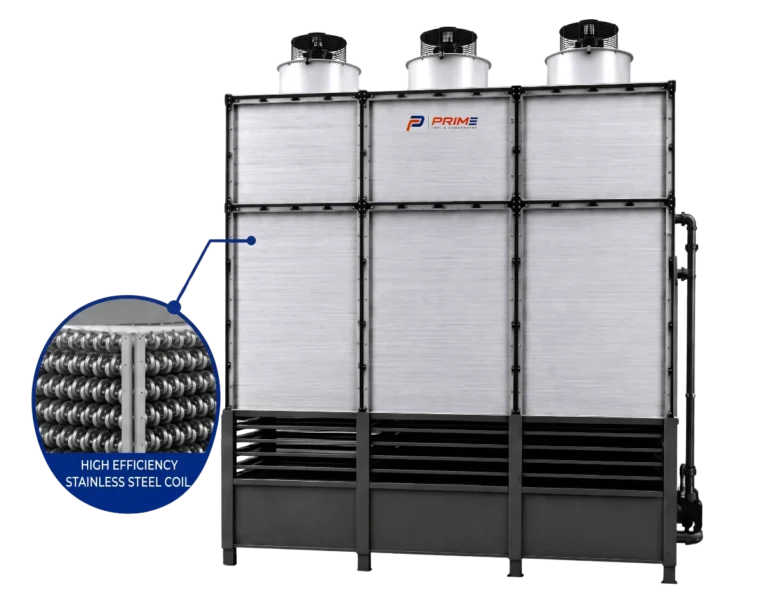
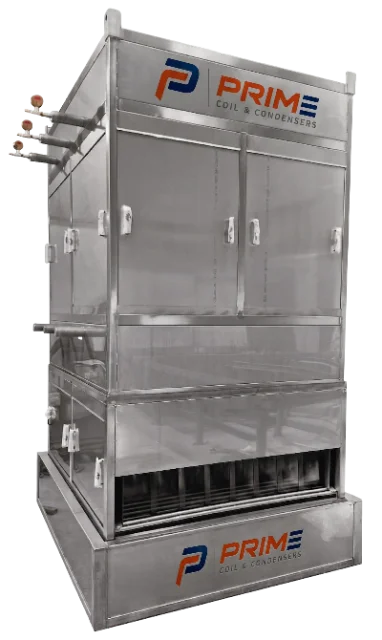
Evaporative condensers reject heat using the combined effect of water evaporation and air movement, which lets them run at a lower condensing pressure than an air-cooled equivalent — and condensing pressure is what your compressor power bill is really made of. We build them in two configurations. The mixed flow design uses laser-welded stainless steel pillow plates and suits plants where footprint and water quality both matter. The counter flow design uses an SS-304 tube coil block and is available from 100 kW to 1600 kW of heat rejection, in multi-section construction so large units can still be transported and installed on a working site.

Cooling and freezing

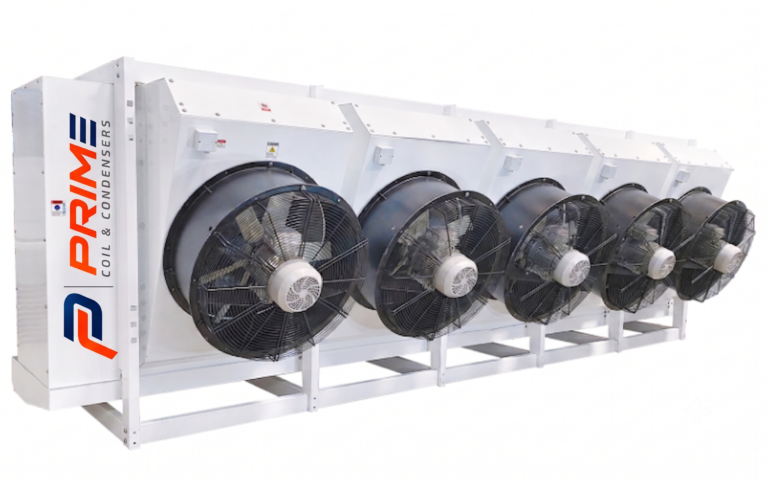
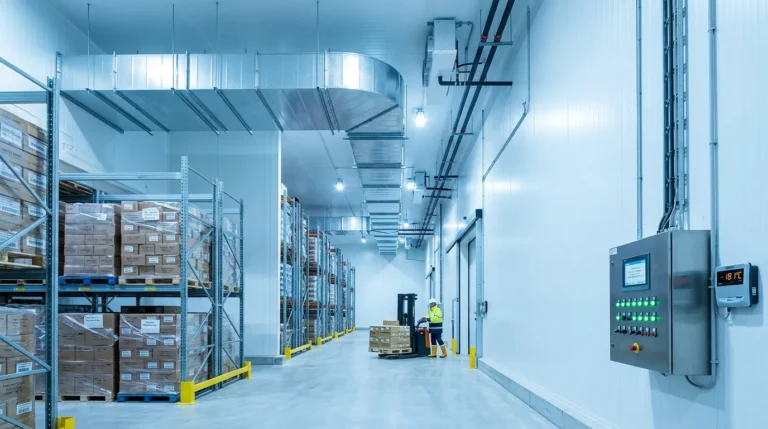
Ammonia air cooling units transfer heat through stainless steel tubes and aluminium fins, operating from −5°C down to −55°C. Fin spacing is the decision that gets made too quickly: wide spacing for freezer rooms where frost builds, tighter spacing for chillers where it does not. Defrost method follows from the same reasoning — electric, hot gas, water or air, each with different consequences for room temperature stability and running cost.

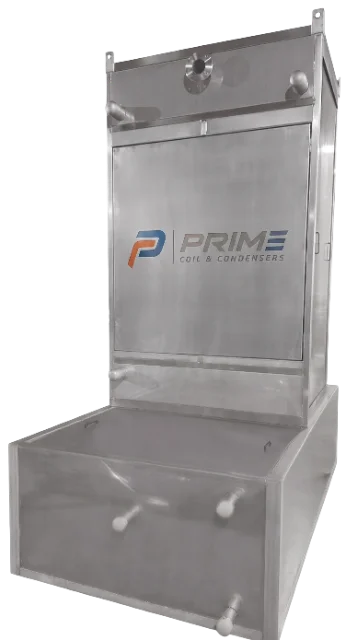
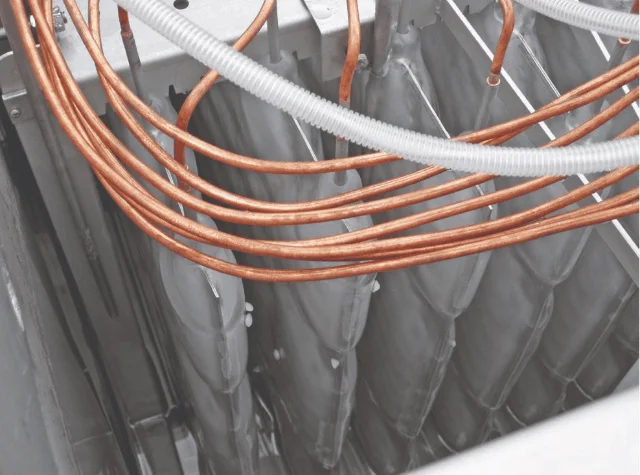
For liquid chilling, falling film chillers hold water within half a degree of freezing by flowing a thin film across a pillow plate surface. The thin film means a small temperature difference does the work, so the evaporating temperature stays high and the compressor works less. Where the load is intermittent rather than continuous — a dairy that chills hard for four hours a day — a plate ice bank stores cooling as ice during off-peak hours and releases it on demand, which lets you size the plant for the average load instead of the peak.

Liquid management

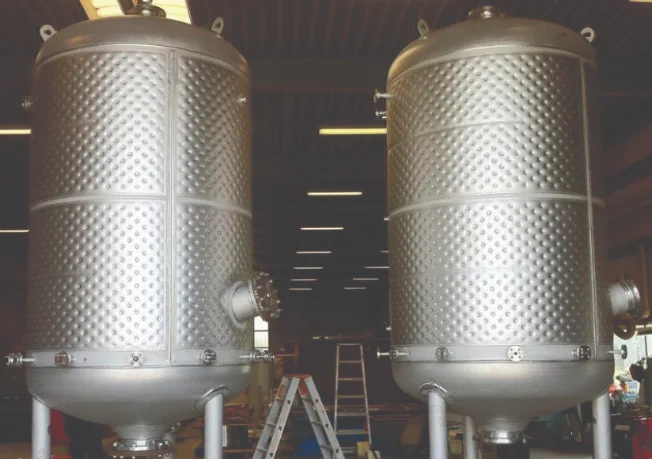
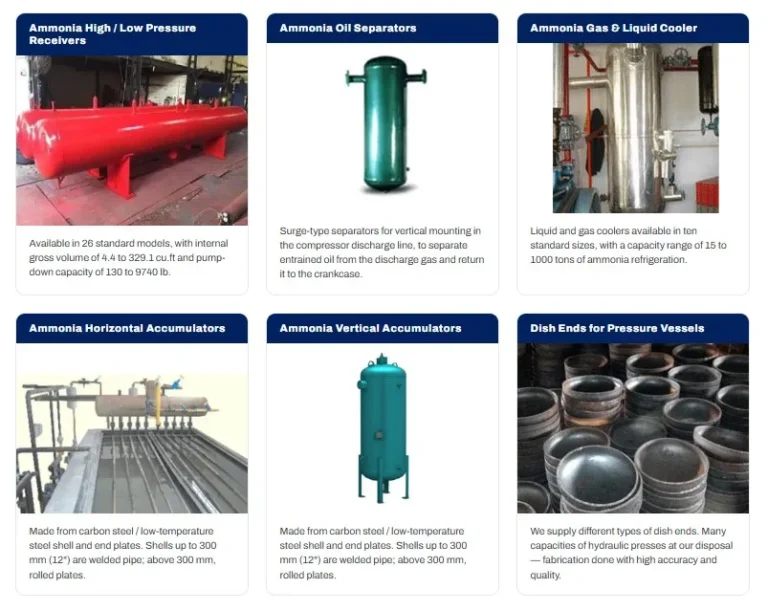
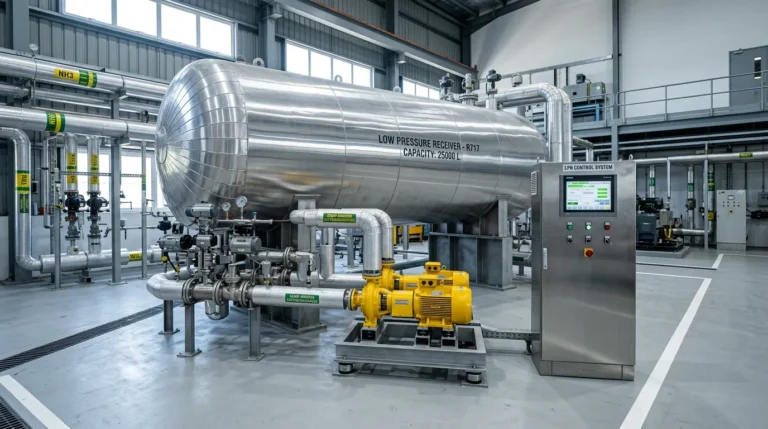
An ammonia plant is only as reliable as its liquid handling. Our pressure vessel range covers high and low pressure receivers in 26 standard models, oil separators, gas and liquid coolers, and horizontal and vertical accumulators. Shells up to 300 mm are welded pipe; above that, rolled plate. Every vessel is hydraulically and pneumatically tested before it leaves the works.

Liquid overfeed systems push more liquid through the evaporators than will evaporate, which keeps the tube surface fully wetted and stops oil from logging in the coils. The result is higher plant efficiency, no liquid slugging back to the compressor, and hot gas defrost that actually works. Our sealless liquid ammonia pumps are available from 2 HP to 10 HP, with no shaft seal and no external lubrication — the pumped fluid cools and lubricates the motor.

Built in-house, tested before dispatch

Pillow plates are laser welded on our own equipment, a process we developed further in-house so that relatively thin plate still withstands high operating pressure. Stainless tube joints are orbital welded for consistent, leak-free results across every joint rather than every welder. Coils are pressure tested individually. This matters because the failures that hurt in industrial refrigeration are not dramatic — they are slow leaks in inaccessible joints, found months later as falling capacity.

Prime Coil & Condensers Pvt. Ltd. was founded by industry veterans Neeraj Checker and Vikram Luthra, and supplies across India and to export markets.

Products in this category

5 products
Evaporative Condenser Counter Flow
Ammonia Range · Q4

Evaporative Condenser Counter Flow

Prime Coil’s counter flow evaporative condensers are the workhorses of industrial ammonia refrigeration — engineered to reject large heat loads efficiently, reliably, and over decades of continuous duty.…

Capacity
100 kW to 1,600 kW per unit
Refrigerants
Ammonia (R-717), Freon (HFC)
Temperature
Condensing 35°C to 45°C typic…
Evaporative Condenser Mixed Flow
Industrial Heat Rejection Solutions

Evaporative Condenser Mixed Flow

Prime Mixed Flow Evaporative Condensers combine advanced evaporative cooling with highly efficient stainless-steel pillow plates to deliver maximum heat rejection while minimising water and energy consumption. The mixed-flow…

Capacity
Up to 700 TR (Single Unit)
Laser Welded Pillow Plates
Ammonia Range · Q2

Laser Welded Pillow Plates

Prime Coil’s laser-welded pillow plates are engineered heat transfer surfaces that pair unusually thin gauge material with high pressure ratings — a combination made possible by our in-house…

Capacity
Custom sized per application
Refrigerants
Water, Steam, Glycol, Freon, NH…
Temperature
–40°C to +200°C typical
Plate Ice Machine
Ammonia Range · NH₃

Plate Ice Machine

Plate ice forms as a thin sheet on vertical freezing plates, then harvests and breaks into irregular chips. That geometry gives it a high surface-to-mass ratio — so…

Capacity
500 kg/day to 75,000 kg/day per…
Refrigerants
Ammonia (R-717), Freon, Glycol
Construction
Full SS, laser-welded pillow pl…
Prime NH3-06 Air Cooling Unit
Industrial Refrigeration Solutions

Prime NH3-06 Air Cooling Unit

Ammonia air cooling units circulate R-717 refrigerant through SS-304L tube and aluminium fin coils to deliver rapid, uniform heat transfer across cold rooms and freezer applications. The high-efficiency…

Capacity
Available in various capacities…
Refrigerants
Ammonia (R-717 / NH₃)
Temperature
5°C down to −55°C.
Applications

Where this range is used.

  • Cold chain & cold storage
  • Food processing
  • Dairies
  • Breweries
  • Sea food processing
  • Chemical & pharma
  • Ice manufacturing
  • Beverage production
  • Meat & poultry processing
  • Industrial Refrigeration Systems
  • Cold Storage Facilities
  • Food Processing Plants
  • Dairy Processing Units
  • Meat & Seafood Processing Plants
  • Ice Manufacturing Plants
  • Closed Circuit Cooling Systems
  • Chemical Processing Industries
  • Pharmaceutical Manufacturing
  • Beverage Processing Plants
  • Industrial Process Cooling
  • Bulk milk coolers
  • Dairy processing tanks
  • Beverage cooling (soft drinks, beer, wine)
  • Chemical process tanks
  • Pharmaceutical vessels
  • Falling film chillers
  • Immersion coolers
  • Heat recovery systems
  • Fisheries & seafood processing
  • Poultry & meat chilling
  • Dairy
  • Concrete cooling
  • Chemical processing
  • Pharmaceuticals
  • Retail & ice vending
  • Fruits & Vegetable Storage
  • Chilli Cold Storage
  • Meat Freezer Room
  • Sea-Food Freezer Room
  • Dairy Cold Room
  • CA Chamber for Apple Storage
FAQ

Ammonia Systems — answered.

Why choose ammonia over Freon for an industrial plant?

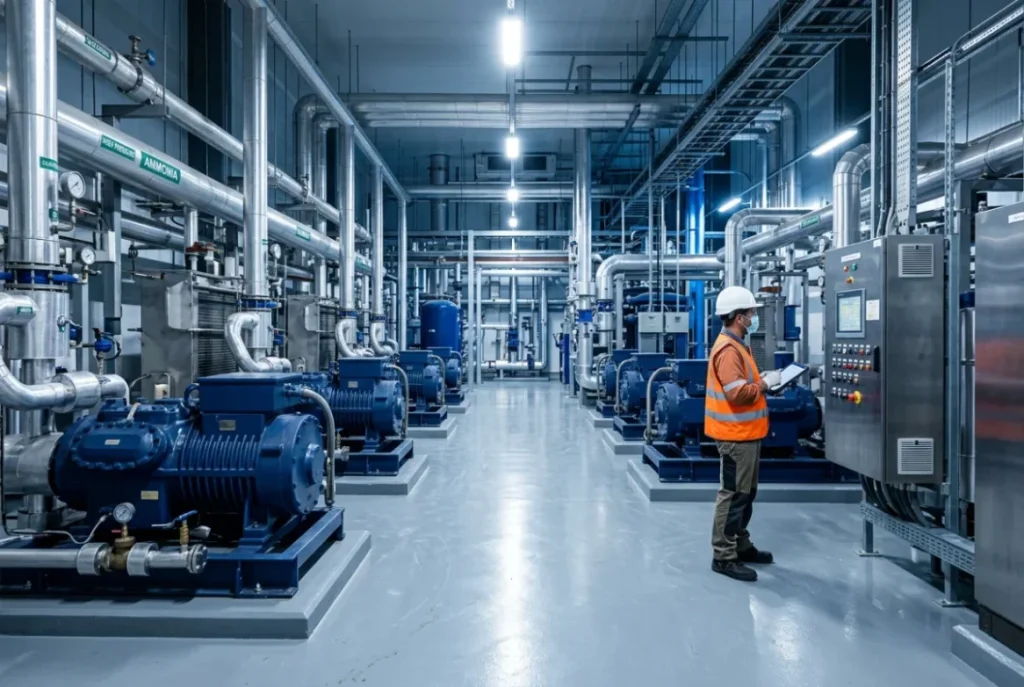
Ammonia has a much higher latent heat of vaporisation, so it moves the same heat with less refrigerant and a smaller heat-transfer surface. It costs a fraction of synthetic refrigerants per kilogram, has zero ozone depletion and zero global warming potential, and is not subject to phase-down schedules. The trade-offs are real: it is toxic at concentration, so plant rooms need proper ventilation and detection, and it is unsuitable for small commercial installations. Above roughly 50 TR, the efficiency gain usually settles the argument.

What capacities do you manufacture?

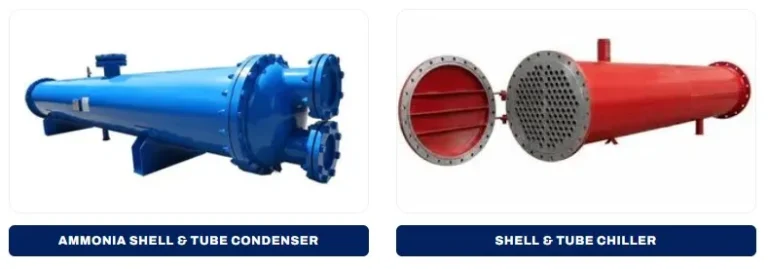
Evaporative condensers run from 100 kW to 1600 kW of heat rejection in a single unit. Plate ice machines run from 500 kg/day to 75,000 kg/day. Shell and tube condensers and chillers cover 5 TR to over 400 TR. Falling film chillers are built to the capacity required. Larger duties are met by multiple units in parallel.

Do you handle installation and commissioning?

Yes. We undertake complete turnkey refrigeration projects — system design, equipment selection, manufacturing, installation, testing and commissioning — and we also supply individual equipment to plants that have their own contractor.

Can your equipment run on refrigerants other than ammonia?

Much of it can. Pillow plate equipment — plate ice machines, falling film chillers, ice banks — works with ammonia, Freon and glycols, and in DX, gravity or pumped systems. The counter flow evaporative condenser is suitable for both ammonia and Freon. Air cooling units are built specifically for the refrigerant specified at the order stage.

How long does manufacturing take?

Lead time depends on capacity, configuration and current order load. Share your duty, temperatures and refrigerant and our engineers will confirm a delivery schedule with the quotation.

Sized for your plant

Tell us your load — we'll size the right unit.

Share your capacity, temperature and ambient conditions and our engineers will specify the system.

Request a Quote


    Your details stay private. No obligation, no spam.