Ammonia Liquid Overfeed System — Recirculation Package
Complete engineered recirculation system for industrial ammonia refrigeration — highest plant efficiency, longest compressor life, and lowest running cost of any refrigeration architecture in use today.
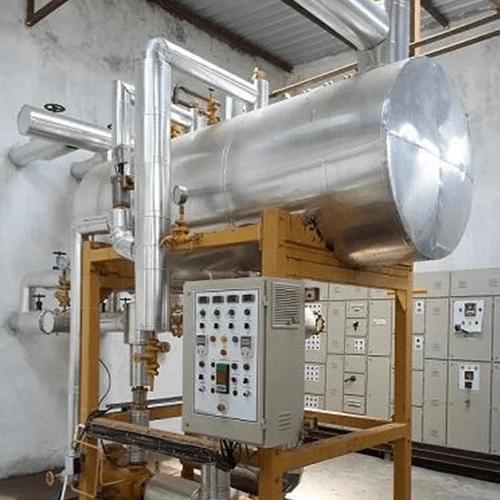
Complete engineered recirculation system for industrial ammonia refrigeration — highest plant efficiency, longest compressor life, and lowest running cost of any refrigeration architecture in use today.
The Prime Coil ammonia liquid overfeed system is a complete engineered recirculation package that delivers the highest plant efficiency, longest compressor life, and lowest running cost of any ammonia refrigeration architecture in industrial use today. Every ammonia liquid overfeed system we supply is designed as an integrated package — hermetic pump, low-pressure receiver, controls, isolation valves, and interconnecting piping — sized for your specific evaporator load and delivered ready to commission.
Why an ammonia liquid overfeed system beats every alternative
Industrial refrigeration plants can be built three ways: direct expansion (DX), flooded, or liquid overfeed. Each has trade-offs, but for medium-to-large ammonia plants with variable loads, an ammonia liquid overfeed system wins on every meaningful metric.
Direct expansion systems meter exactly enough refrigerant into each evaporator to match the load. Simple, cheap to install, but produces uneven distribution across large evaporator batteries, allows oil to accumulate in evaporator coils (dropping COP over time), and exposes compressors to liquid slugging during load transients. Suitable for small plants; problematic at scale.
Flooded systems fill evaporators with liquid ammonia continuously, giving excellent heat transfer but requiring separate suction accumulators, complex piping, and careful liquid level control at each evaporator. Effective but engineering-heavy.
Liquid overfeed systems mechanically force 3 to 6 times more liquid than actually vaporises through each evaporator, using a hermetic pump to circulate liquid from a low-pressure receiver, and returning excess liquid back to the LPR through the evaporator return lines. This ensures every square inch of evaporator surface is wet with liquid ammonia, delivering maximum heat transfer, zero oil accumulation, and complete compressor protection from liquid slugging — all at once.
Twelve concrete operational advantages
Every ammonia liquid overfeed system Prime Coil supplies delivers the following operational benefits documented across decades of industry experience:
- Higher plant efficiency — full wetted evaporator surface produces the highest achievable COP
- Hot-gas defrosting compatible — clean defrost cycles without liquid trap issues
- Ease of operation — one central LPR and control station instead of distributed valves
- Lower compressor discharge pressure — evaporator returns come back cold, reducing condensing load
- No suction accumulators required — the LPR handles all liquid separation duty centrally
- Proper refrigerant distribution — every evaporator sees the correct liquid flow regardless of load balance
- Compressor protection from slugging — liquid never reaches compressor suction because it drops out in the LPR
- Zero pressure drops in liquid lines — no expansion valves throttling flow in each evaporator
- Low maintenance — no thermostatic expansion valves or float controls in the field
- Elimination of control valves — simplified control philosophy at each evaporator
- Increased compressor life — no liquid ingestion means longer service intervals
- No fluctuation effects — steady-state operation with excellent load-following
Complete engineered package supply
An ammonia liquid overfeed system is not a single component you can buy off the shelf — it is an engineered architecture that requires the right pump, correctly sized LPR, matching control philosophy, and interconnecting piping to work correctly. Prime Coil supplies the complete package.
Standard scope includes:
- Hermetic liquid ammonia pump — sized to your total evaporator flow at your specified overfeed ratio (typically 3:1 to 4:1)
- Low Pressure Receiver (LPR) — sized for liquid holding, vapour separation, and pump NPSH
- Level control instrumentation — float switches, level transmitter, and PLC-compatible signals
- Isolation valves — inlet and outlet for maintenance without plant shutdown
- Bypass and Q-min protection — automatic recirculation to protect pump at low-flow conditions
- Insulation and lagging — polyurethane foam with food-grade cladding
- Skid mounting — pre-piped and pre-wired on a common structural skid for smaller systems
- Site-erected — for larger systems that exceed skid transport limits
Every ammonia liquid overfeed system ships with full documentation: P&ID, wiring schematic, control logic description, commissioning procedure, and operator training materials.
Applications across industrial refrigeration
Our ammonia liquid overfeed system is used across the full range of industrial refrigeration applications where efficiency, reliability, and compressor life matter more than upfront capital cost.
Built to run, season after season.
Higher plant efficiency
Full wetted evaporator surface produces the highest achievable COP of any ammonia refrigeration architecture. Every square inch of the evaporator is doing its job — no dry patches, no reduced heat transfer, no oil accumulation dropping performance over time.
Hot-gas defrost compatible
Overfeed architecture handles hot-gas defrost cycles cleanly — no liquid trap issues, no distribution problems during defrost sequences. Compared to DX systems where defrost creates complex control challenges, overfeed defrost is straightforward.
Compressor protection from liquid slugging
Liquid returning from evaporators drops out in the low-pressure receiver and never reaches the compressor suction. Eliminates the single biggest cause of compressor damage in industrial refrigeration — a saving of ₹50 lakh+ per averted incident.
Proper refrigerant distribution
Mechanical circulation means every evaporator gets its designed liquid flow regardless of load imbalance between evaporators. DX systems can't guarantee this — some evaporators get too much, others too little, and overall plant performance suffers.
Elimination of thermostatic expansion valves
Individual expansion valves at each evaporator, with all their commissioning, tuning, and maintenance overhead, are eliminated. Simple manual isolation valves at each evaporator replace the field control complexity of DX systems.
Lower compressor discharge pressure
Evaporator returns come back cold (they contain unvaporised liquid), reducing the sensible load on the condenser and dropping condensing pressure. Every degree of condensing pressure drop saves 2-3% on compressor power draw — significant on continuous-duty plants.
Extended compressor life
No liquid ingestion, no oil accumulation in evaporators, and stable operating conditions extend compressor overhaul intervals significantly. Documented case studies show 30-50% longer compressor life compared to equivalent DX systems.
Complete engineered package
Prime Coil supplies the pump, LPR, controls, isolation valves, insulation, and interconnecting piping as an integrated package — not as separate components you have to engineer together. P&ID, wiring schematic, and commissioning procedure included.
Skid-mounted or site-erected
Smaller systems supplied as pre-piped, pre-wired skids that drop into plant rooms ready for connection. Larger systems that exceed skid transport limits are site-erected with our engineering supervision. Both approaches deliver the same integrated package.
Specifications
| Type | Complete liquid overfeed recirculation package |
|---|---|
| Plant capacity | 30 TR to 1,000+ TR |
| Overfeed ratio | 3:1 to 6:1 typical (application dependent) |
| Pump | Hermetic sealless canned motor, 2-10 HP |
| LPR | Carbon steel / LT steel, sized to plant duty |
| Level controls | Float switches + level transmitter |
| Isolation valves | Inlet, outlet, drain, purge |
| Bypass protection | Q-min orifice + differential regulator |
| Insulation | Polyurethane foam, food-grade cladding |
| Piping | Carbon steel, all welds pressure tested |
| Skid limit | Plants up to ~200 TR |
| Above skid limit | Site-erected assembly |
| Controls | PLC-compatible signals, PID recommendation |
| Refrigerants | Ammonia (R-717), CO₂ variants available |
| Design code | ASME Section VIII / IS 2825 / PED for vessels |
| Certifications | PESO SMPV, IBR, third-party on request |
| Documentation | P&ID, wiring, commissioning, training materials |
Where it's used.
- Cold storages
- Dairies
- IQF systems
- Blast freezers
- Ice cream plants
- Refineries & chemical
- Industrial refrigeration
- Food processing
- Meat & poultry processing
- Turnkey ammonia plants
Product questions, answered.
What's the difference between an ammonia liquid overfeed system and a direct expansion (DX) system?
In a DX system, an expansion valve at each evaporator meters exactly enough refrigerant to match the load — simple but produces uneven distribution across multiple evaporators, allows oil accumulation over time, and exposes compressors to liquid slugging during transients. In a liquid overfeed system, a pump forces 3-6 times more liquid through each evaporator than actually vaporises, with the excess returning to a central low-pressure receiver. Every evaporator is fully wetted, oil never accumulates, and compressors are physically protected from liquid ingestion. Overfeed costs more upfront but wins on every operational metric.
What plant sizes justify an overfeed system?
As a rough rule, plants above 30 TR total refrigeration capacity start to benefit from overfeed architecture — below that, DX simplicity usually wins. Plants above 100 TR should default to overfeed unless there is a specific reason not to. Plants above 300 TR essentially require overfeed to achieve competitive plant efficiency and reasonable compressor life. Our engineers help you assess based on your specific load profile.
What's the payback period on the additional capital cost?
Compared to a DX system of the same capacity, an overfeed system typically costs 15-25% more upfront. The additional cost is paid back in three streams: energy savings (5-10% higher COP from fully wetted evaporators), avoided compressor damage (any single liquid slugging event exceeds the incremental cost), and extended compressor overhaul intervals (30-50% longer service life). Total payback is typically 18-30 months on continuous-duty plants.
Can I retrofit an existing DX plant to overfeed?
Yes, and this is one of the most common upgrade paths for aging DX plants that suffer from evaporator oil accumulation or repeated compressor damage. Retrofit scope includes: adding a hermetic pump and LPR, converting the evaporator liquid feed piping, and reworking the suction line to feed the LPR instead of the compressor directly. Plant downtime is typically 2-3 weeks. Payback economics are often better for retrofits than new installations because the existing DX plant is usually already showing performance degradation.
What is the overfeed ratio and how is it selected?
The overfeed ratio is the ratio of liquid pumped through the evaporator to liquid actually vaporised. Typical range is 3:1 (moderate overfeed) to 6:1 (heavy overfeed for demanding applications like IQF or blast freezing). Higher ratios ensure fully wetted evaporator surfaces even at partial load but increase pump power consumption. Our engineers select the optimal ratio based on your evaporator type, temperature levels, and load profile.
What happens during a power failure or emergency shutdown?
The pump shuts down and the system settles into a static state — liquid remains in the LPR, evaporators drain naturally to the LPR through the return lines, and the plant is safe. Restart requires priming the pump (typically automatic via the pump discharge check valve) and normal start sequence. Standard installation includes UPS-backed control power to ensure orderly shutdown even during a grid failure.
What certifications and documentation ship with the system?
Complete documentation package includes P&ID, electrical wiring schematic, control logic description, commissioning procedure, factory acceptance test (FAT) certificates for pump and LPR, hydraulic test certificates, material test certificates, PESO SMPV certification for the LPR, and operator training materials. Third-party inspection (Lloyd's, TÜV, DNV, SGS) available on request for regulated applications.
What's the typical delivery and installation timeline?
Skid-mounted systems (up to ~200 TR) ship in 6-8 weeks from order confirmation, with site installation and commissioning taking 1-2 weeks. Site-erected systems (larger plants) ship components over 10-12 weeks, with site assembly taking 2-4 weeks depending on scope. Full commissioning including operator training typically completes in 1 week after mechanical and electrical connections are done.
Every ammonia liquid overfeed system we deliver is engineered to your specific plant — not built to a catalogue. The result is a refrigeration architecture that runs efficiently, protects compressors, and lasts decades. That is the entire point of overfeed technology, and the reason it has become the industrial standard.
Tell us your daily requirement.
Share your output target, product and ambient conditions — we'll specify the machine and the plant around it.