
Insulated Hinged Doors — Thermally-Broken Cold Room Doors
Thermally-broken insulated hinged doors for walk-in coolers, small chiller rooms, and retail cold storage — polyamide thermal-break frame, PUR-filled leaf, multi-point gasket seal.
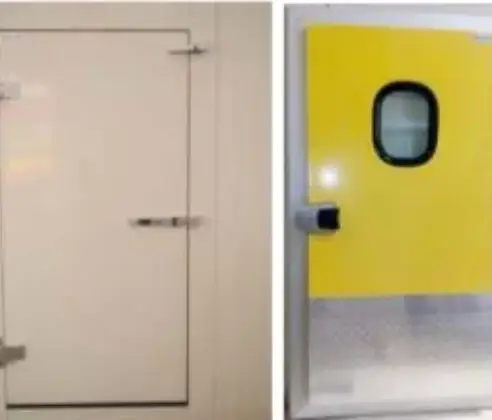
Thermally-broken insulated hinged doors for walk-in coolers, small chiller rooms, and retail cold storage — polyamide thermal-break frame, PUR-filled leaf, multi-point gasket seal.
Prime Coil insulated hinged doors are thermally-broken swing doors engineered for walk-in coolers, small chiller rooms, retail cold storage, and light-commercial cold chain applications where a full sliding door system is unnecessary. Every insulated hinged door we supply pairs a thermal-break aluminium frame with a foam-filled door leaf, eliminating the cold bridging and surface condensation that plague standard commercial swing doors when used in refrigerated service.
Why the frame matters as much as the leaf
Most swing-door failures in cold storage don’t start at the door leaf — they start at the frame. A conventional aluminium frame conducts heat directly from the warm side to the cold side, creating a metal cold bridge that sweats, frosts, and eventually corrodes regardless of how well-insulated the door leaf itself is. Insulated hinged doors solve this at the frame level, not just the leaf level.
Our insulated hinged doors use a thermal-break profile — a low-conductivity polyamide strip separates the interior and exterior aluminium sections of the frame, interrupting the metal-to-metal heat path entirely. This single design detail is what separates purpose-built insulated hinged doors from repurposed commercial doors that fail within a season of cold-side service.
Conditions our insulated hinged doors are engineered for:
Frequent cycling. Walk-in coolers and retail cold rooms see 50-200+ door openings per day. Hinges, closers, and gaskets must handle continuous cycling without seal degradation or frame fatigue.
Surface condensation control. Warm humid air meeting a cold frame or leaf surface causes sweating that drips onto floors and creates slip hazards. Thermal break construction keeps interior frame surfaces above dew point in normal ambient conditions.
Light to moderate traffic. Unlike high-speed or automatic doors built for forklift traffic, insulated hinged doors are sized for foot traffic and hand trolleys — smaller footprint, lower cost, faster installation.
Retrofit compatibility. Many insulated hinged door installations replace existing swing doors in facilities that were never built to cold-chain standards, so frame dimensions and reversible hinging matter as much as thermal performance.
Door leaf construction — PUR-filled and impact rated
The door leaf on our insulated hinged doors uses a rigid PUR (polyurethane) foam core injected between pre-painted galvanised steel or GRP-faced skins, giving a thermal conductivity comparable to our cold room storage panels rather than a hollow commercial door slab. Leaf thickness is matched to operating temperature — thinner leaves for chiller-range doors, thicker leaves for freezer-range applications — the same thickness logic we apply across our full cold chain range.
Seal design — multi-point gasket compression
Insulated hinged doors depend on gasket quality more than any other door type in our range, since a swing door has no continuous track seal to fall back on. Our doors use a multi-point compression gasket around the full perimeter of the frame, engaged automatically as the door closes against the frame rebate. Combined with an adjustable, self-closing hydraulic hinge system, this keeps the seal engaged consistently across thousands of open-close cycles without manual adjustment.
Hardware — reversible hinging and closer options
Every insulated hinged door ships with left- or right-hand reversible hinging, so the same door unit fits either swing direction on site without a different SKU. Standard hardware includes a hydraulic self-closing hinge, lever handle with cylinder lock, and impact-resistant kick plates at the base — the zone most exposed to trolley and pallet-jack contact.
Standard dimensions and vision panel option
Our insulated hinged doors are available in standard single-leaf widths from 800 mm to 1,200 mm and heights from 1,900 mm to 2,200 mm, covering the large majority of walk-in cooler and small chiller room openings. A double-glazed, anti-fog vision panel is available where visibility into the cold room is needed — common in retail and QSR back-of-house applications. Custom sizes are available for non-standard openings and retrofit projects.
Coordination with the rest of the cold chain range
Insulated hinged doors are frequently specified alongside our cold room storage panels for complete small-format cold room builds, and alongside display glass doors where a facility needs both a service entrance and customer-facing retail access. Door openings are sized and reinforced to match our panel system so the two products install as a coordinated unit rather than requiring on-site adjustment.
Built to run, season after season.
Thermal-break frame profile
Polyamide thermal-break strip separates interior and exterior aluminium sections, interrupting the metal cold bridge that causes frame sweating and frost in conventional commercial swing doors.
PUR foam-filled door leaf
Rigid polyurethane foam core between steel or GRP-faced skins delivers panel-grade thermal performance in the leaf, matched to chiller or freezer service temperature.
Multi-point compression gasket
Full-perimeter gasket engages automatically on closing, maintaining seal integrity across thousands of open-close cycles without manual adjustment.
Self-closing hydraulic hinge system
Adjustable hydraulic hinges close the door automatically and consistently, critical in high-cycle retail and foodservice environments where doors are often left ajar.
Reversible left/right hinging
Every insulated hinged door ships configurable for either swing direction, reducing SKU complexity and simplifying retrofit installations.
Anti-fog vision panel option
Double-glazed, anti-fog vision panel available for retail and back-of-house applications where visual access into the cold room is needed.
Impact-resistant kick plates
Reinforced base plates protect the door leaf and frame from trolley and pallet-jack contact in high-cycle service areas.
Anti-condensation frame heater
Low-wattage heater trace available for high-humidity ambient conditions where standard thermal-break construction alone is insufficient to prevent surface condensation.
Custom sizes available
Standard sizing covers most walk-in cooler and small chiller openings. Custom widths, heights, and frame configurations available for retrofit and non-standard installations.
Specifications
| Product Type | Thermally-broken insulated swing door |
|---|---|
| Frame material | Thermal-break aluminium |
| Door leaf core | PUR (polyurethane) foam |
| Leaf skin material | Pre-painted galvanised steel or GRP-faced |
| Leaf thickness | 40-60 mm typical, temperature dependent |
| Seal type | Multi-point compression gasket, full perimeter |
| Hinge type | Self-closing hydraulic, reversible |
| Closer type | Adjustable hydraulic self-closer |
| Standard width | 800-1,200 mm |
| Standard height | 1,900-2,200 mm |
| Operating temperature | +10°C to -25°C |
| Vision panel option | Double-glazed, anti-fog |
| Handle/lock type | Lever handle with cylinder lock |
| Kick plate | Impact-resistant, base-mounted |
| Frame heater | Optional, anti-condensation |
| Threshold type | Low-profile, insulated |
| Custom sizes | Available on request |
| Service life | 15+ years typical |
Where it's used.
- Walk-in coolers
- Small chiller room construction
- Retail cold storage
- Pharmacy & retail pharma cold rooms
- Convenience store coolers
- QSR & restaurant kitchen cold rooms
- Dairy & floral retail counters
- Laboratory cold storage
- Hospitality & catering cold rooms
- Retrofit replacement of existing swing doors
Product questions, answered.
What's the difference between insulated hinged doors and your standard Hinged Door product?
The standard Hinged Door is a general insulated swing door for cold room service. Insulated hinged doors add a thermal-break frame — a polyamide strip that interrupts the metal cold bridge through the frame itself, not just the leaf. For frequently-cycled retail and light-commercial cold rooms where frame sweating and frost are recurring problems, the thermal-break frame is the meaningful upgrade.
Will an insulated hinged door work for a walk-in freezer, or only chillers?
Both, within limits. Our insulated hinged doors are rated from +10°C down to -25°C with an appropriately specified leaf thickness and gasket system. For blast freezer service below -25°C, our dedicated Blast Freezer Door product is the correct specification.
How many open-close cycles can the hardware handle?
Standard hardware is rated for typical retail and foodservice cycle counts — commonly 50-200 openings per day. For higher-traffic applications, our Heavy-Traffic Reinforced Door variant uses upgraded hinges and closers rated for elevated daily cycle counts.
Can the door be reversed on site if we get the swing direction wrong?
Yes — every insulated hinged door ships with reversible left/right hinging as standard, so installers can configure swing direction on site without ordering a different unit.
Do we need the anti-condensation frame heater?
Most installations don't. The thermal-break frame prevents condensation in normal ambient conditions. The optional heater trace is recommended only for consistently high-humidity environments — coastal locations, monsoon-season kitchens, or facilities without climate control on the warm side of the door.
What sizes are available, and can you do custom openings?
Standard widths run 800-1,200 mm and heights 1,900-2,200 mm, covering most walk-in cooler and small chiller openings. Custom sizes are available for retrofit projects and non-standard openings — our engineers confirm frame dimensions against your existing opening during quotation.
Can we get a window in the door to see into the cold room?
Yes — the Vision Panel variant adds a double-glazed, anti-fog vision panel while maintaining the thermal break around the panel frame. Common in retail and QSR back-of-house doors where staff need to see into the cold room without opening it.
What's the typical delivery and installation timeline?
Standard insulated hinged doors typically ship in 2-3 weeks with half-day to one-day installation. Custom and retrofit configurations run 3-5 weeks depending on frame adaptation requirements. Our engineers confirm timelines during specification.
Capacities & model codes
Standard Insulated Hinged Door
Thermal-break frame with PUR-filled leaf for chiller-range walk-in coolers and small cold rooms — the default choice for retail and light-commercial applications.
- Thermal-break aluminium frame
- PUR-filled steel-skin leaf
- Multi-point gasket seal
- Standard sizing 800-1,200 mm width
Heavy-Traffic Reinforced Door
Reinforced frame and leaf construction with heavy-duty hinges for higher-cycle applications such as QSR kitchens and busy retail back-of-house doors.
- Reinforced hinge and closer hardware
- Extended kick plate coverage
- Rated for elevated daily cycle counts
- Available in all standard sizes
Vision Panel Door
Standard or reinforced door with a double-glazed anti-fog vision panel, for retail and customer-facing applications requiring visibility into the cold room.
- Double-glazed anti-fog vision panel
- Available on standard or reinforced variant
- Frame thermal break maintained around panel
- Custom panel sizes on request
Custom-Engineered Door
Custom-designed door for non-standard openings, retrofit projects, and specialised frame configurations where standard sizing does not fit.
- Custom width and height
- Retrofit frame adaptation
- Optional anti-condensation heater
- Full engineering support included
Tell us your daily requirement.
Share your output target, product and ambient conditions — we'll specify the machine and the plant around it.