
Rolling High-Speed Doors — Fast Roll-Up Doors for Cold Storage
High-speed roll-up doors for distribution centres, cross-dock facilities, and cold storage loading bays — reinforced curtain, break-away guides, PLC-controlled rapid cycling.
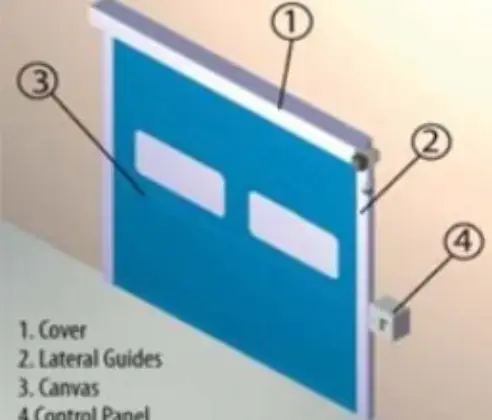
High-speed roll-up doors for distribution centres, cross-dock facilities, and cold storage loading bays — reinforced curtain, break-away guides, PLC-controlled rapid cycling.
Prime Coil high-speed roll-up doors are curtain-based fast-acting doors engineered for high-traffic openings in distribution centres, cross-dock facilities, and cold storage loading bays where forklift and pallet traffic demands rapid opening and closing. Every high-speed roll-up door we supply combines a reinforced fabric curtain with a high-torque motor and control system, cutting cold air loss and energy waste at doorways that open dozens or hundreds of times per shift.
Why speed matters as much as insulation
At a high-traffic cold storage doorway, the biggest source of energy loss often isn’t a poorly-sealed door — it’s a door that stays open too long. A standard sliding or hinged door left open during forklift traffic exchanges cold interior air for warm humid ambient air continuously, forcing the refrigeration plant to work overtime to recover. High-speed roll-up doors attack this problem directly: opening and closing in seconds rather than the many seconds a conventional door mechanism takes, minimising the window during which cold air escapes.
Conditions our high-speed roll-up doors are engineered for:
Continuous forklift and pallet traffic. Distribution and cross-dock openings can see 200-1,000+ cycles per day. Curtain, guides, and motor must handle this cycle count without fatigue failure.
Wind and pressure loading. High-speed doors on exterior or high-pressure interior openings experience wind and stack-effect pressure that a curtain door must resist without billowing or disengaging from its guides.
Impact risk. Forklift traffic occasionally makes contact with the door curtain. A rigid door fails catastrophically on impact; a curtain door is engineered to break away and re-engage without damage or downtime.
Cold-to-warm transition zones. Many high-speed door installations sit at the transition between refrigerated and ambient space, where condensation and icing risk is highest — curtain and guide design must account for this.
Curtain material — insulated and non-insulated options
The curtain is the core engineering component of a high-speed roll-up door. Our standard curtain is a heavy-duty reinforced PVC fabric selected for flexibility at low temperature, UV and abrasion resistance, and tear strength. For cold storage applications where thermal performance at the opening itself matters — not just speed — an insulated curtain option is available, using a foam-core panel-in-curtain construction that adds meaningful R-value without sacrificing roll-up speed.
Speed matched to traffic profile
Opening and closing speed on our high-speed roll-up doors is configurable to match traffic profile — faster cycle times for high-volume cross-dock doors, moderate speeds for lower-traffic cold storage entries where curtain longevity matters more than shaving another second off cycle time. Typical opening speeds range from 0.6 to 1.2 metres per second, several times faster than a conventional sliding or hinged door mechanism.
Guide and bottom bar design — safety and wind resistance
Lateral guides keep the curtain tracking cleanly through thousands of open- close cycles, and are engineered to allow the curtain to break away and release from the guide on significant impact — protecting both the door and the vehicle that struck it — before automatically re-engaging on the next cycle without a service call. The bottom bar incorporates a safety edge sensor that reverses the door immediately on contact, a mandatory safety feature for any door operating in active forklift traffic.
Control system — sensors and automation
Every high-speed roll-up door ships with a PLC-based control panel supporting photocell and radar traffic sensors, induction loop triggers for forklift detection, and remote or badge-access activation. Emergency manual operation is available for power-loss situations. Control logic can be configured to hold the door open during sustained traffic and close immediately once the opening clears, minimising both cold air loss and unnecessary cycle wear.
Standard dimensions
Our high-speed roll-up doors are available in standard single-opening widths from 2,400 mm to 4,500 mm and heights from 2,400 mm to 5,000 mm, covering typical loading bay and internal transfer openings. Larger and custom openings are available for specialised dock configurations.
Coordination with the rest of the cold chain range
High-speed roll-up doors are frequently specified at the transition points of a cold storage facility — loading bays, internal transfer corridors between chiller and freezer zones, and dispatch areas — working alongside our cold room storage panels for the surrounding envelope and our blast freezer doors or automatic sliding doors at lower-traffic entry points. Opening dimensions are coordinated with the panel system during facility planning so the fast-acting door integrates cleanly into the building envelope.
Built to run, season after season.
High-speed motor and cycle time
Configurable opening speeds of 0.6-1.2 m/s, several times faster than conventional sliding or hinged doors, minimising the window during which cold air escapes during traffic transitions.
Insulated or non-insulated curtain options
Standard reinforced PVC curtain for general high-traffic openings, or foam-core insulated curtain where thermal performance at the doorway itself is required.
Break-away lateral guides
Curtain releases from the guide track on significant impact and automatically re-engages on the next cycle, protecting both door and vehicle without requiring a service call.
Safety-edge bottom bar
Sensor-equipped bottom bar reverses door travel immediately on contact — a mandatory safety feature for doors operating in active forklift traffic.
Induction loop forklift detection
In-floor loop sensors detect forklift presence for hands-free activation in high-volume dock and cross-dock environments.
PLC control panel with remote access
Configurable control logic for hold-open, auto-close, and remote/badge-access activation, tuned to facility traffic patterns.
Emergency manual operation
Manual override mechanism allows door operation during power-loss situations, maintaining facility access continuity.
Custom sizing and cycle ratings
Standard sizing covers typical loading bay and transfer openings. Custom widths, heights, and heavy-duty cycle-rated configurations available for high-volume distribution centre applications.
Specifications
| Product Type | Curtain-based high-speed roll-up door |
|---|---|
| Curtain material | Reinforced PVC fabric, insulated option available |
| Curtain thickness | 0.9-1.5 mm typical (non-insulated) |
| Opening speed | 0.6-1.2 m/s, configurable |
| Closing speed | 0.4-0.8 m/s, configurable |
| Cycle rating | High-duty, distribution-centre grade |
| Wind resistance | Application-specific, guide-reinforced |
| Guide type | Break-away lateral guides |
| Bottom bar type | Safety-edge sensor equipped |
| Safety system | Auto-reverse on contact, photocell monitored |
| Control system | PLC with remote/loop/badge activation |
| Standard width | 2,400-4,500 mm |
| Standard height | 2,400-5,000 mm |
| Insulation option | Foam-core insulated curtain |
| Operating temperature | Ambient to -25°C (insulated variant) |
| Power supply | 3-phase, facility-standard |
| Custom sizes | Available on request |
| Service life | 10+ years typical, curtain replaceable |
Where it's used.
- Distribution centres
- Cross-dock facilities
- Cold storage loading bays
- Forklift traffic doorways
- Food processing high-traffic zones
- Dairy dispatch bays
- Pharma warehouse bays
- Blast freezer entry points
- Retail backroom cold storage
- Manufacturing clean-zone transitions
Product questions, answered.
How much faster is a high-speed roll-up door than a standard sliding door?
Our high-speed roll-up doors open at 0.6-1.2 metres per second, several times faster than a conventional sliding or hinged door mechanism. In a high-traffic loading bay with hundreds of daily cycles, that speed difference adds up to a meaningful reduction in the total time the opening stands open — directly reducing cold air exchange and refrigeration load.
Can a high-speed roll-up door actually keep a cold room cold, or is it just for ambient openings?
Both, depending on the variant. Our standard curtain is non-insulated and best suited to ambient-to-ambient internal transfer openings. For chiller and freezer transition points, the insulated curtain variant uses foam-core construction rated to -25°C, and the Break-Away Freezer Door variant extends that further for blast freezer and deep-freeze entries.
What happens if a forklift hits the door curtain?
The curtain is designed to release from its lateral guides on significant impact rather than tearing or jamming, protecting both the door and the vehicle. It automatically re-engages on the next open cycle without requiring a service call in most cases — a core safety and uptime feature for doors operating in active forklift traffic.
How many times per day can the door cycle without failing?
Standard configurations are rated for high-duty distribution-centre traffic — commonly several hundred cycles per day. For very high-volume cross-dock applications, we specify elevated cycle-rated motor and curtain components during quotation based on your projected daily cycle count.
Do we need photocells, or can we use a pull cord or push button?
Manual activation is available, but photocell and radar traffic sensors or induction loop forklift detection are strongly recommended for high-traffic openings — they reduce wait time, cut unnecessary manual switch wear, and keep the door open only as long as traffic requires, minimising cold air loss.
What happens during a power outage?
Every high-speed roll-up door includes an emergency manual operation mechanism, allowing the door to be opened and closed by hand during power-loss situations so facility access isn't interrupted.
Can the door be sized for our existing dock opening?
Standard widths run 2,400-4,500 mm and heights 2,400-5,000 mm, covering most loading bay and internal transfer openings. Custom sizing is available for oversized or non-standard dock configurations — our engineers confirm opening dimensions during quotation.
What's the typical delivery and installation timeline?
Standard high-speed roll-up doors typically ship in 4-6 weeks with 2-3 day installation. Custom-sized or heavy-duty cycle-rated configurations run 6-8 weeks depending on motor and control specification. Our engineers confirm project timelines during specification.
Capacities & model codes
Standard High-Speed Door (Non-Insulated)
Reinforced PVC curtain for general high-traffic openings where speed and cycle durability matter more than thermal performance at the doorway — typical for ambient-to-ambient internal transfer openings.
- Reinforced PVC curtain
- Break-away lateral guides
- Standard opening speed 0.8-1.0 m/s
- Rated for high daily cycle counts
Insulated Cold Storage High-Speed Door
Foam-core insulated curtain construction for chiller and freezer transition openings where thermal performance at the doorway is required alongside high-speed cycling.
- Foam-core insulated curtain
- Rated to -25°C service
- Break-away guides with cold-side seal
- Configurable opening speed
Break-Away Freezer Door
Heavy-duty variant engineered for blast freezer and deep-freeze entry points with reinforced impact-release guides and cold-rated motor and control components.
- Rated for sub -25°C service
- Reinforced break-away guide system
- Cold-rated motor and control enclosure
- Heavy-duty safety-edge bottom bar
Custom-Engineered High-Speed Door
Custom-designed door for oversized openings, non-standard dock configurations, and specialised cycle-rating requirements.
- Custom width and height
- Elevated cycle-rating specification
- Non-standard dock/opening adaptation
- Full engineering support included

Tell us your daily requirement.
Share your output target, product and ambient conditions — we'll specify the machine and the plant around it.