
Cold Room Panels — PUF/PIR Insulated Storage Panels
Insulated wall, ceiling, and floor panels for cold storage building envelope construction — PUF or PIR core, pre-painted or stainless steel skin, interlocking cam-lock joints for continuous insulation across the entire facility.
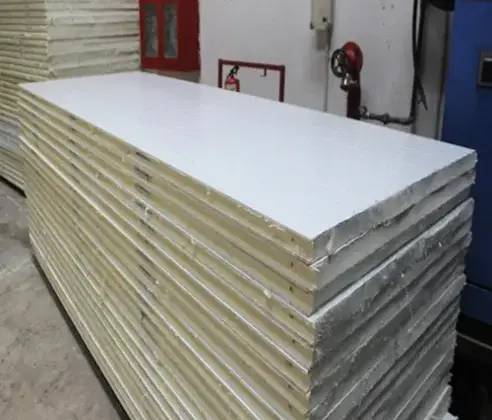
Insulated wall, ceiling, and floor panels for cold storage building envelope construction — PUF or PIR core, pre-painted or stainless steel skin, interlocking cam-lock joints for continuous insulation across the entire facility.
Why panels matter as much as doors
A cold storage facility is a building system, not a collection of components. The refrigeration equipment removes heat from the room; the doors control access; but the panels form the entire building envelope that separates cold interior from warm exterior. Poorly-specified panels waste refrigeration energy every hour of operation, allow condensation buildup that damages structure and product, and eventually fail in ways that require expensive facility reconstruction.
Every square metre of your cold storage envelope is either a door (typically 5-10% of total surface) or a panel (typically 90-95%). Panel specification dominates facility thermal performance — a fact that facility designers often underestimate when focus goes to the visible refrigeration equipment.
Our cold room panels are engineered specifically for cold-chain operating conditions:
Continuous cold-side operation. Panels see cold temperatures on one side and warm ambient on the other, continuously, for 20+ years. Panel construction must handle this thermal gradient without delamination, panel warping, or seal degradation.
High humidity and condensation. Cold room interiors run at 85-95% RH; ambient humidity in Indian conditions routinely exceeds 70% in summer. Panels must resist moisture penetration from either side without insulation degradation.
Sanitation chemical exposure. Food processing cold rooms are washed with cleaning chemicals regularly. Panel skins must resist chemical corrosion and biological growth.
Fire safety compliance. Cold storage facilities are increasingly subject to fire safety regulations that require specific insulation classifications and panel construction standards.
PUF or PIR — choosing the right insulation core
Two insulation materials dominate cold storage panel construction, each with specific advantages:
Polyurethane Foam (PUF) is the industry-standard cold storage insulation. High-density closed-cell foam delivers excellent thermal performance (typical thermal conductivity 0.020-0.022 W/mK), moisture resistance, and structural rigidity. PUF panels are the cost-effective default choice for the vast majority of cold storage applications.
Polyisocyanurate (PIR) is a related insulation material with superior fire performance — significantly improved thermal stability at elevated temperatures and reduced smoke generation during fire events. PIR panels cost approximately 15-25% more than equivalent PUF panels but are increasingly required by fire safety regulations for large cold storage facilities, warehouses adjacent to occupied areas, and facilities storing high-value inventory.
Our cold room panels are available in both PUF and PIR core configurations, with insulation specification selected based on facility fire safety requirements and thermal performance targets during quotation.
Panel thickness matched to operating temperature
Panel thickness directly determines thermal performance — thicker panels reduce heat gain through the envelope but add cost and reduce usable interior space. Our cold room panels are available in six standard thicknesses covering the full cold storage temperature range:
- 60 mm — chiller rooms operating at +5°C to +10°C (light chill applications)
- 80 mm — chiller rooms at 0°C to +5°C (standard chill applications)
- 100 mm — freezer rooms at -18°C to -25°C (standard freezer applications)
- 120 mm — deep freezer rooms at -25°C to -30°C
- 150 mm — blast freezer chambers at -30°C to -40°C
Panel thickness applies to walls, ceilings, and floors as a coordinated specification — mixing thicknesses across the envelope creates thermal bridges that undermine overall performance.
Interlocking cam-lock joint design
Every cold room panel uses a specific interlocking joint design that produces continuous insulation across panel boundaries — the critical engineering detail that separates well-built cold storage from poor construction:
- Male-female interlocking profile — one panel edge has a projecting profile, the other has a matching recess
- Continuous PUF or PIR core across the joint — no air gap between panels
- Cam-lock hardware — mechanical connection tightens the joint from inside, ensuring compression
- Perimeter sealant — food-grade silicone seals the joint from moisture ingress
Correctly-installed panels produce a continuous insulated envelope with no visible or thermal joint lines — panels that look like they were assembled at the factory rather than on site.
Steel skin — pre-painted or stainless
Panel skin material affects durability, hygiene, and cost:
Pre-painted galvanised steel (PPGI) is the standard skin material for most cold storage applications. Zinc coating provides corrosion resistance; polyester or PVDF paint provides colour and additional protection. PPGI skin is durable, cost-effective, and available in a range of colours (white is standard; food-grade beige and clean-room grey are common alternatives).
Stainless steel (SS-304 or SS-316) skin is used for direct food-contact applications, pharmaceutical facilities, and high-hygiene environments. SS-304 covers most food processing applications; SS-316 is specified for saline environments and aggressive cleaning chemicals. Stainless skin adds approximately 40-60% to panel cost.
Aluminium skin is available for weight-sensitive applications (mobile cold storage, refrigerated container applications) though rarely used in fixed facility construction.
Standard panel dimensions
Our cold room panels are available in standard modular dimensions:
- Width — 1,000 mm to 1,200 mm typical (standard modular sizing)
- Length — up to 15 metres (transport limits typically govern longer panels)
- Thickness — 60 mm to 150 mm per variant
Custom sizes available for specialised applications, transport-limited sites, and non-standard facility geometries.
Building envelope completeness
Every Prime Coil cold room panel supply includes not just the wall panels but the complete building envelope system:
- Wall panels — with interlocking cam-lock joints
- Ceiling panels — matched to wall panel specification with structural support planning
- Floor panels — insulated floor system with moisture barrier
- Corner extrusions — factory-formed corners that maintain thermal continuity
- Cove trim — food-grade radiused corners at wall-to-floor and wall-to-ceiling junctions
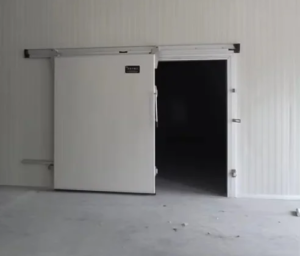
- Coordination with doors — panel openings sized and reinforced for our cold storage doors
Built to run, season after season.
PUF or PIR insulation core
PUF (polyurethane foam) for cost-effective standard cold storage applications; PIR (polyisocyanurate) for enhanced fire safety in large facilities, warehouses adjacent to occupied areas, and high-value inventory storage. Both materials deliver equivalent thermal performance for cold storage service.
Thickness 60 mm to 150 mm
Six standard thicknesses covering the full cold storage temperature range — 60 mm for light chill, 80 mm for standard chill, 100 mm for freezers, 120 mm for deep freezers, 150 mm for blast freezers. Coordinated thickness across walls, ceilings, and floors prevents thermal bridging.
Interlocking cam-lock joints
Male-female interlocking joint profile with continuous insulation core across panel boundaries. Cam-lock hardware tightens the joint mechanically from inside — no visible fasteners on external surfaces. Perimeter food-grade silicone sealant prevents moisture ingress at joints.
Pre-painted galvanised or stainless steel skin
PPGI (pre-painted galvanised iron) skin standard for cost-effective durability. Stainless steel (SS-304 or SS-316) available for food-contact applications and pharmaceutical facilities. Both skin materials deliver 20+ year service life in cold storage environments.
Fire safety compliance
PIR variant meets increased fire safety requirements for large cold storage facilities, warehouses adjacent to occupied buildings, and inventory-value-threshold installations. PUF variant meets standard cold storage fire requirements. Fire performance documentation available for regulatory approval.
Complete building envelope system
Not just wall panels — complete supply includes wall panels, ceiling panels, floor panels, corner extrusions, cove trim, and coordination with door openings. Turnkey cold storage envelope system from a single supplier with single-source accountability.
Food-grade construction
Full food-grade construction including radiused cove trim at wall-floor and wall-ceiling junctions (eliminating right-angle corners where biological growth accumulates), smooth panel surfaces for effective sanitation, and food-grade sealant throughout. FSSAI-compliant.
Coordinated door integration
Panel openings for doors sized and reinforced to accept Prime Coil sliding, hinged, automatic, blast freezer, and display glass doors. Coordinated supply ensures panel openings and door frames match precisely, eliminating on-site adjustment work.
Custom sizes available
Standard modular sizing (1,000-1,200 mm width) covers most installations. Custom panel dimensions available for specialised applications, transport-limited sites, non-standard facility geometries, and retrofit installations replacing damaged panels in existing facilities.
Where it's used.
- Cold storage warehouses
- Chiller room construction
- Freezer room construction
- Blast freezer chambers
- Food processing facilities
- Dairy processing plants
- Meat & poultry processing
- Pharmaceutical cold rooms
- Cleanroom construction
- Retail cold storage
Capacities & model codes
PUF Panels (Standard)
Polyurethane foam core panels for standard cold storage applications —
cost-effective default choice for the vast majority of chiller and freezer
installations. Excellent thermal performance, moisture resistance, and
structural rigidity.
- Standard PUF (polyurethane foam) core
- Thermal conductivity 0.020-0.022 W/mK
- Standard fire performance
- Cost-effective default choice
- Available in all six thicknesses (60-150 mm)
PIR Panels (Fire Performance
Polyisocyanurate core panels for enhanced fire safety — required for large
cold storage facilities, warehouses adjacent to occupied areas, high-value
inventory, and installations subject to specific fire safety regulations. 15-25%
cost premium over PUF.
- PIR (polyisocyanurate) core
- Enhanced fire performance
- Superior thermal stability at elevated temperatures
- Reduced smoke generation during fire events
- 15-25% cost premium over PUF
Stainless Steel Skin Panels
Standard PUF or PIR core with SS-304 or SS-316 stainless steel skin for
direct food-contact applications, pharmaceutical facilities, and high-hygiene
cleanroom environments. 40-60% cost premium over PPGI-skin equivalents.
- SS-304 or SS-316 stainless steel skin
- Food-contact compliant
- Pharmaceutical facility grade
- Cleanroom construction
- 40-60% cost premium over standard PPGI skin
Custom-Engineered Panel System
Custom-designed panel system for specialised applications — mobile cold
storage installations, transport-constrained sites, complex facility geometries,
and retrofit installations replacing damaged panels in existing facilities. Full
engineering support included.
- Custom panel dimensions and geometries
- Specialised applications and retrofits
- Full engineering support
- Transport-constrained site adaptation
- Compatible with all standard configurations



Tell us your daily requirement.
Share your output target, product and ambient conditions — we'll specify the machine and the plant around it.