Category Water-cooled · 5–400 TR+

Ammonia Shell & Tube Condensers & Chillers.

Where cooling water is available, a shell and tube condenser is the most compact and controllable way to reject heat from an ammonia plant. Condensing temperature follows water temperature rather than ambient air, which…

Shell & Tube Condensers & Chillers

Products in this category

2 products
Ammonia Shell & Tube Chiller — Water, Brine & Glycol
Ammonia Range ·

Ammonia Shell & Tube Chiller — Water, Brine & Glycol

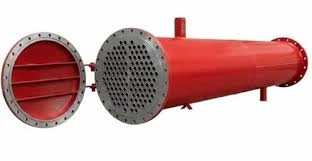
The Prime Coil ammonia shell tube chiller is a high-efficiency heat exchanger engineered to produce chilled water, brine, or glycol for industrial process cooling applications. Every ammonia shell…

Capacity
5 TR to 400 TR+ chilling capaci…
Refrigerants
Ammonia (R-717) shell side, wat…
Temperature
Chilled fluid output -30°C to +…
Ammonia Shell & Tube Condenser — Water-Cooled
Ammonia Range ·

Ammonia Shell & Tube Condenser — Water-Cooled

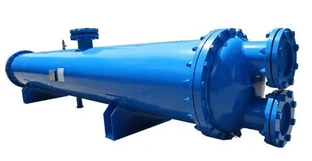
The Prime Coil ammonia shell tube condenser is a high-efficiency water-cooled heat exchanger engineered for continuous industrial refrigeration duty. Every ammonia shell tube condenser we manufacture is designed…

Capacity
5 TR to 400 TR+ heat rejection
Refrigerants
Ammonia (R-717) primary, Freon …
Temperature
Condensing 35°C to 45°C typic…
About this range

Shell & Tube Condensers & Chillers.

Where cooling water is available, a shell and tube condenser is the most compact and controllable way to reject heat from an ammonia plant. Condensing temperature follows water temperature rather than ambient air, which means stable head pressure through the day and through the season — and head pressure is what sets compressor power.

The same construction, reversed in duty, gives you the chiller. Ammonia evaporates in one circuit and cools water, brine or glycol in the other, producing the secondary refrigerant that feeds process loads, jacketed vessels and distributed cooling around a plant.

Prime Coil builds both from 5 TR to 400 TR and above — precision tube sheets, seamless tubes, and 2, 4, 6 or 8 pass designs selected to suit the flow and temperature rise you actually have.

Condenser or chiller — the same shell, opposite duties

In a condenser, ammonia vapour condenses on the shell side while cooling water passes through the tubes. In a chiller, ammonia evaporates and the tubes carry the fluid being cooled. Same geometry, opposite direction of heat flow, and quite different selection criteria.

You need a condenser when the plant has to reject heat and water is available. You need a chiller when the load is not a cold room but a process — a pasteuriser, a jacketed tank, a distributed glycol loop — where you are cooling a fluid rather than air.

Plenty of plants use both: a shell and tube condenser rejecting heat from the plant room, and a shell and tube chiller producing chilled water or glycol for the process side.

Pass design and why it matters

Pass count sets how many times the tube-side fluid traverses the shell before leaving. More passes mean higher velocity, better heat transfer and a smaller unit — at the cost of higher pumping pressure drop.

Two-pass suits high flow with a small temperature rise. Eight-pass suits low flow with a large rise. Choosing on unit price rather than on the actual flow available is how plants end up with a correctly sized exchanger that never reaches its rated duty, because the pump cannot deliver against the pressure drop.

We offer 2, 4, 6 and 8 pass designs and select against your available flow and pump head, not against a catalogue default.

Water quality decides tube material

Carbon steel tube is standard and appropriate for closed circuits and clean cooling water. Stainless steel is worth the difference on open cooling tower circuits with high dissolved solids, on borewell water with unpredictable chemistry, and on any brine circuit where chloride content will attack carbon steel.

This is the decision most often made on price and most often regretted. Retubing a condenser is far more expensive than specifying the right tube once, and the failure shows up as a leak between circuits — cooling water into the ammonia charge, which contaminates the whole plant.

The same reasoning applies to the water side generally: scale on the tube surface raises condensing temperature, and every degree of condensing temperature costs roughly 2 to 3% in compressor power. A treated water circuit protects the exchanger and the electricity bill together.

Water-cooled against evaporative

Shell and tube condensers need a cooling water source — a tower, a process return, or once-through water where that is permitted. Evaporative condensers reject heat directly to the air using a much smaller volume of water, and generally give a lower condensing temperature for the same ambient.

Choose shell and tube when you already have a water circuit, when the plant room is indoors with no route to atmosphere, when water chemistry is controlled, or when you need the most compact footprint. Choose evaporative when water is scarce or expensive and you have the space and access to site the unit outdoors.

We build both, and on projects where either would work we will tell you which we would specify and why.

Cleaning and service access

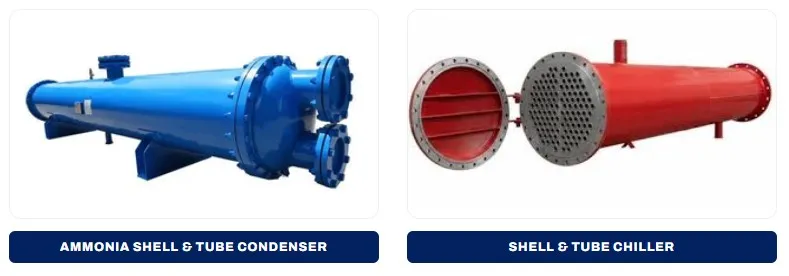
Shell and tube earns its keep over a long service life, and that depends on being able to clean it. Removable end covers give access to the tube sheet for mechanical cleaning, and the horizontal layout means a bundle can be pulled without dismantling surrounding pipework — provided the pull space was allowed for at layout stage.

Leave that space out of the plant room drawing and you convert a routine clean into a shutdown. It is worth confirming on the general arrangement before the foundations are poured.

Applications

Cold storage, food processing, dairy, ice plants, breweries and beverage, chemical and process industries — anywhere an ammonia plant meets a water or glycol circuit. The chiller range covers water, brine, glycol and process cooling duties; the condenser range covers water-cooled, horizontal and stainless tube variants.

Applications

Where this range is used.

  • Cold storages
  • Food processing plants
  • Dairy industries
  • Ice plants
  • Breweries & beverage plants
  • Chemical & process industries
  • Ammonia refrigeration systems
  • Pharmaceutical manufacturing
  • HVAC secondary loops
  • Concrete cooling
  • Pharmaceutical facilities
  • Water-cooled refrigeration plants
  • Marine refrigeration
FAQ

Shell & Tube Condensers & Chillers — answered.

Shell and tube or evaporative condenser?

Shell and tube suits plants that already have a cooling water circuit, indoor plant rooms with no route to atmosphere, and sites where water chemistry is controlled. Evaporative suits sites where water is scarce and outdoor space is available, and generally gives a lower condensing temperature for the same ambient. We build both and will say which we would specify for your site.

Carbon steel or stainless steel tube?

Carbon steel is fine for closed circuits and clean cooling water. Stainless is worth the difference on open cooling tower circuits with high dissolved solids, on borewell water, and on any brine circuit with chloride content. Retubing costs far more than specifying correctly once, and a tube failure puts cooling water into the ammonia charge.

How many passes should I specify?

Pass count follows your available flow and pump head. Two-pass suits high flow with a small temperature rise; eight-pass suits low flow with a large rise. More passes give better heat transfer and a smaller unit but higher pressure drop, so the pump has to be able to deliver against it. Send us flow, inlet temperature and required outlet and we will select it.

What capacity range do you build?

5 TR to 400 TR and above, in horizontal shell and tube construction with 2, 4, 6 and 8 pass options. Larger duties are handled with multiple units, which also gives useful part-load staging on plants that do not run flat out.

Can you supply chillers for brine and glycol, not just water?

Yes. The chiller range covers water, brine, glycol and process cooling duties. Secondary fluid affects tube material, velocity and pass selection — glycol in particular has lower heat transfer and higher viscosity than water, so a unit sized on water figures will underperform on glycol. Tell us the fluid and concentration at enquiry stage.

Sized for your plant

Tell us your load — we'll size the right unit.

Share your capacity, temperature and ambient conditions and our engineers will specify the system.

Request a Quote


    Your details stay private. No obligation, no spam.