Category Unit coolers · Low to high temp

Cold Room Evaporators & Unit Coolers.

The evaporator is where the cooling actually happens. Everything else in the plant exists to serve it — the compressor raises pressure so heat can be rejected, the condenser rejects it, the expansion device…

Commercial Evaporators

Products in this category

2 products
Angular Type Evaporator Unit (Medium & High Temperature)
Freon Unit Coolers

Angular Type Evaporator Unit (Medium & High Temperature)

Prime Angular Type Evaporator Units are high-efficiency finned-coil evaporators designed for medium and high temperature refrigeration applications. Manufactured using advanced technology and a compact 3D-modelled design, these units…

Capacity
1.5 kW – 50 kW
Construction
GI powder coated & SS-304 casing
Configuration
300 mm to 550 mm
About this range

Commercial Evaporators.

The evaporator is where the cooling actually happens. Everything else in the plant exists to serve it — the compressor raises pressure so heat can be rejected, the condenser rejects it, the expansion device meters liquid back. The evaporator is the only component in contact with the load.

Which is why air pattern matters as much as capacity. A unit cooler that hits its rated kW but throws air unevenly leaves warm pockets at the back of the room, and the product in those pockets is the product that gets rejected on arrival.

Prime Coil builds finned-coil unit coolers in two families: angular type for medium and high temperature rooms, and slim line dual discharge for low temperature and low-headroom installations. Both are 3D-modelled for low air draft, with electric and hot gas defrost options and casing specified to the room's washdown regime.

Angular type — medium and high temperature

The angular unit is the workhorse for chill rooms, ripening chambers and processing areas. Aluminium tube construction with a collared fan outlet gives wide air throw, so a single unit covers a longer room than a flat-outlet cooler of the same duty.

  • Fin spacing — 4 mm to 6 mm
  • Fan configuration — 300 mm to 550 mm
  • Casing — AlMg powder coated, or GI powder coated and SS-304 for dust-free applications
  • Defrost — electric or hot gas
  • Individual tubes pressure tested before assembly

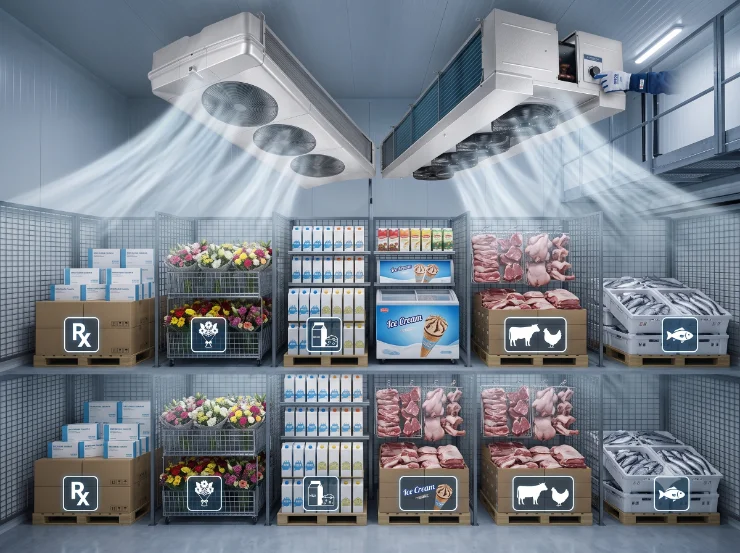
Typical duties: mushroom plants, banana ripening, chocolate, pharmaceutical storage, seafood, flowers, meat and poultry, fruit and vegetables, dairy.

Slim line dual discharge — low temperature

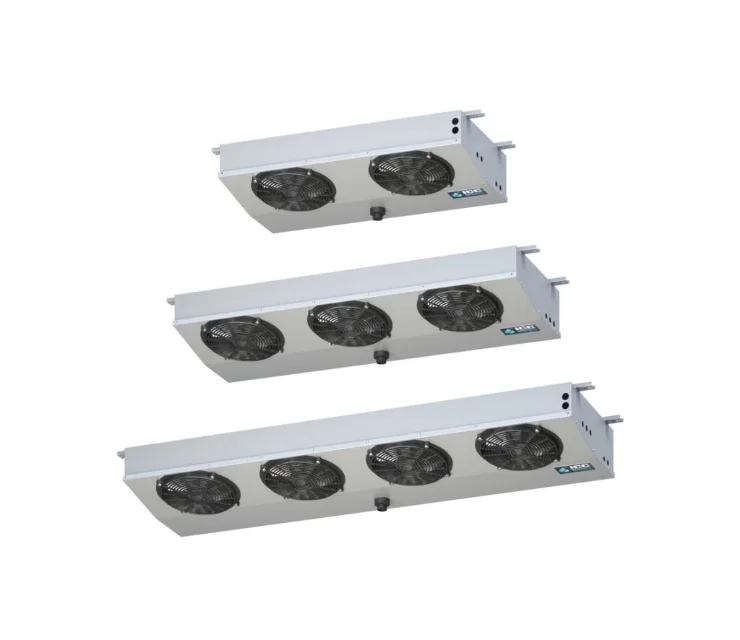
Freezer rooms are usually height-constrained, because insulated ceiling eats headroom the building never had spare. The slim line unit is built for exactly that: a shallow profile that mounts tight to the ceiling, with dual discharge throwing air in two directions instead of one.

Dual discharge is not just about coverage. Splitting the airflow gives more uniform distribution across a stacked room, which is the difference between a freezer that holds −18°C everywhere and one that holds it at the sensor.

  • Cooling capacity — 10 kW to 50 kW
  • Tube material — copper
  • Fin spacing — 4 mm to 6 mm
  • Fan configuration — 300 mm to 550 mm
  • Casing — AlMg or GI powder coated, and SS-304
  • Tube expansion through bullets for tight fin-to-tube contact

Typical duties: ice cream, pharmaceuticals, flowers, dairy, meat and poultry, seafood, frozen foods and general cold chain.

Fin spacing is a duty decision, not a price decision

Closer fins give more surface area in the same volume, so a 4 mm coil is smaller and cheaper than a 6 mm coil of the same capacity. It is also the wrong choice for most freezer rooms.

Frost forms between fins, and the closer they are the sooner the gaps bridge. Once bridged, airflow collapses and capacity goes with it — the unit is nominally correct and practically useless until it defrosts. Wider spacing holds more frost before that happens, so it runs longer between defrosts and spends more of its life at rated duty.

As a working rule: 4 mm suits chill rooms above 0°C with moderate humidity. 6 mm suits freezer duty, high-humidity produce, and any room where doors open frequently. We specify against the room, not against the quotation.

Electric or hot gas defrost

Electric defrost is simpler and cheaper to install. Hot gas uses heat the system has already produced, defrosts faster, and puts less heat into the room afterwards — every kW of electric defrost energy is a kW the plant has to remove again.

On a chill room defrosting twice a day, electric is usually fine. On a freezer running three or four defrosts daily across several units, hot gas repays the extra pipework and valving within a season. We supply both and will tell you which we would specify for your defrost frequency.

Casing — when stainless is worth it

AlMg and GI powder coated casing is appropriate for dry storage and general cold rooms. SS-304 earns its cost in seafood, meat, high-humidity produce and any washdown environment, which are precisely the conditions where a coated casing starts to fail at the seams and corner welds.

If your facility is audited by an export buyer or a pharma customer, stainless is usually expected rather than optional.

These units connect directly to our condensing units and Freon range. For freezer duty specifically, the refrigerant choice is worth reading first — see choosing a refrigerant for a blast freezer.

Applications

Where this range is used.

  • Mushroom Plants
  • Banana Ripening Chambers
  • Chocolate Processing
  • Pharmaceutical Cold Rooms
  • Seafood Storage
  • Flower Storage
  • Meat & Poultry
  • Fruits & Vegetables
  • Dairy Cold Rooms
  • Ice Cream Storage
  • Dairy Industry
  • Seafood Processing
  • Frozen Food Storage
  • Cold Chain Warehouses
FAQ

Commercial Evaporators — answered.

Angular or slim line — which do I need?

Angular type suits medium and high temperature rooms with normal headroom, and its collared fan outlet gives wide throw down a longer room. Slim line dual discharge suits low temperature and low-headroom rooms, and distributes air in two directions for uniform coverage across stacked storage. Room height and operating temperature usually decide it before capacity does.

What fin spacing should I specify?

4 mm for chill rooms above 0°C with moderate humidity; 6 mm for freezer duty, high-humidity produce and rooms with frequent door openings. Closer fins give a smaller cheaper coil but bridge with frost sooner, and a bridged coil loses airflow and capacity until it defrosts. Spacing follows the room, not the budget.

Electric or hot gas defrost?

Electric is simpler and cheaper to install and is normally fine on chill rooms defrosting twice a day. Hot gas is faster, uses heat the plant has already produced, and puts less heat back into the room — on a freezer running three or four defrosts a day across several units it repays the extra pipework within a season.

When do I need SS-304 casing?

Seafood, meat, high-humidity produce and any washdown environment. Those are exactly the conditions where powder coated casing starts to fail at seams and corner welds. Export and pharma buyers generally expect stainless as standard rather than as an upgrade.

Sized for your plant

Tell us your load — we'll size the right unit.

Share your capacity, temperature and ambient conditions and our engineers will specify the system.

Request a Quote


    Your details stay private. No obligation, no spam.