About this range
Shell & Tube Heat Exchangers.
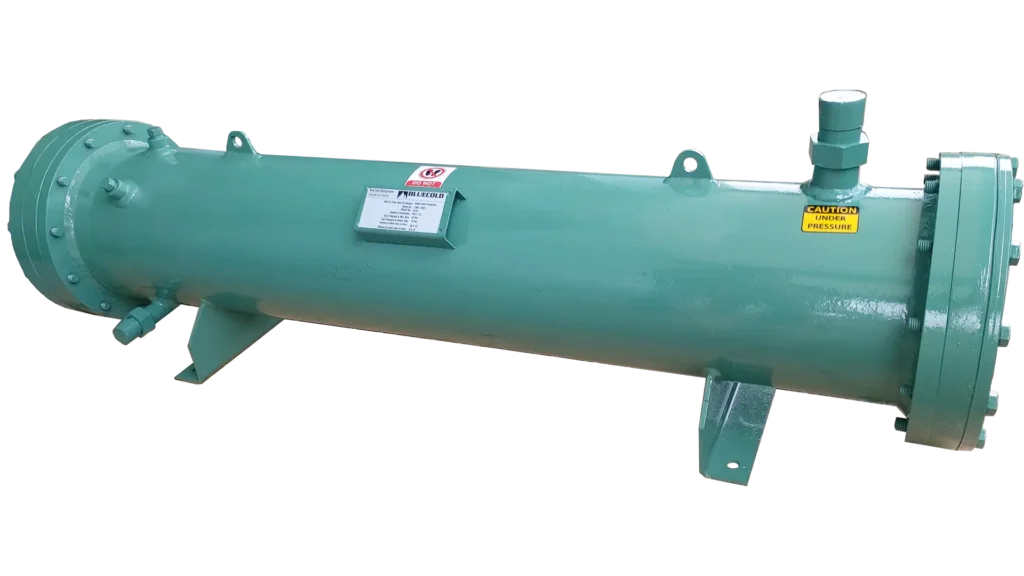
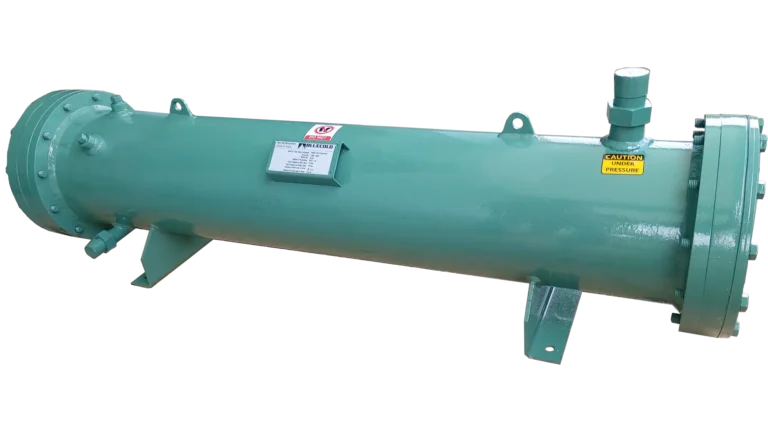
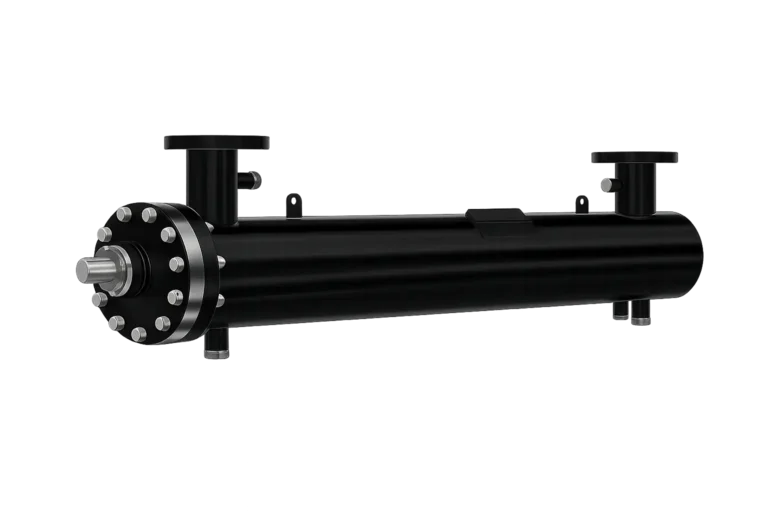
Shell and tube heat exchangers do one job in two directions: move heat between a refrigerant circuit and a water or process-fluid circuit. As a condenser, hot Freon gas enters the shell side, cooling water flows through the tubes, and the gas condenses. As an evaporator, liquid Freon evaporates in the shell and cools the tube-side fluid.
Same construction, opposite duty, and the same reason to choose it: a shell and tube exchanger is compact, cleanable and gives you a secondary fluid loop that keeps the refrigerant out of the building. That matters on distributed systems, on sites where refrigerant in occupied areas is not permitted, and anywhere the process load is a fluid rather than air.
These are the Freon-side equivalents — built for R-22, R-134a, R-404A, R-407C, R-410A, R-507 and others, with copper tubes optimised for HFC heat transfer characteristics. For ammonia duties, see the <a href="/products/ammonia-shell-tube-condensers-chillers/">ammonia shell and tube range</a>.
Shell and tube condenser — Freon
The condenser sits between the compressor and the expansion device, rejecting the heat the system has absorbed plus the work of compression. In a water-cooled Freon system, the shell and tube condenser is where that heat moves from the refrigerant circuit to the water circuit.
Water cooling gives a lower, more stable condensing temperature than air cooling — performance follows the water temperature, not the ambient. On a site that already runs a cooling tower for chiller or process loads, adding a shell and tube condenser to the water circuit is often the most efficient way to reject heat from a separate Freon system.
Key features:
- Refrigerants — R-22, R-134a, R-404A, R-407C, R-410A, R-507 and others
- Tube material — copper, optimised for HFC heat transfer
- Construction — compact, robust, designed for easy tube cleaning and inspection
- Custom-built — sized to your duty, flow and temperature conditions
Shell and tube evaporator — Freon
The evaporator is where the cooling happens. Liquid Freon enters at low pressure, evaporates inside the shell, and the tube-side fluid — water, glycol or brine — is cooled. This is the core of a water chiller or process cooling system.
The advantage over a direct expansion coil in air is the secondary loop. The chilled fluid can travel anywhere in the building through insulated pipe — to fan coil units, jacketed tanks, injection moulding machines, or multiple process points — without running refrigerant lines to each one. On a facility with twenty cooling points spread across three floors, the difference in installation complexity is the difference between a practical project and an impractical one.
Key features:
- Refrigerants — same HFC and HCFC range as the condenser
- Tube material — copper
- Fluids — water, glycol, brine and process fluids
- Enhanced heat transfer — internally grooved and externally finned tube options for higher UA per unit length
Freon or ammonia shell and tube — the difference
The geometry is similar. The engineering is not.
Ammonia has a much higher latent heat than any HFC, so an ammonia exchanger moves the same duty through smaller mass flow and different tube circuiting. Ammonia is also incompatible with copper — ammonia shell and tube units use steel tubes where Freon units use copper. Material, circuiting, pressure ratings and safety provisions all differ.
If your plant runs Freon, these are the exchangers to specify. If it runs ammonia, the ammonia shell and tube range is the correct page. Specifying a Freon exchanger for ammonia service — or the reverse — is not a performance question, it is a material compatibility failure.
Cleaning and service life
Scale, fouling and biological growth on the water side of any shell and tube exchanger are inevitable over time, and they degrade performance quietly — condensing temperature creeps up, chilled water temperature creeps up, and the compressor absorbs more power to compensate. The operator pays for it monthly without seeing a failure.
Removable end covers give access to the tube sheet for mechanical cleaning or chemical flushing. On a condenser connected to an open cooling tower circuit, annual cleaning is reasonable; on a closed chilled-water loop, the interval is longer but not infinite.
Water treatment on the tower side protects both the exchanger and the electricity bill — every degree of fouling-induced condensing temperature rise costs 2 to 3% in compressor power.
Applications
Water-cooled refrigeration systems, process chillers, HVAC chilled water plants, beverage and dairy cooling, pharmaceutical process cooling, and any Freon system where the heat rejection path is water rather than air. These exchangers pair with our condensing units and industrial chillers to form the complete Freon-side plant.