1. Start with the load, not the refrigerant
The most common mistake in industrial refrigeration is choosing a platform before the load profile is understood.
A cold store holding 2,500 metric tonnes of produce through a six-week intake peak behaves nothing like a distribution room cycling doors all day. Pull-down duty, ambient design temperature, and how many hours a year the plant sits at part load matter far more than any headline COP figure printed in a brochure.
Size for the worst realistic hour, then check efficiency across the whole year. That order matters — a plant sized only for steady state will fail exactly when the business needs it most, during a summer heatwave or a compressor breakdown.
Before you compare refrigerants, write down:
- Peak refrigeration duty in TR or kW
- Evaporating and condensing temperatures
- Ambient design conditions (site temperature and humidity)
- Hours per year at 100%, 75%, 50%, and idle load
- Number of pull-downs per week
- Available plant room footprint and height
- Operator experience level
- Local regulatory environment
Without these, any refrigerant comparison is theoretical.
2. Where ammonia wins
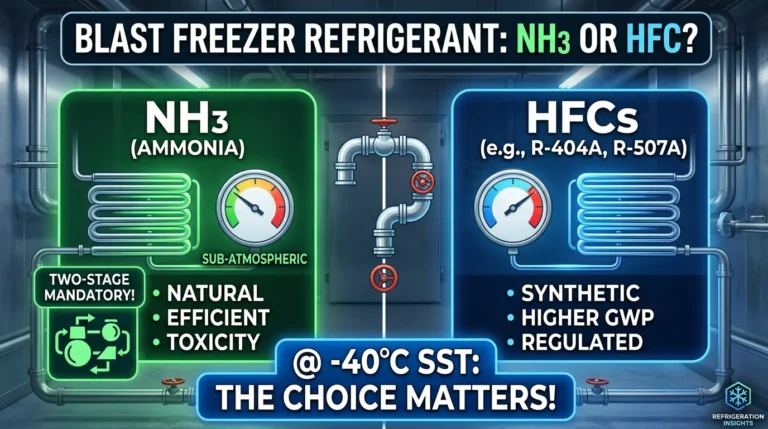
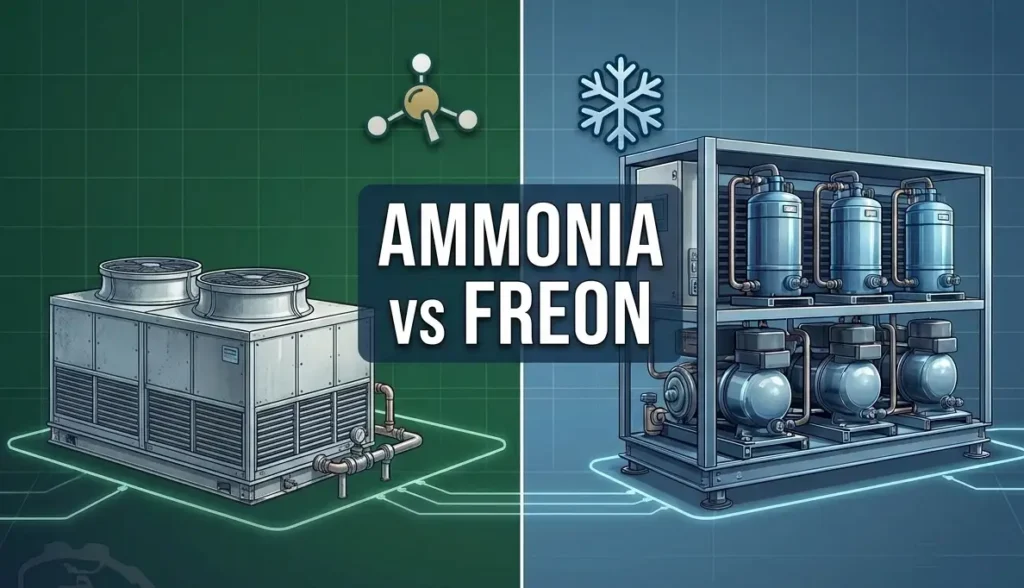
Ammonia (NH₃) is the most thermodynamically efficient refrigerant in common industrial use, with zero ozone depletion potential and no global warming potential. On a plant running around the clock, that efficiency compounds into a materially lower electricity bill every single year.
The concrete advantages, in the order they usually matter to buyers:
- Highest efficiency per kW of cooling — the gap over Freon widens as capacity grows, and shows up most on continuous industrial loads.
- Zero ODP and zero GWP — no phase-down risk over your asset’s twenty-year lifetime, and no F-gas reporting overhead.
- Low refrigerant cost — significant when charge is measured in tonnes rather than kilograms.
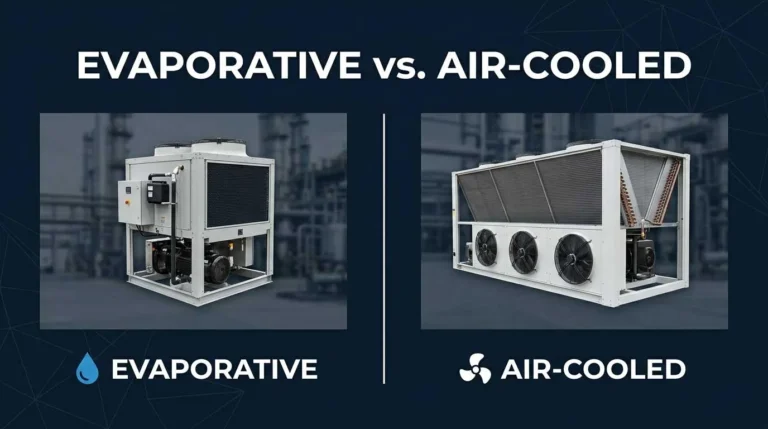
- Proven at scale — evaporative condensers to 700+ TR per unit and plate ice systems to 75,000 kg/day are routine ammonia territory.
- Established supply chain — parts, service engineers, and reference designs are available in every industrial region.
For any load above roughly 200 TR that runs continuously — ice manufacturing, cold storage, dairy, seafood, beverage, meat processing — ammonia is the default answer, and has been for a century.
3. Where Freon still makes sense
Freon (HFC) systems remain the pragmatic answer for compact and distributed duties. The equipment is packaged, modular, and quick to install — and it can operate with a smaller maintenance team than ammonia requires.
Situations where Freon is genuinely the right choice:
- Compact loads below 100 TR where packaged condensing units are simpler and faster to deploy
- Distributed refrigeration across multiple small rooms, where one central ammonia plant would need long insulated pipe runs
- Retrofits inside occupied buildings where an ammonia machinery room would need major structural work to comply with safety codes
- Sites with no on-site refrigeration technician where remote monitoring and telephone support is the operating model
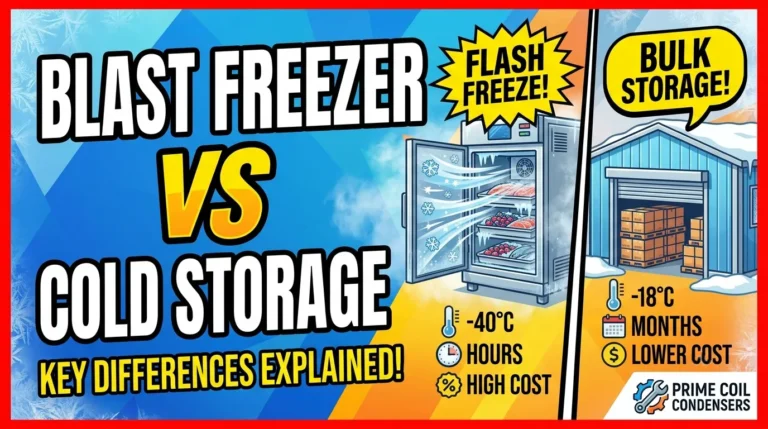
- Blast freezing or low-temperature applications at small scale where the additional Freon inefficiency is outweighed by simpler controls
For these duties, Freon is not a compromise — it is the correct engineering choice.
4. A side-by-side comparison
| Criterion | Ammonia (NH₃) | Freon (HFC) |
|---|---|---|
| Best-fit scale | Large, continuous industrial | Compact to mid-scale |
| Efficiency (COP) | Highest available | Good, lower at scale |
| Global warming potential | Zero | Moderate to high |
| Refrigerant cost | Low | High and rising |
| Regulatory outlook | Stable long term | Phase-down scheduled globally |
| Plant room | Dedicated space required | Often not required |
| Charge size | Larger, needs containment | Smaller, factory-sealed |
| Operator expertise | Trained team required | Standard HVAC technician |
| Capital cost per TR | Higher at small scale, lower at large scale | Lower at small scale |
| Lifetime cost | Lower for continuous loads | Lower for intermittent loads |
5. Safety and compliance, honestly
Ammonia is toxic at concentration, and that fact deserves respect rather than avoidance. Properly engineered plants handle it with containment, ventilation, gas detection, relief protection and trained operators — which is why ammonia has run safely in food and cold-chain facilities worldwide for over a century.
The safety picture has actually improved on both sides in recent years.
Low-charge ammonia designs have reduced the charge required per TR of cooling significantly — often by 60-80% versus classic flooded systems. That reduces both the risk profile and the regulatory burden, and has made ammonia viable in sites that would previously have defaulted to Freon.
Meanwhile, HFC refrigerants face tightening phase-down schedules under the Kigali Amendment and regional F-gas regulations. Long-term availability and cost of Freon refrigerants should factor into any decision made today — a system commissioned this year may need to be retrofitted or replaced within its designed life if you pick a refrigerant with a shrinking future.
The honest reading in 2026: ammonia carries operational responsibilities, Freon carries regulatory ones. Both are manageable. Which one you’d rather manage depends on your team and your site.
6. The decision framework we actually use
When we scope a project internally, the reasoning collapses to four questions:
Question 1: What’s the peak load?
- Under 100 TR → Freon is almost always the right answer
- 100-300 TR → depends on continuity and site constraints
- Over 300 TR → ammonia is almost always the right answer
Question 2: How continuous is the load?
- 24/7 continuous → ammonia efficiency compounds massively
- Single shift or seasonal → Freon simplicity often wins
Question 3: Do you have plant room space?
- Yes, greenfield or plant expansion → ammonia is straightforward
- No, retrofitting occupied buildings → Freon may be the only practical answer
Question 4: Who will run it?
- Trained refrigeration team on site → ammonia is fine
- No refrigeration expertise available → Freon with remote monitoring is safer
Three or four ammonia answers → we design an ammonia system. Three or four Freon answers → we design a Freon system. Mixed answers are where the interesting projects live, and where a detailed site visit earns its keep.