Most ammonia plant specifications copy the condenser type from the last project. The engineer who designed the previous cold store used an evaporative condenser, so the next project gets one too — no questions asked.
That laziness costs real money. Either the plant owner pays for water treatment and basin maintenance they never needed, or they burn 30–40% more compressor energy because their condensing temperature is sitting 10–15°C higher than it should be.
The condenser is the single biggest lever on your plant’s head pressure. Head pressure sets your compressor’s energy bill. And the energy bill is 60–70% of your cold storage operating cost. So getting the condenser type wrong doesn’t just waste capital — it bleeds cash every hour the plant runs.
This guide gives you the decision framework we use internally when specifying condensers for ammonia refrigeration plants — whether it’s a 30 TR potato cold store in UP or a 500 TR multi-commodity facility for export.
How Each Condenser Type Actually Rejects Heat
Skip this section if you already know the thermodynamics. But most condenser discussions stop at “evaporative is more efficient” without explaining why — or how much more efficient under your specific site conditions.
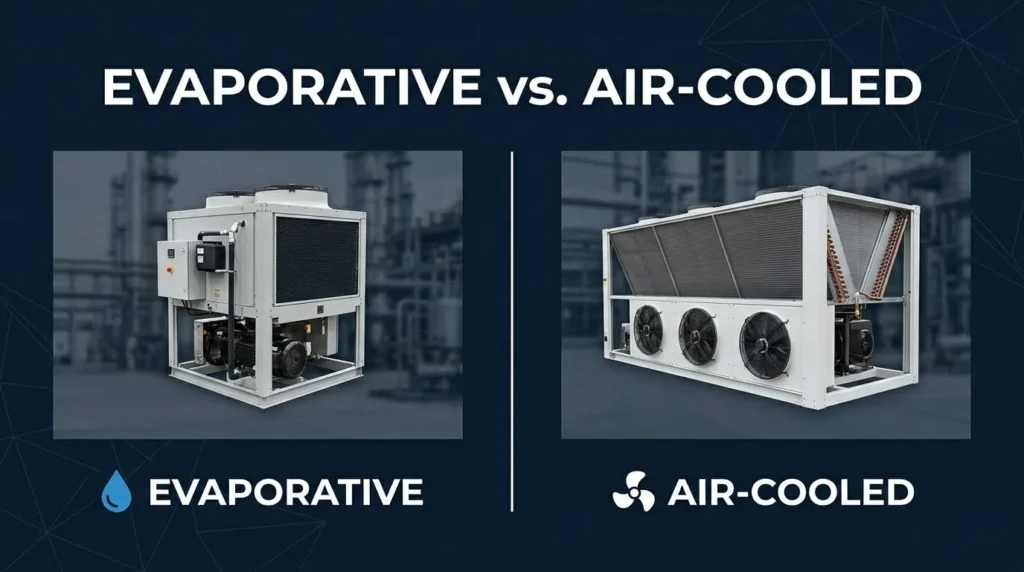
Evaporative condenser
An evaporative condenser rejects heat by spraying water over the ammonia-carrying coil while fans pull air across it. The water evaporates, and that evaporation is what carries the heat away. The condensing temperature tracks the site’s wet-bulb temperature (WBT), not the dry-bulb.
Typical temperature difference (TD) above WBT: 8–11°C.
So if your site’s design WBT is 28°C, your saturated condensing temperature (SCT) lands around 36–39°C. That’s a condensing pressure of roughly 13.5–14.8 bar gauge for ammonia.
Air-cooled condenser
An air-cooled condenser pushes ambient air over finned coils using fans. No water involved. The condensing temperature tracks the site’s dry-bulb temperature (DBT).
Typical TD above DBT: 12–17°C.
Same site, same summer day. If the DBT is 43°C, your SCT lands around 55–60°C. That’s a condensing pressure of roughly 21–23 bar gauge. Your compressor is working significantly harder to push against that pressure.
What this means at three real Indian sites
| City | Design DBT (°C) | Design WBT (°C) | SCT with Air-Cooled (°C) | SCT with Evaporative (°C) | SCT Difference |
|---|---|---|---|---|---|
| Ludhiana, Punjab | 43 | 28 | ~57 | ~37 | 20°C |
| Chennai, TN | 38 | 30 | ~52 | ~39 | 13°C |
| Delhi NCR | 43 | 27 | ~57 | ~36 | 21°C |
In Ludhiana and Delhi, that 20–21°C condensing temperature gap translates to roughly 35–40% higher compressor power consumption on an air-cooled system compared to evaporative. In Chennai, the gap is narrower because the wet-bulb is already high — but it’s still a 13°C penalty.
This is the fundamental physics. Everything else — water cost, maintenance, footprint — sits on top of this energy reality.
When an Evaporative Condenser Is the Right Call
In our experience across ammonia plants in India and export markets, evaporative condensers are the default choice when three or more of these conditions are true at the plant site:
1. High ambient dry-bulb with meaningful wet-bulb depression
The wider the gap between your site’s DBT and WBT, the more an evaporative condenser saves you. Most of North India — Punjab, Haryana, UP, Rajasthan, MP — has a 12–16°C wet-bulb depression in peak summer. That depression is free energy savings. Air-cooled condensers cannot use it.
In coastal or high-humidity zones (Konkan coast, Kerala, parts of Bengal) where WBT tracks close to DBT, the energy advantage shrinks dramatically. That’s where the decision gets tighter.
2. Plant capacity above 50 TR
Below 50 TR, the water treatment infrastructure — dosing system, blowdown management, basin cleaning, Legionella prevention — costs nearly as much as it does for a 200 TR plant. The per-TR overhead is disproportionate. Above 50 TR, that overhead gets amortised across enough capacity to make economic sense.
3. Reliable water supply at reasonable cost
An evaporative condenser on a 100 TR ammonia plant consumes roughly 2,500–3,500 litres of water per hour at peak load (including evaporation, drift, and blowdown). That’s 60–80 KL/day in summer. If your water comes from a borewell or municipal connection at ₹20–40/KL, the cost is manageable. If you’re buying tanker water at ₹200+/KL in a water-scarce zone, the math breaks.
4. Compressor energy dominates your OPEX
In any plant where the refrigeration load runs 18–24 hours/day — multi-commodity cold stores, frozen food processing, dairy chilling — compressor energy is 60–70% of total operating cost. The 30–40% energy saving from lower condensing temperatures pays for the water treatment and maintenance many times over.
5. Compact plot availability
An evaporative condenser rejects roughly 3–4× more heat per square metre of plot area than an equivalent air-cooled condenser. When your plant room layout is tight — common in industrial estates and existing factory expansions — evaporative is often the only way to fit the required heat rejection capacity.
Quick example: 100 TR cold store, Punjab
For a 100 TR ammonia cold storage plant near Jalandhar, an evaporative condenser (counter-flow, SS tube coil) needs roughly 12–15 m² of plot area and delivers an SCT of ~37°C at design conditions. An air-cooled condenser for the same duty would need 45–60 m² of plot area and still deliver an SCT of ~57°C — burning an extra ₹8–12 lakh per year in compressor electricity at ₹9/kWh industrial tariff.
In this scenario, the evaporative condenser pays for its own water and maintenance cost within the first 4–6 months of operation.
When an Air-Cooled Condenser Makes More Sense
Air-cooled condensers aren’t inferior equipment — they’re the right equipment for specific conditions. We manufacture both types because both have legitimate applications.
1. Water-scarce regions or unreliable supply
Parts of Rajasthan, Vidarbha, Kutch, and Bundelkhand face genuine water scarcity. Running an evaporative condenser on tanker water at ₹150–300/KL turns the operating cost advantage inside out. Air-cooled eliminates water dependency entirely.
2. Coastal and corrosive environments
Salt-laden air near the coast accelerates corrosion on evaporative condenser coils, basins, and spray nozzles. Even with SS tube coils, the structural steel, fan assemblies, and water distribution system take damage. In coastal Gujarat, Konkan, and southern Tamil Nadu, we’ve seen evaporative condenser shells need major overhaul within 5–7 years. An air-cooled condenser with proper epoxy-coated or copper-fin coils handles coastal air much better with less maintenance intervention.
3. Smaller plants under 30 TR
A 20 TR potato cold store in a mandi doesn’t have a maintenance technician on staff. It has an operator who opens the door and checks the temperature display. Asking that operation to manage water treatment, blowdown valves, and basin cleaning is unrealistic. An air-cooled condenser is install-and-forget — clean the fins once a quarter, replace a fan motor every 5–7 years.
4. Plants in moderate-climate zones
Hill stations and higher-altitude locations in Himachal, Uttarakhand, and parts of the Northeast have peak summer DBTs of 30–35°C. An air-cooled condenser at 35°C DBT gives you an SCT of ~49°C — not great, but workable. And you avoid all the water infrastructure for a climate where the extreme condition only lasts 60–90 days per year.
5. Modular or fast-track projects
Air-cooled condensers arrive as self-contained units. No basin construction, no water piping, no pump sets, no chemical dosing skid. For projects where commissioning speed matters — a seasonal fruit processing line, a temporary blast freezing setup — air-cooled cuts 3–4 weeks off the installation timeline.
Maintenance cost comparison
| Cost head | Evaporative (100 TR, annual) | Air-Cooled (100 TR, annual) |
|---|---|---|
| Water consumption | ₹3.5–5.5 lakh | ₹0 |
| Water treatment chemicals | ₹0.8–1.2 lakh | ₹0 |
| Basin cleaning & inspection | ₹0.3–0.5 lakh | ₹0 |
| Drift eliminator replacement | ₹0.2–0.4 lakh (every 3 yrs, amortised) | ₹0 |
| Spray nozzle & pump maintenance | ₹0.3–0.5 lakh | ₹0 |
| Fin cleaning / coil washing | ₹0.1 lakh | ₹0.3–0.5 lakh |
| Fan motor servicing | ₹0.2 lakh | ₹0.3–0.5 lakh |
| Total maintenance | ₹5.4–8.3 lakh/year | ₹0.6–1.0 lakh/year |
| Compressor energy penalty vs. evaporative | — | ₹8–14 lakh/year extra |
The numbers tell the story: evaporative condensers cost more to maintain, but the compressor energy saving dwarfs the maintenance expense in most North Indian installations. The breakeven shifts in water-scarce zones, coastal sites, and smaller plants — which is exactly why both condenser types exist.
The Hybrid Approach: Adiabatic Pre-Cooling
There’s a third path that’s gaining traction, particularly for plants in locations where extreme heat lasts only 60–90 days per year.
An adiabatic system adds wetted media pads upstream of an air-cooled condenser. During peak summer, water saturates the pads and pre-cools the incoming air — dropping the effective inlet temperature from dry-bulb toward wet-bulb. The rest of the year, the pads stay dry and the unit operates as a standard air-cooled condenser.
The result:
- Water consumption drops by 85–90% compared to a full evaporative condenser
- Peak condensing temperature drops by 8–12°C compared to running dry
- No basin, no recirculation pump, no chemical dosing system
- Maintenance is limited to pad replacement every 2–3 seasons
The trade-off is that adiabatic pre-cooling doesn’t match a true evaporative condenser’s year-round performance. During monsoon or high-humidity periods when WBT is close to DBT, the pads add negligible benefit. And the capital cost is higher than a standard air-cooled unit.
For plants in transitional climates — Pune, Bangalore, parts of Madhya Pradesh — where 40°C+ days are limited but painful, adiabatic makes a compelling case. It avoids the full water infrastructure while clipping the worst of the summer energy penalty.
Condenser Selection: A Decision Framework
After 25+ years of specifying condensers for ammonia plants, we’ve found the decision comes down to five site-specific questions. Answer them honestly and the right condenser type becomes obvious.
Question 1: What is the wet-bulb depression at your site?
WBD = Design DBT − Design WBT
If WBD is above 12°C (most of inland North and Central India), evaporative condensers deliver massive energy savings. If WBD is below 6°C (coastal, high-humidity zones), the energy advantage shrinks enough that other factors dominate the decision.
Question 2: Is water available at under ₹50/KL?
If yes, water cost won’t break the evaporative condenser’s energy math. If you’re above ₹100/KL or dependent on tankers, the operating cost advantage starts to erode. Above ₹200/KL, air-cooled almost always wins on total cost of ownership.
Question 3: Is the plant capacity above or below 50 TR?
Below 50 TR, water treatment infrastructure is a disproportionate overhead. Above 50 TR, it amortises well. This isn’t a hard line — a 40 TR plant in Ludhiana with ₹15/KL borewell water still benefits from evaporative — but it’s a useful threshold for quick screening.
Question 4: Do you have maintenance capability for water treatment?
An evaporative condenser with neglected water treatment develops scale, biological growth, and corroded coils within 18–24 months. If the plant doesn’t have — and won’t hire — someone to manage water chemistry, an evaporative condenser will underperform and degrade faster than an air-cooled unit left alone.
Question 5: Is the site coastal or in a corrosive atmosphere?
Within 15 km of the coastline, or near chemical processing areas with airborne corrosives, air-cooled condensers with appropriate coil coatings generally outlast evaporative units — even when the energy math favours evaporative.
The decision path
| Scenario | Recommendation |
|---|---|
| WBD >12°C + water <₹50/KL + capacity >50 TR + maintenance team + non-coastal | Evaporative condenser — strongest energy case |
| WBD >12°C + water expensive/scarce + any capacity | Air-cooled with adiabatic pre-cooling — clip summer peaks without water dependency |
| WBD <6°C (coastal/humid) + any other factors | Air-cooled — evaporative advantage too small to justify water infrastructure |
| Capacity <30 TR + no dedicated maintenance | Air-cooled — simplicity and low maintenance win |
| Coastal site within 15 km of shoreline | Air-cooled with epoxy/coated coils — corrosion resistance is priority |
| Fast-track / modular project | Air-cooled — no civil works, faster commissioning |
If your site sits between two scenarios — and many do — run the numbers. Calculate the annual compressor energy difference at your site’s DBT and WBT, subtract the annual water and maintenance cost of an evaporative condenser, and see which side the net savings fall on. That calculation takes 30 minutes and saves lakhs per year over the plant’s life.
What This Means for Your Plant Design
The condenser type you select cascades through the entire system. It sets the head pressure, which sizes the compressor, which determines the motor rating, which sets the electrical panel and transformer capacity. Changing the condenser type after the plant room is built means re-engineering half the system.
Get this decision right at the DPR stage. Not after the civil contractor has poured the basin — or left it out.
What we manufacture
We build both condenser types in-house — evaporative condensers (counter-flow with SS tube coil) and air-cooled condensing units — because both have legitimate applications. We also manufacture water-cooled condensing units for shell-and-tube applications where a cooling tower is already part of the facility infrastructure.
Every condenser we ship is designed and pressure-tested to IS 2825 / ASME standards and carries PESO certification where required.
Frequently Asked Questions
Does an evaporative condenser use more water than a cooling tower?
Per unit of heat rejected, they’re comparable. Both rely on the latent heat of water evaporation. The key difference is that an evaporative condenser puts the ammonia coil directly inside the air-water stream, eliminating the intermediate water loop and approach temperature loss that a cooling tower + shell-and-tube condenser combination introduces. That’s why evaporative condensers typically deliver 2–3°C lower condensing temperatures than a cooling tower serving a separate condenser.
Can you use an air-cooled condenser for a system with evaporating temperature below −35°C?
You can, but the compression ratio becomes punishing. At −35°C evaporating and 57°C condensing (air-cooled in North India summer), you’re looking at a compression ratio above 14:1 on a single-stage system — well beyond practical limits. You’d need two-stage compression to make it work, which adds capital cost. An evaporative condenser bringing the SCT down to 37°C drops that ratio to around 8:1, which a single-stage screw compressor handles comfortably. The condenser choice directly affects whether you need single-stage or two-stage compression — and the cost difference between those two is substantial.
What is the typical condensing TD for an evaporative condenser?
Industry standard is 8–11°C above design wet-bulb temperature for ammonia service. We typically design at 10°C TD for new installations, which balances condenser cost against energy performance. Tighter TDs (8°C) require larger condenser coil surface and higher fan power, so the capital cost goes up. Wider TDs (12°C+) mean a cheaper condenser but higher compressor energy bills — a false economy on plants running more than 16 hours/day.
How often does an evaporative condenser need water treatment?
Water chemistry should be checked and dosed weekly during heavy-load months. The basin needs physical cleaning every 3–4 months to remove sludge and biological growth. Drift eliminators should be inspected annually and replaced every 3–4 years depending on water quality. Scale deposits on the coil — the real performance killer — build up faster with hard water (above 300 ppm TDS). Plants using hard borewell water without a softener will see condenser performance degrade by 15–20% within 12–18 months.
Planning a new ammonia plant or upgrading an existing condenser? Send us your site location, design temperatures, and plant capacity. We’ll run the condensing temperature and energy comparison for your specific conditions — no obligation.