
Falling Film Chiller
Precise cooling to 0.5°C for dairy, food processing and brewing — engineered for continuous duty with negligible maintenance.
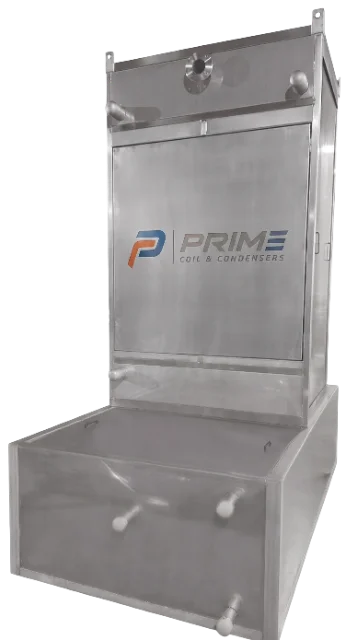
Precise cooling to 0.5°C for dairy, food processing and brewing — engineered for continuous duty with negligible maintenance.
Prime Coil’s Falling Film Chiller is precision-engineered for applications where chilled water is needed close to the freezing point without ice formation on the exchange surface. A curtain of water descends as a thin film over vertical stainless steel pillow plates while refrigerant flows through the plate interior — the physics of thin-film heat transfer means the water reaches temperatures conventional shell-and-tube exchangers cannot, at higher energy efficiency than any flooded alternative.
The design has been the standard in dairy, brewing and food processing for decades because it does three things unusually well: it delivers stable chilled water at 0.5°C to 1°C without freeze-up risk, it uses a fraction of the refrigerant charge of equivalent flooded systems, and it stays hygienic through years of continuous duty because the construction is fully welded stainless steel with no gaskets, no seals, and no dead pockets.
Every Prime Coil Falling Film Chiller is built to your capacity requirement — we do not sell standard sizes, we engineer the plate count and pump specification to your load profile.
Built to run, season after season.
SS pillow plates for heat transfer
Vertical stainless steel pillow plates carry refrigerant on the inside while water descends as a thin film on the outside. The geometry maximises surface area per unit footprint and keeps heat transfer coefficient high across the plate face.
Chills to 0.5°C without freeze-up
Thin water film means minimal residence time on any given plate area, so ice never gets a chance to form on the surface. That precision is why dairy, brewing and food buyers specify falling film over any other chiller technology when they need water close to freezing.
Fully welded, no gaskets
All stainless steel construction with no seals, gaskets or crevices — passes food-grade hygiene requirements out of the box, cleans in place, and eliminates the annual gasket-replacement service call that plate-and-frame exchangers demand.
Low refrigerant charge
Thin refrigerant film inside the plates uses a fraction of the charge a flooded evaporator requires. Lower charge means safer ammonia operation, less refrigerant loss on any leak event, and simpler compliance with charge-based safety regulations.
No moving parts on the exchange
Water is distributed by gravity across a header, refrigerant is fed by system valves — nothing inside the chiller moves. No pumps to fail, no seals to leak, no vibration. Maintenance is limited to periodic wash-down of the plate face.
Open access from all sides
Accessibility on all sides for inspection, cleaning and any occasional service. No enclosed casing to dismantle, no restricted headroom around the plates — a genuine 30-minute wash-down job instead of a shutdown event.
DX, gravity, or pumped operation
Runs on direct expansion for smaller plants, gravity-fed for medium duty, or pumped liquid recirculation for large continuous loads. Our engineers select the right feed method for your capacity, ambient, and operator preference.
Seawater option available
SS-316 or duplex stainless steel construction available for marine and seawater cooling duties — for shipboard installations, coastal seafood processing, and salt-water beverage cooling applications.
Specifications
| Cooling capacity | 50 kW to 2,000+ kW per unit, custom-sized |
|---|---|
| Chilled water temperature | Down to 0.5°C stable |
| Water inlet temperature | Up to 40°C typical |
| Refrigerants | Ammonia (R-717), Freon variants, Glycol, CO₂ |
| Plate material | SS-304 standard, SS-316 for aggressive media |
| Welding method | Laser welded pillow plates |
| Plate configuration | Vertical, gravity water distribution |
| Feed methods | DX, gravity, pumped recirculation |
| Refrigerant charge | Low (fraction of flooded systems) |
| Water distribution | Perforated header, thin-film cascade |
| Hygiene rating | Food-grade, CIP compatible |
| Access | Open construction, all sides |
| Optional | Enclosed hygienic cover, seawater duty (SS-316) |
| Design pressure | Standard 25 bar, higher on request |
| Testing | 100% pressure tested before dispatch |
Where it's used.
- Food processing
- Dairy & milk processing
- Fisheries & seafood
- Brewing & beverage
- Chemical processing
- Pharmaceutical production
- Concrete cooling (construction)
- Produce & vegetable pre-cooling
- Bakery ingredient chilling
Product questions, answered.
Why choose falling film over a shell-and-tube or plate chiller?
For chilled water applications, especially close to freezing, falling film has three concrete advantages. First, it can reliably deliver water at 0.5°C without freeze-up on the exchange surface — most shell-and-tube designs cannot go below 4°C safely. Second, refrigerant charge is dramatically lower than flooded evaporators, which matters for ammonia safety and compliance. Third, the fully welded stainless construction with no gaskets removes the biggest maintenance headache of plate-and-frame heat exchangers.
How does the chiller avoid ice formation on the plate surface?
Two things prevent freeze-up: the water forms a thin, continuously flowing film across the plate, so residence time on any given spot is measured in seconds, not minutes. And the refrigerant temperature is controlled so the plate surface sits just below the target water temperature — cold enough to chill effectively, not cold enough to freeze the thin film. Proper control valve selection matters; we specify these based on your design conditions.
What flow rates and capacities are typical?
Small units for dairy or brewing start around 50 kW handling 8-10 m³/hr of water. Large installations for food processing plants routinely reach 1,000-2,000 kW at 150-300 m³/hr. Every unit is engineered to your specific load profile — plate count, feed method, and pump sizing all vary. Send us your load and inlet/outlet temperatures for accurate sizing.
Can I use it with ammonia? What about CO₂ or glycol?
All four common refrigerants — ammonia (NH₃), Freon (HFC), glycol brines, and CO₂ — work with the pillow plate construction without design changes. Ammonia is the most common choice for high-capacity plants due to efficiency and zero GWP. CO₂ is increasingly specified for lower-temperature duty and where local regulations discourage HFCs. Our engineers help you select based on your infrastructure and long-term compliance plan.
How does maintenance work?
Very simple compared to alternative chillers. The plate face is accessible from all sides, so a manual wash-down with a low-pressure hose takes 30 minutes to an hour. For dairy and food applications, CIP (Clean-in-Place) circulation can be built in. There are no gaskets to replace, no seals to inspect, no belts, no pumps inside the chiller — annual maintenance is a wash and a visual check.
Is it suitable for seawater or coastal environments?
Yes — we offer SS-316 or duplex stainless steel construction for marine and seawater duty. Shipboard installations, coastal seafood processing plants, and salt-water beverage cooling systems all benefit from this option. Confirm your chloride level and expected corrosion environment during specification.
What's the delivery lead time?
Standard sizes ship in 6-8 weeks from order confirmation. Custom capacities and marine-grade builds run 10-12 weeks. Every unit is built to order — we do not stock inventory, because right-sizing to your load is what makes the chiller efficient over its lifetime.
Every Prime Coil Falling Film Chiller is engineered around your specific load profile, refrigerant choice and hygiene requirement. Send us your numbers and we'll come back with the model, footprint, and delivered price within one working day.

Tell us your daily requirement.
Share your output target, product and ambient conditions — we'll specify the machine and the plant around it.