
CO₂ Sensor for Cold Storage — NDIR Transmitter
Accurate CO₂ monitoring for cold storage, controlled atmosphere and pharmaceutical facilities — NDIR technology, CE-certified, and backed by a 2-year replacement warranty.
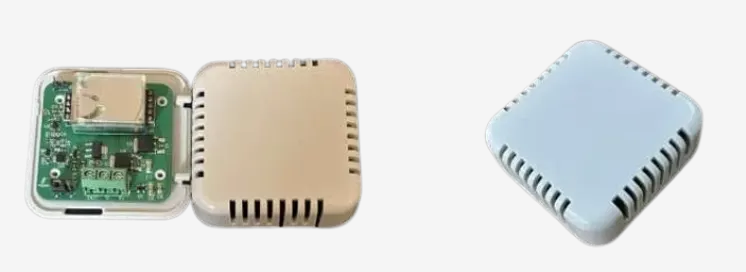
Accurate CO₂ monitoring for cold storage, controlled atmosphere and pharmaceutical facilities — NDIR technology, CE-certified, and backed by a 2-year replacement warranty.
The Prime Coil CO2 sensor for cold storage is an indigenously developed, CE-certified NDIR transmitter engineered for the precise atmospheric monitoring that cold storage, controlled atmosphere, and pharmaceutical facilities require. Every CO2 sensor we supply is backed by a 2-year replacement warranty and designed for 15+ years of continuous service in the corrosive humidity and temperature swings that kill commercial-grade sensors.
Why atmospheric CO₂ monitoring matters in cold storage
Every cold storage room accumulates CO₂ from three sources — produce respiration (fruit and vegetables release CO₂ as they slowly ripen even in refrigeration), microbial activity (natural spoilage even in properly-cooled products), and staff working inside the room. Uncontrolled, CO₂ concentration rises steadily and reaches levels that damage product quality and threaten worker safety.
For a general cold storage warehouse, CO₂ should stay below 5,000 ppm for staff safety (10,000 ppm triggers OSHA alarm thresholds). For controlled atmosphere (CA) storage — the specialty storage that lets apples, pears, and kiwis reach markets three to six months after harvest — CO₂ concentration has to be held within a tight window (typically 1-5% depending on variety) that maximises storage life without inducing fruit disorders.
Neither goal is achievable without a reliable CO2 sensor for cold storage installed at the room level. Ventilation controls that don’t measure actual CO₂ either over-ventilate (wasting refrigeration energy) or under-ventilate (letting concentration drift). CA storage systems that use estimated CO₂ instead of measured concentration deliver inconsistent storage life results year to year.
NDIR technology — the right measurement principle
Non-Dispersive Infrared (NDIR) technology is the industry standard for accurate CO₂ measurement across the wide concentration ranges cold storage requires. NDIR sensors work by shining infrared light through a sample gas chamber and measuring how much of the light is absorbed at CO₂’s specific absorption wavelength. Absorption is proportional to CO₂ concentration — the physics is direct, calibration is stable, and the technology has no consumable elements to replace over time.
Our CO2 sensor for cold storage uses NDIR measurement across configurable ranges from 0-2,000 ppm (for staff-safety monitoring in general warehouses) to 0-100,000 ppm (for CA storage that operates at percent-level concentrations). Same sensor platform serves both applications by range selection during quotation.
Made in India — CE-certified for local support
Every CO2 sensor for cold storage in our range is designed and manufactured in India, then CE-certified to European electromagnetic and safety standards. That combination matters for two reasons:
Local support and calibration. Replacement units, calibration services, and technical support come from within India — no international shipping delays, no import duties on service calls, no time-zone mismatches with technical support engineers. When a sensor needs replacement in year 6 of operation, it’s available.
CE certification confirms performance. The sensors are tested against European electromagnetic compatibility, safety, and performance standards — the same certification European industrial sensors carry. Made-in-India construction does not compromise measurement performance.
Compact form factor for room-level installation
Physical size matters when you’re mounting sensors inside operational cold storage rooms. Our CO2 sensor for cold storage measures just 60 × 60 × 25 mm — small enough for discrete wall-mounted installation, out of the path of forklift traffic, and easy to clean during routine sanitation cycles. IP30-rated ABS vented enclosure protects the sensor element from dust while allowing accurate atmospheric sampling.
Integration with your PLC or BMS
Standard output signals — 0-5 V DC or 4-20 mA — integrate directly with any Siemens PLC (including our own PLC Control Panels), any commercial building management system, or any refrigeration controller with analog input channels. 24 VDC power supply matches standard industrial control voltages. No proprietary protocols, no closed integration ecosystems — the sensor works with whatever control platform your facility uses.
Built to run, season after season.
NDIR measurement technology
Non-Dispersive Infrared sensing is the industry-standard technology for accurate CO₂ measurement — direct physics-based measurement, stable calibration, no consumable elements to replace. Same technology used in laboratory reference instruments.
Wide range — 2,000 to 100,000 ppm
Configurable ranges from 0-2,000 ppm (for general cold storage staff safety monitoring) to 0-100,000 ppm (for CA storage at percent-level concentrations). Same sensor platform serves both applications with range selection during order.
Made in India, CE-certified
Indigenously developed and manufactured in India, then CE-certified to European electromagnetic compatibility and safety standards. Local support, calibration services, and replacement availability without international shipping delays or import complications.
15-year service life
Documented 15+ year service life under normal cold storage operating conditions. NDIR technology has no consumable elements — no zirconium cells to burn out, no electrochemical cells to expire, no consumable filters. Sensor drift is minimal and correctable through periodic calibration.
2-year replacement warranty
Standard 2-year replacement warranty on every unit. If a sensor fails within warranty period, we replace it — no arguments about calibration procedures or installation practices. Warranty is unconditional beyond obvious tampering.
Compact 60 × 60 × 25 mm form factor
Small enough for discrete wall-mounted installation inside operational cold storage rooms. Out of the path of forklift traffic, easy to clean during routine sanitation cycles, and unobtrusive to daily operations.
Standard analog outputs
0-5 V DC and 0-20 mA output options match every industrial control platform. Direct integration with Siemens PLC, commercial BMS, refrigeration controllers, or standalone data loggers. No proprietary protocols required.
Standard 24 VDC power
Industrial-standard 24 VDC power supply requirement integrates with existing plant control voltages. No special power supplies, no isolated grounding requirements, no signal conditioning modules needed for basic installation.
IP30 protection
ABS vented enclosure provides IP30 protection against dust and particulate ingress while allowing accurate atmospheric sampling. Suitable for direct cold storage room installation, storage vestibules, and control room environments.
Specifications
| Technology | Non-Dispersive Infrared (NDIR) |
|---|---|
| Measurement range | 0-2,000 to 0-100,000 ppm (configurable) |
| Output signal | 0-5 V DC / 0-20 mA (selectable) |
| Power supply | 24 VDC |
| Enclosure | ABS vented, IP30 |
| Dimensions | 60 × 60 × 25 mm |
| Mounting | Wall-mounted, screw fixings included |
| Operating temperature | -20°C to +50°C |
| Operating humidity | 0-95% RH non-condensing |
| Response time | T90 within 60 seconds typical |
| Accuracy | ±3% of reading + 50 ppm typical |
| Calibration stability | <2% drift per year typical |
| Certification | CE (EMC + LVD) |
| Manufacturing | Made in India |
| Warranty | 2 years replacement |
| Service life | 15+ years typical |
| Signal cable | Shielded, 3-core minimum recommended |
| Compatible systems | Any PLC/BMS with analog inputs |
Where it's used.
- Cold storage warehouses
- Controlled atmosphere (CA) storage
- Apple, pear, and kiwi storage
- Fruit ripening rooms
- Mushroom cultivation chambers
- Pharmaceutical cold rooms
- Food processing facilities
- Meat & poultry storage
- Research & test chambers
- Worker safety monitoring
Product questions, answered.
Why does a cold storage facility need CO₂ monitoring?
Every cold storage room accumulates CO₂ from produce respiration, microbial activity, and staff working inside. Without measurement and ventilation control, concentration rises steadily. For general warehouses, CO₂ above 5,000 ppm impacts staff safety and productivity — 10,000 ppm triggers OSHA alarm thresholds. For controlled atmosphere storage, CO₂ has to be maintained within tight ranges (1-5%) that maximise storage life — impossible without accurate measurement.
What's NDIR technology and why does it matter?
Non-Dispersive Infrared is the industry-standard measurement principle for CO₂. The sensor shines infrared light through a sample gas chamber; CO₂ molecules absorb light at specific wavelengths in proportion to concentration. Direct physics-based measurement with no consumable elements, stable calibration over years, and accurate across wide concentration ranges. It's the same technology used in laboratory reference instruments and premium industrial sensors.
Which measurement range should I select for my application?
Depends on your facility type. General cold storage warehouses need 0-2,000 ppm range covering staff safety monitoring thresholds. Controlled atmosphere storage needs 0-100,000 ppm (0-10%) range covering full CA operating envelope. Ripening rooms typically need 0-20,000 ppm. Our engineers help select the correct range during quotation based on your intended use and control setpoints.
How often does the sensor need calibration?
Annual calibration is standard practice for NDIR sensors in critical applications. Our units drift less than 2% per year under normal operating conditions, so calibration is more about compliance verification than actual correction. Calibration uses standard reference gases and takes 15-30 minutes per sensor. Our field service team provides calibration services, or your on-site engineers can perform it with basic reference gas cylinders.
Can I integrate the sensor with my existing PLC or BMS?
Yes — 0-5 V DC or 0-20 mA analog outputs integrate with any control system that has standard analog inputs. Siemens, Rockwell, Schneider, Honeywell BMS — all major platforms accept our sensor output directly. For our own PLC Control Panels, integration is plug-and-play with pre-configured tag names and alarm thresholds.
How is a Made-in-India sensor different from an imported European sensor?
Measurement performance is equivalent — CE certification confirms the sensor meets the same electromagnetic compatibility, safety, and performance standards as European sensors. The differences that matter are local support (replacement units available in India without international shipping), calibration service (local field engineers rather than shipping to Europe), and cost (typically 30-50% less than imported equivalents at equivalent performance).
What's covered under the 2-year warranty?
Unconditional replacement of sensor units that fail during normal operation within 24 months of dispatch. Coverage includes measurement drift beyond specification, output signal failure, and physical component failures. Not covered: physical damage from mishandling, water ingress beyond IP30 rating, and calibration drift induced by extreme conditions (>50°C temperature, extreme humidity beyond specifications).
Do I need one sensor per room or one per facility?
One sensor per storage room minimum for CA storage where each room has independent atmosphere setpoints. For general cold storage warehouses, one sensor per zone (approximately every 500-1,000 m²) is standard practice. Ripening rooms need one sensor per chamber. Our engineers help lay out the sensor deployment during facility engineering based on your room layout and product mix.
Every Prime Coil CO2 sensor for cold storage is calibrated at our facility before dispatch and ships with a calibration certificate valid for 12 months. When you need atmospheric monitoring that works reliably for 15 years, indigenous manufacturing plus CE certification delivers the right combination of performance, cost, and support.
Tell us your daily requirement.
Share your output target, product and ambient conditions — we'll specify the machine and the plant around it.