
Plate Ice Bank
Store cooling capacity as ice during off-peak hours, release it during peak demand — reduce chiller size, cut electricity bills, and buffer variable loads without oversizing the plant.
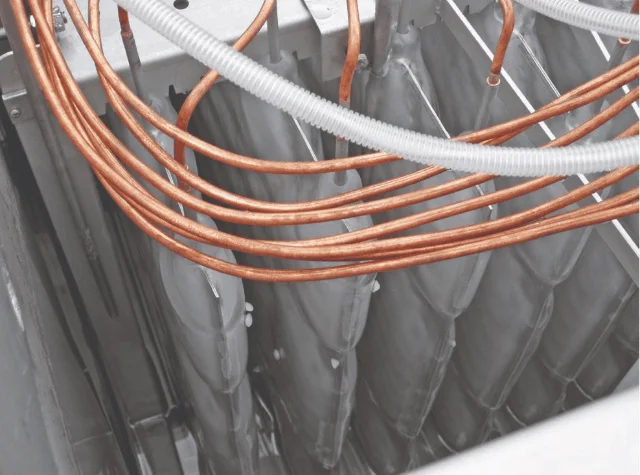
Store cooling capacity as ice during off-peak hours, release it during peak demand — reduce chiller size, cut electricity bills, and buffer variable loads without oversizing the plant.
The Prime Coil Plate Ice Bank is a thermal energy storage system that lets a refrigeration plant do more with less installed capacity. Cooling energy is stored as ice during off-peak electricity hours, then released as chilled water below 0.5°C to meet peak-hour demand — the same principle a battery uses for electricity, applied to refrigeration.
For plants with variable cooling loads — dairies during morning milking, breweries during wort production, food processing lines during shift changeovers — this changes the economics of the entire refrigeration system. You can specify a chiller sized for average load rather than peak, run it at high efficiency around the clock, and let the ice bank absorb the demand spikes. The result: lower capital cost, lower electricity bills, and a more predictable operation.
Every Prime Coil Plate Ice Bank is built around laser-welded stainless steel pillow plates submerged in a stainless water tank. During charging, refrigerant inside the plates freezes water into a controlled 7–10 mm ice layer on the plate face. During discharge, warm process water flows through the tank, melts the ice, and exits as consistent chilled water. Ice thickness is monitored automatically so the system never over-freezes or leaves capacity on the table.
Built to run, season after season.
Load shifting to off-peak hours
Build ice at night when electricity tariffs are lowest, use it during the day when both power costs and cooling demand peak. On sites with time-of-day tariffs, this alone can cut annual refrigeration electricity spend by 25-40%.
Right-size your refrigeration plant
Instead of installing a chiller for peak load, install one sized for average load — and let the ice bank absorb the spikes. Smaller chiller means lower capital, lower connected load, and lower ongoing maintenance.
Consistent 0.5°C chilled water
Melting ice delivers stable output temperature regardless of upstream fluctuations. The physics of latent heat means the water leaving the tank stays close to 0°C until the last of the ice is gone — no capacity dropout as load ramps.
SS pillow plates, laser welded
Vertically arranged stainless steel plates provide the exchange surface. In-house laser welding means thin plates that transfer heat quickly during both charge (freezing) and discharge (melting) cycles.
Automated ice thickness control
An ice-thickness sensor tells the chiller when to stop charging — typically at 7-10 mm ice layer on each plate. Prevents over-freezing, protects plate structure, and ensures the ice bank is ready for the next discharge cycle.
Full stainless hygienic construction
Entire wetted assembly is stainless steel — plates, tank, distribution headers, structural elements. Food-grade construction ready for dairy, brewing and beverage duty, cleans in place, no gaskets or seals to fail.
Works with any refrigerant
Ammonia (NH₃) is the most common choice for large industrial ice banks; Freon variants and glycol brines also supported. The pillow plate platform is refrigerant-agnostic, so plant integration follows your existing infrastructure.
DX, gravity, or pumped feed
Direct expansion for smaller banks, gravity feed for medium duty, and pumped liquid recirculation for large installations. Our engineers select the feed method to match your chiller and control logic.
Negligible maintenance
No moving parts inside the tank. Occasional water quality check and visual inspection of the plate condition — that's the routine. Annual downtime for the ice bank itself is essentially zero.
Specifications
| Storage capacity | 500 kWh to 10,000+ kWh, custom sized |
|---|---|
| Chilled water output | 0.5°C stable during discharge |
| Ice thickness (charged) | 7–10 mm typical on plate face |
| Plate material | SS-304 standard, SS-316 for aggressive media |
| Tank material | Stainless steel |
| Welding | Laser welded pillow plates, in-house |
| Refrigerants | Ammonia (R-717), Freon (HFC), Glycol |
| Feed methods | DX, gravity, or pumped recirculation |
| Charging cycle | Typically 8-12 hours (off-peak) |
| Discharge cycle | Sized to your peak load profile |
| Ice control | Automated sensor + PLC valve station |
| Storage mode | Full storage or partial storage (hybrid) |
| Tank configuration | Rectangular or cylindrical, application dependent |
| Insulation | Polyurethane foam, food-grade cladding |
| Access | Top hatches for plate inspection |
| Testing | 100% pressure tested before dispatch |
Where it's used.
- Dairy processing plants
- Milk cooling & storage
- Thermal storage systems
- Food processing
- Ice cream production
- Brewing & beverage
- Cheese making
- Bakery cooling
- Peak-load buffering
- HVAC thermal storage
Product questions, answered.
How much does an ice bank actually save on electricity?
Depends on your tariff structure. On sites with time-of-day pricing, the difference between night and day rates is often ₹3–5 per kWh. For a plant using 5,000 kWh/day for refrigeration, shifting 60-70% of that to off-peak saves ₹3-4 lakh per month or ₹40-50 lakh per year. Payback on ice bank capital is typically 2-4 years on continuous-duty plants.
What's the difference between full storage and partial storage?
Full storage builds enough ice overnight to handle the entire next-day cooling demand — the chiller doesn't run at all during peak hours. Requires larger chiller and tank. Partial storage runs a smaller chiller during peak hours and lets the ice bank supplement the shortfall — smaller capital, less flexibility. We help you pick based on your tariff spread and load profile.
How is the ice layer controlled?
An ice-thickness sensor mounted between two plates detects when the ice reaches the target thickness (typically 7-10 mm). It signals the PLC to close the refrigerant liquid supply and stop charging. During discharge, warm water melts the ice from the outside inward until the sensor is exposed again — that triggers the next charging cycle.
Is the ice bank compatible with my existing chiller?
In most cases yes — Prime Coil ice banks work with any ammonia, Freon or glycol chiller of appropriate capacity. Integration is typically at the plant PLC level with day/night mode switching. We supply the ice bank package, distribution headers and controls; your existing refrigeration equipment provides the cooling.
Can I retrofit an ice bank to an existing plant?
Yes — this is one of the most common installations we do. If your current chiller is running near capacity during peak hours and you don't want to add another chiller, retrofitting an ice bank lets you use the existing chiller during off-peak hours to build storage. Total plant capacity effectively increases without any new chiller purchase.
What's typical footprint and site preparation?
A 2,000 kWh ice bank sits on roughly 15-20 m² of ground area with 3-4 m headroom. Foundation is a level concrete pad rated for the filled tank weight (typically 20-40 tonnes for medium capacities). Plumbing connections at the top; electrical supply for the PLC and sensor. We provide full foundation and connection drawings during engineering.
How long does an ice bank last in service?
The pillow plate assembly and stainless tank have design lives of 20+ years. The plates never see wear — no gaskets, no seals, no moving parts inside the tank. The PLC controls and ice sensor may need replacement or firmware updates every 8-10 years, and the insulation cladding on the tank exterior lasts 15+ years. It's genuinely long-life equipment.
Environmentally, is off-peak power cleaner?
In most Indian grids, off-peak power has a higher share of baseload thermal generation, so the environmental case depends on your specific location. However, ice banks pair well with rooftop solar — build ice during peak solar hours (which often overlap with off-peak grid tariff windows), use it after sunset. This combination cuts both electricity bills and carbon footprint significantly.
Every plate ice bank we supply is engineered to your specific tariff structure and load profile — because the payback maths only works when the sizing is right. Send us your numbers and we'll come back with the ice storage capacity, chiller sizing, and full life-cycle cost analysis in one working day.


Tell us your daily requirement.
Share your output target, product and ambient conditions — we'll specify the machine and the plant around it.