
Pressure Vessel Dish Ends — Torispherical, Ellipsoidal, Hemispherical
Complete range of pressure vessel dish ends — precision-formed to IS 4049, ASME, and DIN standards. Carbon steel, low-temperature, and stainless grades across all standard sizes.
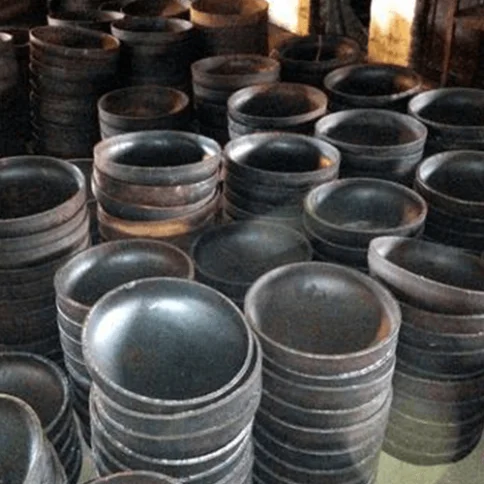
Complete range of pressure vessel dish ends — precision-formed to IS 4049, ASME, and DIN standards. Carbon steel, low-temperature, and stainless grades across all standard sizes.
Prime Coil manufactures pressure vessel dish ends across the full range of standard shapes and sizes used in industrial fabrication — torispherical (F&D), ellipsoidal (2:1), hemispherical, and flat covers — for pressure vessels, storage tanks, heat exchangers, and process equipment. Our pressure vessel dish ends are supplied both as components to other fabricators building custom vessels and as internal supply for our own refrigeration equipment production.
Complete range of standard dish end shapes
Every pressure vessel dish ends order gets the right shape for the duty, not just what happens to be in stock. We manufacture:
- Torispherical (Flanged & Dished / F&D) — the most common and economical shape for pressure vessels up to about 15 bar working pressure. Combines a spherical crown with a toroidal knuckle and a short cylindrical straight flange for welding. Ideal for storage tanks, refrigeration vessels, and general pressure equipment.
- Ellipsoidal (2:1) — semi-elliptical profile with a 2:1 major-to-minor axis ratio. Higher pressure capacity than torispherical at the same thickness, more compact overall height. Standard choice for higher-pressure vessels above 15 bar.
- Hemispherical — full hemispherical dome, offering the highest pressure capacity per unit thickness of any dished end shape. Used for very high-pressure vessels, cryogenic equipment, and applications where minimum wall thickness is critical.
- Flat covers — flat plate ends with bolted or welded connections, used for man-way access, atmospheric vessels, or low-pressure duty where dished ends would be unnecessary.
Every pressure vessel dish ends configuration is available in the diameter and thickness combination your vessel design requires.
Hydraulic press capacity for all standard sizes
Our fabrication shop operates hydraulic presses with capacities covering diameters from 100 mm (4″) to 5,000 mm (16′), with plate thicknesses from 3 mm to 100 mm depending on shape and diameter. This capacity range means we can supply pressure vessel dish ends for:
- Small instrument vessels and refrigeration receivers
- Medium-scale process equipment and heat exchangers
- Large industrial storage tanks and reactor vessels
- Boiler drums and steam accumulators
For sizes above our standard press capacity, dish ends are supplied as segmented components for site welding, with matching detail drawings.
Material grades — carbon, low-temperature, stainless
Pressure vessel dish ends supplied by Prime Coil are available across all common industrial pressure vessel materials:
- Carbon steel — SA-516 Gr 70, SA-283 Gr C, IS 2062 for standard duty
- Low-temperature carbon steel — SA-333 Gr 6, SA-350 LF2 with Charpy impact-tested materials for cold-side and cold-climate applications
- Austenitic stainless steel — SS-304, SS-304L, SS-316, SS-316L for corrosive service, food-grade duty, and hygienic applications
- Duplex stainless steel — SAF 2205, SAF 2507 for chloride environments and marine applications
- Nickel alloys — Inconel, Monel, Hastelloy on request for aggressive chemical duty
Material test certificates (mill certificates traceable to heat number) supplied with every batch.
Precision forming, high accuracy, consistent quality
Pressure vessel dish ends must meet strict dimensional tolerances — spherical radius, knuckle radius, straight flange length, and overall depth — to fit correctly onto the vessel shell during final assembly. Our hydraulic pressing operations are qualified to:
- Cold forming for thinner plates and less critical materials
- Hot forming for thick plates, low-temperature steels, and materials requiring post-forming heat treatment
- Multi-stage pressing for large diameters and complex profiles
Every finished dish end is dimensionally inspected against IS 4049, ASME, DIN 28011 (torispherical), and DIN 28013 (ellipsoidal) tolerance standards. Templates and gauges verify spherical radius, knuckle radius, and diameter at each production stage.
Design code compliance
Pressure vessel dish ends supplied by Prime Coil comply with:
- ASME Section VIII Division 1 (pressure vessel code)
- IS 4049 (Indian dished end standard)
- DIN 28011 (torispherical) and DIN 28013 (ellipsoidal) standards
- PED 2014/68/EU (European Pressure Equipment Directive)
Third-party inspection by Lloyd’s Register, TÜV, DNV, or SGS is available on request. Every batch ships with documentation: material test certificates, dimensional inspection reports, and (where specified) radiography or ultrasonic testing reports.
Built to run, season after season.
Complete shape range
Torispherical (F&D), ellipsoidal (2:1), hemispherical, and flat covers — every standard shape used in industrial pressure vessel design. Right shape for the duty, not just what's available in stock.
100 mm to 5,000 mm diameter
Hydraulic press capacity covers small instrument vessels through large industrial storage tanks. Above 5,000 mm supplied as segmented components with matching detail drawings for site welding.
All industrial materials
Carbon steel (SA-516 Gr 70), low-temperature carbon steel (SA-333 Gr 6), austenitic stainless (SS-304, SS-316), duplex stainless (SAF 2205, SAF 2507), and nickel alloys (Inconel, Monel, Hastelloy) on request.
Precision forming operations
Cold forming for thinner plates; hot forming for thick sections and low-temperature steels. Multi-stage pressing for large diameters. Dimensional accuracy verified with templates and gauges at each production stage.
IS 4049, ASME, DIN compliance
Every dish end formed and inspected to international standards — IS 4049 (Indian), ASME Section VIII Div 1 (American), DIN 28011 torispherical and DIN 28013 ellipsoidal (European). Consistent tolerance across all deliveries.
Post-forming heat treatment available
Stress relieving, normalizing, and quench-and-temper heat treatments available for materials that require post-forming treatment to restore mechanical properties. Critical for thick sections and low-temperature steel applications.
Complete documentation package
Every batch ships with material test certificates (mill certs traceable to heat number), dimensional inspection reports, and where specified, radiography or ultrasonic testing reports. Meets audit requirements for pressure vessel manufacturing.
Third-party inspection ready
Lloyd's Register, TÜV, DNV, SGS inspection available on request. Common for export orders and projects with statutory certification requirements. Inspection stages coordinated during production so delivery is not delayed.
Bulk supply capability
Production capacity handles orders from single dish ends to bulk supply for OEM production runs. Consistent quality across large volumes because forming operations are gauge-verified at each stage rather than sample-inspected at completion.
Specifications
| Shape range | Torispherical, Ellipsoidal (2:1), Hemispherical, Flat |
|---|---|
| Diameter range | 100 mm to 5,000 mm (larger segmented) |
| Plate thickness | 3 mm to 100 mm (shape and diameter dependent) |
| Material — carbon steel | SA-516 Gr 70, SA-283 Gr C, IS 2062 |
| Material — LT carbon steel | SA-333 Gr 6, SA-350 LF2 (impact tested) |
| Material — stainless | SS-304, SS-304L, SS-316, SS-316L |
| Material — duplex | SAF 2205, SAF 2507 |
| Material — alloys | Inconel, Monel, Hastelloy on request |
| Forming — cold | Thinner plates, standard materials |
| Forming — hot | Thick sections, low-temp steels |
| Standard compliance | IS 4049, ASME VIII Div 1, DIN 28011/28013 |
| Post-form heat treatment | Stress relief, normalizing, Q&T available |
| Dimensional tolerance | Per IS 4049 / ASME / DIN |
| NDT — RT / UT | Available per project spec |
| Documentation | MTC, dimensional report, NDT reports |
| Third-party inspection | Lloyd's, TÜV, DNV, SGS on request |
| Temperature range | -50°C to +400°C (material dependent) |
Where it's used.
- Pressure vessel fabrication
- Storage tank construction
- Heat exchanger manufacturing
- Boiler & steam drum production
- Refrigeration receiver fabrication
- Reactor vessel construction
- Process equipment OEM supply
- Repair & replacement market
- EPC contractor site fabrication
- Custom vessel projects
Product questions, answered.
Which dish end shape should I use for my pressure vessel?
Depends on your design pressure. For working pressures up to 15 bar, torispherical (F&D) is the most economical and widely used shape. Above 15 bar, ellipsoidal (2:1) offers higher pressure capacity at the same thickness. For very high-pressure vessels or where minimum thickness matters, hemispherical is the strongest shape. Flat covers are used for atmospheric vessels or man-way access only. Our engineers help select based on your design conditions.
Can you supply dish ends to my drawings?
Yes — this is our primary business model for pressure vessel dish ends. Send us your drawings with dimensions, material specification, and applicable code, and we fabricate to exact requirements. For standard shapes we work from tabulated dimensions per IS 4049, ASME, or DIN standards. For custom profiles, we prepare production drawings for your approval before forming.
What's your typical lead time for pressure vessel dish ends?
Standard sizes in common materials ship in 3-4 weeks from order confirmation. Larger diameters, thicker sections, or specialty materials (duplex, alloy) run 5-6 weeks due to material procurement and forming complexity. Bulk orders and repeat production have shorter lead times because material is pre-planned. Discuss your project schedule during quotation.
Do dish ends require post-forming heat treatment?
Depends on material and forming method. Thin carbon steel cold-formed dish ends typically don't require heat treatment. Thick sections, hot-formed pieces, low-temperature steels, and many stainless grades benefit from stress relieving, normalizing, or quench-and-temper treatment to restore mechanical properties. We advise on treatment requirements during quotation based on your material and code requirements.
What certifications and documentation are included?
Standard supply includes material test certificates (mill certificates traceable to heat number), dimensional inspection reports verifying shape and tolerances, and welding procedure records if any welding is involved. NDT reports (radiography, ultrasonic testing) supplied where the project spec requires them. PESO and IBR certification available for regulated applications; third-party inspection by Lloyd's, TÜV, DNV, or SGS on request.
Can you supply dish ends larger than your press capacity?
Yes — for diameters beyond our single-piece press capacity (approximately 5,000 mm), we supply dish ends as segmented components. Each segment is formed individually to matching tolerances, then supplied with detailed weld preparation and fit-up drawings for on-site assembly by your fabrication team. This approach is standard for very large storage tanks and process vessels.
Do you machine the weld edges on dish ends?
Yes — edge preparation for welding is included in standard supply. Straight flange length, weld bevel angle, root face, and root gap are machined to match your vessel design and welding procedure. Send us your weld joint detail with the order; we prepare edges accordingly. This eliminates fit-up delays during vessel assembly.
Are dish ends available for stainless steel and alloy vessels?
Yes — we regularly form dish ends in SS-304, SS-304L, SS-316, SS-316L for food-grade and hygienic applications, duplex stainless (SAF 2205, SAF 2507) for chloride environments, and nickel alloys (Inconel, Monel, Hastelloy) for aggressive chemical duty. Material availability varies by grade; we confirm lead time during quotation based on current mill stock.
Capacities & model codes
Torispherical (F&D) Dish Ends
The most common shape for industrial pressure vessels up to 15 bar working pressure. Spherical crown with toroidal knuckle transitions into a short cylindrical straight flange for welding to the vessel shell. Standard choice for storage tanks, refrigeration vessels, and general pressure equipment.
- Crown radius = vessel diameter (typical)
- Knuckle radius = 6% of vessel diameter (typical)
- Formed to IS 4049 / DIN 28011 tolerances
- 100 mm to 5,000 mm diameter range
- Cold or hot formed depending on thickness
Ellipsoidal (2:1) Dish Ends
Semi-elliptical profile with 2:1 major-to-minor axis ratio. Higher pressure capacity than torispherical at the same wall thickness, more compact overall height. Standard choice for higher-pressure vessels above 15 bar or where vessel height needs to be minimised.
- 2:1 semi-ellipse geometry
- Higher pressure rating than torispherical
- Formed to ASME / DIN 28013 tolerances
- 100 mm to 5,000 mm diameter range
- Hot forming for thicker sections
Hemispherical Dish Ends
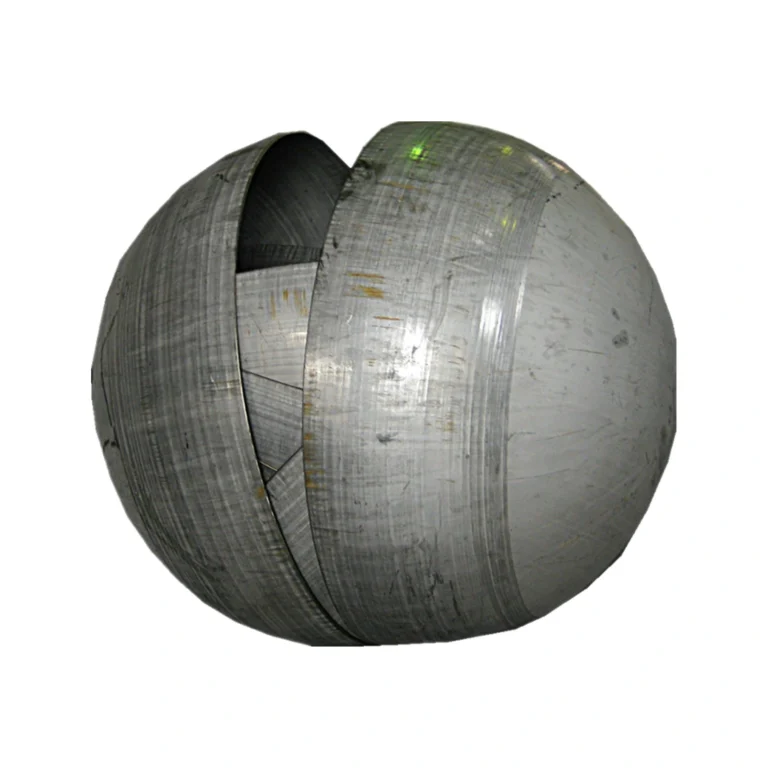
Full hemispherical dome — the highest pressure capacity of any dished end shape. Standard for very high-pressure vessels, cryogenic equipment, and applications where minimum wall thickness is critical to weight or material cost. Requires precision forming due to deep draw ratio.
- Full hemisphere, uniform curvature
- Highest pressure rating per unit thickness
- Hot forming required for most sizes
- Multi-stage pressing for large diameters
- Post-forming heat treatment typical
Flat Covers
Flat plate ends with bolted flange or welded connections. Used for man-way access, atmospheric vessels, or low-pressure duty where dished ends would be unnecessary. Supplied as flat plates or with reinforcement ribs based on application.
- Flat plate construction with edge preparation
- Bolted flange or welded configurations
- Man-way access and atmospheric vessels
- Reinforcement ribs available for larger sizes
- Machined face for gasket sealing on bolted types


Tell us your daily requirement.
Share your output target, product and ambient conditions — we'll specify the machine and the plant around it.