
Liquid Ammonia Pump — Hermetic Sealless Design
Sealless hermetic canned motor pump for liquid ammonia recirculation — no shaft seal, no external lubrication, no leakage. Engineered for years of continuous industrial duty.
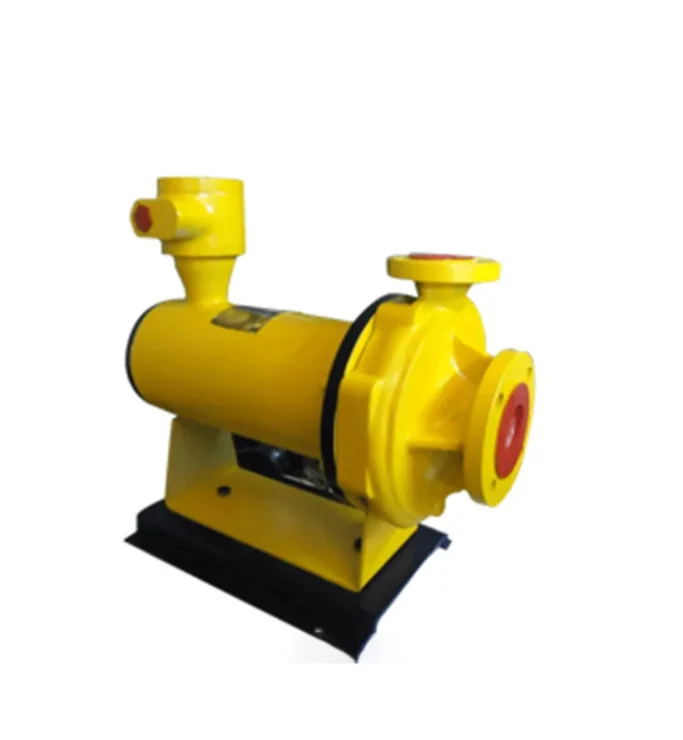
Sealless hermetic canned motor pump for liquid ammonia recirculation — no shaft seal, no external lubrication, no leakage. Engineered for years of continuous industrial duty.
The Prime Coil liquid ammonia pump is a hermetic, sealless canned motor pump engineered specifically for industrial ammonia refrigeration duty. Every liquid ammonia pump we supply is designed to run leak-free and trouble-free for years — the essential characteristic for the heart of any overfeed refrigeration system.
Why a hermetic liquid ammonia pump is the industry standard
In an ammonia refrigeration plant, the liquid ammonia pump is not an accessory — it is the component that makes the entire overfeed circulation architecture possible. Overfeed systems deliver 3 to 6 times more liquid ammonia to the evaporators than actually vaporises, which drastically improves heat transfer, eliminates oil accumulation in evaporator coils, and protects the compressors from liquid slugging. That approach requires a pump that can run continuously in an ammonia environment without ever leaking.
A conventional pump with a mechanical shaft seal or gland packing would leak ammonia within weeks, if not days. The consequences would range from air ingress (killing plant efficiency) to catastrophic release (killing the plant, and potentially people). Hermetic liquid ammonia pump technology eliminates that risk entirely by removing every dynamic seal from the design.
The engineering — how the sealless design works
Every Prime Coil liquid ammonia pump combines a centrifugal pump and a 3-phase AC motor into a single unit. The rotor of the motor sits on the same shaft as the pump impeller — mechanical connection eliminated. Around the rotor is a hermetically sealed can (a thin-walled stainless steel liner) that isolates the rotor chamber from the stator windings outside. Liquid ammonia flows into the rotor chamber, circulates around the motor, and returns to the pump discharge — cooling and lubricating the motor bearings in the same continuous flow.
There is no shaft that penetrates the pump casing to the outside atmosphere. There is no mechanical seal that can wear out or leak. There is no gland packing that requires periodic adjustment. The pump is genuinely hermetic — ammonia stays inside, atmosphere stays outside.
Key design characteristics
The liquid ammonia pump we supply is defined by six critical design features:
- No leakage design — handles toxic, explosive, hazardous fluids without leaking. Critical for ammonia safety compliance and PESO approvals.
- Airtight construction — suitable for vacuum service or fluids that react with air. Ammonia in a vacuum environment stays uncontaminated by moisture.
- No shaft seal — no mechanical seal, no gland packing, no dynamic sealing element to wear or fail.
- No external lubrication — the pumped fluid itself cools and lubricates motor bearings. No oil, no grease, no separate lube system to maintain.
- Compact design — motor and pump are one integrated unit. No coupling, no alignment work, no elaborate foundation required.
- Available motor ratings — 2, 3, 5, 7.5, and 10 HP standard, with higher ratings on request for larger plants.
Standard motor ratings and duty range
Our liquid ammonia pump range covers the standard duties in industrial ammonia refrigeration:
- 2 HP — small refrigeration plants, evaporator cluster feed, backup pump
- 3 HP — medium cold storage plants, single evaporator battery
- 5 HP — larger cold storage installations, ice manufacturing plants
- 7.5 HP — high-capacity food processing plants, dairy refrigeration
- 10 HP — turnkey plant primary pump, large industrial installations
Larger HP ratings available on request for plants beyond the standard range.
Materials for ammonia service
Every liquid ammonia pump is built from materials selected specifically for R-717 (ammonia) compatibility:
- Pump casing — Ductile iron for standard duty, cast steel for high-pressure applications
- Stator can — Stainless steel to isolate the motor windings from the ammonia
- Shaft — Chrome steel with corrosion-resistant treatment
- Impeller — Cast iron or stainless steel per duty
- Bearings — Composite material bearings with 10x the service life of conventional graphite bearings
All materials rated for ammonia service at operating temperatures across the industrial refrigeration range.
Applications and typical installations
The Prime Coil liquid ammonia pump is used across all common industrial refrigeration architectures — liquid overfeed circulation, refrigerant transfer between vessels, pressure boost duties, and defrost condensate return. Standard installations include cold storage plant rooms, ice manufacturing plants, food and dairy processing facilities, and turnkey ammonia refrigeration packages where the pump is skid-mounted with the LPR and controls.
Built to run, season after season.
No leakage design
Hermetically sealed construction handles toxic, explosive and hazardous fluids without any leakage to atmosphere. No mechanical shaft seal or gland packing anywhere in the design — the pump is genuinely leak-proof by geometry, not by consumable sealing elements.
Airtight construction
Suitable for vacuum service or fluids that react with atmospheric air. Ammonia in a vacuum or partially-evacuated environment stays uncontaminated by moisture ingress — critical for freeze-up protection in cold-side vessels.
No shaft seal, no gland packing
The motor rotor is on the same shaft as the pump impeller — no shaft penetrates the pressure boundary to the outside atmosphere. Eliminates the most common failure point of conventional refrigeration pumps.
No external lubrication required
The pumped ammonia itself circulates around the motor rotor and bearings, providing both cooling and lubrication in one continuous flow. No oil reservoir, no grease points, no separate lubrication system to maintain — genuinely maintenance-free.
Compact integrated design
Motor and pump are one integrated unit. No shaft coupling, no alignment work, no separate motor mounting, no elaborate concrete foundation. Fits into plant rooms where a conventional pump-motor set would not.
Standard HP ratings — 2 to 10 HP
Available in 2, 3, 5, 7.5, and 10 HP motor ratings covering the full range of typical industrial refrigeration duties. Higher HP ratings available on request for larger plants. Standardisation means predictable performance, availability of spares, and easier engineering.
Materials rated for ammonia service
Ductile iron casing, stainless steel stator can, chrome steel shaft, composite bearings with 10x the life of conventional graphite bearings. Every material chosen specifically for long service life in ammonia (R-717) at industrial refrigeration temperatures.
Smooth and quiet operation
The integrated motor-pump design has no coupling misalignment vibration and no shaft seal friction. Runs significantly quieter than conventional pumps — suitable for plant rooms adjacent to processing areas or noise-sensitive zones.
Years of trouble-free operation
With no dynamic seals, no external lubrication, and no coupling alignment to maintain, the pump routinely delivers 10-15 years of continuous operation before major service. The economics of hermetic pumps favour lifecycle cost, not just capital cost.
Specifications
| Type | Hermetic canned motor centrifugal pump |
|---|---|
| Design | Sealless, integrated motor-pump |
| Motor ratings | 2, 3, 5, 7.5, 10 HP standard |
| Higher HP | Available on request |
| Refrigerants | Ammonia (R-717), CO₂, Freon variants |
| Casing material | Ductile iron A356 (standard) |
| Stator can | Stainless steel |
| Shaft | Chrome steel |
| Impeller | Cast iron / stainless steel |
| Bearings | Composite (FH82A or equivalent) |
| Suction connection | Flanged |
| Discharge connection | Flanged |
| Mounting | Horizontal, foot-mounted |
| Cooling | Pumped fluid (self-cooled) |
| Lubrication | Pumped fluid (no external lube) |
| Power supply | 3-phase, 415V, 50 Hz standard |
| Motor protection | IP55 as standard, higher on request |
| Certifications | ISI / IEC compliance |
Where it's used.
- Cold storages
- Dairies
- IQF systems
- Blast freezers
- Ice cream plants
- Refineries & chemical
- Industrial refrigeration
- Liquid overfeed circulation
- Refrigerant transfer duty
- Pressure boost applications
Product questions, answered.
What's the difference between a hermetic liquid ammonia pump and a conventional refrigeration pump?
A conventional refrigeration pump uses a mechanical shaft seal or gland packing to prevent refrigerant from escaping where the motor shaft enters the pump. That seal wears, requires periodic replacement, and can leak refrigerant during operation — a serious safety concern with ammonia. A hermetic pump integrates the motor and pump into one sealed unit — the motor rotor sits inside the pump casing, cooled and lubricated by the pumped fluid, with no shaft penetrating to the atmosphere. Zero leakage risk, no seal maintenance, and significantly longer service life.
How do I select the right HP rating for my plant?
Selection depends on your evaporator overfeed ratio, total evaporator refrigeration duty, and system head requirements. As a rough guide: 2 HP handles plants up to ~30 TR, 3 HP up to 50 TR, 5 HP up to 100 TR, 7.5 HP up to 200 TR, and 10 HP up to 300+ TR at typical overfeed ratios of 3:1 to 4:1. Send us your evaporator load, overfeed ratio and plant layout and we'll size the pump correctly — undersized pumps starve evaporators, oversized pumps waste electricity.
Does the pump need any external lubrication or cooling system?
No — this is one of the biggest operational advantages of the hermetic design. The pumped liquid ammonia itself flows around the motor rotor and bearings, providing both cooling for the motor and lubrication for the bearings. No oil reservoir, no grease points, no cooling water system for the motor. Once installed, the pump runs indefinitely without any lubrication or cooling intervention.
What happens if the pump loses suction (runs dry)?
Running any centrifugal pump dry is bad practice, but hermetic pumps have specific vulnerabilities — the motor loses its cooling and lubrication simultaneously, and can overheat within minutes. Standard installation includes suction line liquid level protection (typically a low-level cutout in the LPR) that shuts the pump down before liquid supply is lost. We supply installation guidance for these critical protections with every pump.
Can I use the pump for CO₂ or Freon service instead of ammonia?
Yes — the same hermetic canned motor design works for CO₂ (R-744) and various HFC/HFO refrigerants. Materials selection may vary (some Freon variants require different bearing materials), and motor size for the same flow may differ due to fluid density and viscosity differences. Specify your refrigerant during enquiry so we supply the correct configuration.
What's the expected service life?
Under normal industrial operation with proper installation protections in place, our hermetic liquid ammonia pumps routinely deliver 10-15 years of continuous service before major overhaul. Bearings are typically the first component to require attention. The absence of mechanical seals — the primary failure point of conventional pumps — is what makes this long life possible.
How is the pump installed? Any special requirements?
Installation is straightforward — no shaft alignment required, no elaborate foundation needed. The pump mounts horizontally on a flat concrete pad or steel skid base. Standard connections are flanged suction and discharge. Critical requirements: suction line must be flooded with liquid (never allow air ingress), suction piping must be free-draining from the LPR, and low-level protection must be wired to the motor starter to prevent dry-running.
What certifications and documentation ship with the pump?
Every pump ships with performance test certificate (flow, head, and power draw at standard conditions), motor test certificate (electrical parameters, insulation resistance), material certificates for casing and stator can, pressure test certificate (hydrostatic test of the pressure boundary), and complete installation and operation manual. Additional third-party certifications available on request for regulated applications.
Every liquid ammonia pump we ship is performance-tested at our works before dispatch. When you need a pump that runs leak-free for a decade in an ammonia environment, hermetic sealless is the only technology that delivers.
Tell us your daily requirement.
Share your output target, product and ambient conditions — we'll specify the machine and the plant around it.