
Ammonia Shell & Tube Condenser — Water-Cooled
High-performance water-cooled heat exchangers for industrial ammonia refrigeration — reliable heat transfer with easy cleaning, long service life, and low running cost where cooling water is available.
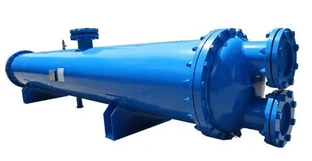
High-performance water-cooled heat exchangers for industrial ammonia refrigeration — reliable heat transfer with easy cleaning, long service life, and low running cost where cooling water is available.
The Prime Coil ammonia shell tube condenser is a high-efficiency water-cooled heat exchanger engineered for continuous industrial refrigeration duty. Every ammonia shell tube condenser we manufacture is designed for maximum heat transfer efficiency, long service life, and easy maintenance access — built from high-quality shells, precision tube sheets, and seamless tubes to international pressure vessel standards.
Why the ammonia shell tube condenser remains an industry standard
For sites with reliable cooling water supply — plants near rivers, canals, or process water sources, or facilities with dedicated cooling towers — an ammonia shell tube condenser delivers superior efficiency at lower capital cost than any alternative technology. The closed-loop water circulation avoids the evaporative losses of open-loop condensers, allows precise control of condensing temperature, and simplifies condenser control philosophy at the compressor.
The physics is straightforward: hot ammonia vapour from the compressor discharge enters the shell side of the condenser, flowing across a bundle of cooling tubes. Cooling water flows through the tubes in the opposite direction, absorbing heat from the ammonia and carrying it away to a cooling tower or process cooling loop. The ammonia condenses on the outer tube surfaces, drops to the bottom of the shell, and exits as high-pressure liquid ready for the expansion side of the refrigeration circuit.
Multiple pass designs — 2, 4, 6 & 8 pass configurations
Every ammonia shell tube condenser is available in multiple pass configurations to match your specific cooling water flow and temperature requirements. Baffles in the water heads route the cooling water through the tube bundle in 2, 4, 6, or 8 passes — increasing water velocity, boosting heat transfer coefficient, and allowing the same total heat rejection with a compact tube bundle.
2-pass configurations suit high cooling water flow rate with low temperature rise — typical for river water or cold ambient plants.
4-pass and 6-pass are the most common for standard cooling tower water supply, balancing water velocity against pressure drop.
8-pass designs are used for lowest water flow rate applications where water is expensive or supply-limited.
Our engineers select the correct pass arrangement during quotation based on your available water supply.
Capacity range from 5 TR to 400 TR+
Our ammonia shell tube condenser range covers the standard duties in industrial refrigeration — from small cold storage plants at 5 TR through large ice manufacturing and food processing facilities exceeding 400 TR. Above 400 TR single-unit capacity, parallel installations of multiple condensers or custom-engineered large-format units serve the requirement.
Materials engineered for ammonia service
Every ammonia shell tube condenser is built from materials selected specifically for R-717 (ammonia) service:
- Shell material — carbon steel for standard duty, with material specifications matched to your design pressure and temperature requirement
- Tube material — carbon steel tubes as the industry standard for ammonia-water service, or stainless steel (SS-304 or SS-316) for enhanced corrosion resistance or when water quality is aggressive
- Tube sheets — precision-drilled carbon steel or stainless steel matching the tube material
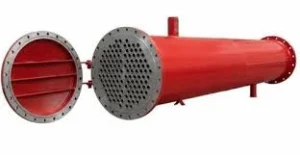
- Water heads — cast iron or fabricated carbon steel with removable end covers for tube bundle access
Material grades and thicknesses are calculated per ASME Section VIII Division 1 or IS 2825 with full material traceability from mill certificate to final assembly.
Easy cleaning and maintenance
Industrial cooling water is rarely clean — dissolved solids, biological growth, and suspended particles gradually foul tube interiors and reduce heat transfer. Prime Coil ammonia shell tube condenser designs anticipate this reality with removable water head covers, straight tube configurations for direct rod cleaning, and adequate tube spacing to allow standard tube brushes. Routine maintenance requires no special tools — the same cleaning procedure used across the industry works on Prime Coil condensers.
Factory tested for leak-proof performance
Every ammonia shell tube condenser is 100% hydrostatically tested at 1.5x design pressure before dispatch — on both shell side (ammonia) and tube side (water) independently. Pneumatic leak testing on tube-to-tubesheet joints confirms zero cross-contamination potential. Test certificates and radiography reports ship with every unit.
Built to run, season after season.
Capacity range 5 TR to 400 TR+
Full range from small cold storage plants to large industrial installations. Above 400 TR single-unit capacity, parallel installations or custom-engineered large-format units are supplied. Standardised sizing means predictable performance and consistent spare parts.
Horizontal shell-and-tube construction
The industry workhorse for water-cooled refrigeration duty — proven across decades of continuous industrial service. Horizontal orientation simplifies tube bundle access and provides better internal drainage of condensed liquid ammonia.
Multiple pass designs (2, 4, 6, 8 pass)
Water head baffles route cooling water through the tube bundle in 2, 4, 6, or 8 passes — increasing water velocity, boosting heat transfer coefficient, and matching the pass arrangement to your specific cooling water supply constraints.
Carbon steel or stainless steel tubes
Carbon steel tubes as industry standard for typical ammonia-water service; stainless steel (SS-304 or SS-316) for enhanced corrosion resistance where water quality is aggressive or seawater duty is required. Tube material selected during quotation based on your water conditions.
Water, brine, and glycol cooling compatible
Same equipment platform works with plain cooling tower water, brine solutions for below-ambient cooling, and glycol mixtures for freeze protection in cold-climate plants. Material selection ensures long service life across all common cooling media.
Optimized heat transfer performance
Tube spacing, baffle configuration, and pass arrangement optimised for maximum heat transfer efficiency per unit shell volume. Counter-flow water routing extracts the maximum thermal duty from the available cooling water — delivering lowest achievable condensing pressure.
Easy cleaning and maintenance
Removable water head covers, straight tube configurations, and adequate tube spacing allow standard tube brushes and cleaning rods. Routine descaling and cleaning uses common industry tools — no proprietary equipment required, no long shutdowns.
Robust industrial construction
Shell and dished ends from certified pressure vessel plate, longitudinal and circumferential welds executed to WPS/PQR-approved procedures, and precision tube-to-tubesheet joints. Built for 20+ years of continuous industrial service.
Factory tested for reliability
100% hydrostatic testing at 1.5x design pressure on both shell and tube sides independently. Pneumatic leak testing on tube-to-tubesheet joints confirms zero cross-contamination potential. Full test certificates ship with every unit.
Specifications
| Type | Horizontal shell-and-tube water-cooled condenser |
|---|---|
| Heat rejection capacity | 5 TR to 400 TR+ per unit |
| Shell material | Carbon steel per ASME / IS 2825 |
| Tube material | Carbon steel or SS-304 / SS-316 |
| Tube diameter | 15 mm to 25 mm typical |
| Pass configurations | 2, 4, 6, or 8 pass |
| Tube arrangement | Triangular or square pitch |
| Baffles | Segmental, application-optimised |
| Design pressure — shell | 25 bar typical |
| Design pressure — tube | 10 bar typical (higher on request) |
| Design temperature | -20°C to +150°C |
| Cooling media | Water, brine, glycol |
| Design code | ASME Section VIII Div 1 / IS 2825 |
| Hydraulic test | 1.5x design pressure, 100% units |
| Tube-tubesheet joint | Expanded or expanded + welded |
| Water heads | Removable for tube bundle access |
| Certifications | PESO, IBR, third-party on request |
Where it's used.
- Cold storages
- Food processing plants
- Dairy industries
- Ice plants
- Breweries & beverage plants
- Chemical & process industries
- Ammonia refrigeration systems
- Pharmaceutical facilities
- Water-cooled refrigeration plants
- Marine refrigeration
Product questions, answered.
Shell tube vs evaporative condenser — which should I choose?
Depends on your cooling water availability. An ammonia shell tube condenser uses a closed-loop water circulation through tubes, requiring a reliable cooling water source (river, canal, cooling tower). It offers lowest running cost and easiest control when water is available. An evaporative condenser uses open water spray + air, evaporating water to reject heat — better suited for water-scarce or high-ambient sites but requires more water treatment. Rule of thumb: shell tube for sites with cooling tower or process water; evaporative for water-scarce plants or where ambient exceeds 35°C regularly.
How do multiple pass designs work?
Baffles inside the water heads (end covers) route cooling water through different sections of the tube bundle sequentially instead of all at once. A 4-pass design divides the tubes into 4 groups; water flows through group 1 in one direction, group 2 in reverse, group 3 forward, group 4 reverse — then exits. This increases water velocity for the same total flow rate, boosting heat transfer coefficient. More passes give higher velocity but also higher water pressure drop. 4-pass and 6-pass are the most common for typical cooling tower supply.
What cooling water flow rate does the condenser need?
Depends on your inlet water temperature, allowable temperature rise, and heat rejection duty. Rule of thumb for typical industrial refrigeration: 3-4 US GPM per TR of heat rejection with 5-8°C water temperature rise. A 100 TR condenser needs 300-400 GPM of cooling water. Our engineers calculate exact requirements during quotation based on your specific operating conditions and available water source.
Which tube material should I choose — carbon or stainless steel?
Depends on your cooling water quality. Carbon steel tubes are the industry standard for typical cooling tower water — clean, treated, and consistent quality. They offer best heat transfer coefficient and lowest capital cost. Stainless steel tubes (SS-304 or SS-316) are recommended for aggressive water quality (high chlorides, low pH, high dissolved solids), seawater cooling, coastal installations, or where extended tube life justifies the additional cost. Duplex stainless available for extreme chloride environments.
How often does the condenser need cleaning?
Depends on cooling water quality and treatment. Typical industrial cooling tower water requires condenser tube cleaning every 6-12 months to remove scale and biological growth. Sites with good water treatment (proper biocide dosing, blowdown control, and chemical treatment) can go 12-18 months between cleanings. Sites with poor water quality may need cleaning every 3-6 months. Our design accommodates whatever your water treatment programme delivers.
Can I retrofit a shell tube condenser to replace an aging air-cooled system?
Yes — replacing air-cooled or evaporative condensers with water-cooled shell tube is a common efficiency upgrade for plants that gain access to a reliable water source. Retrofit reduces condensing temperature significantly (water can be 15-20°C cooler than the design ambient of air-cooled systems), delivering 15-25% lower compressor power draw. Payback typically 2-3 years for continuous-duty plants.
What certifications and documentation ship with the condenser?
Every unit ships with material test certificates (mill certs for shell, tubes, tubesheets), welding procedure records (WPS/PQR), welder qualifications, hydraulic test reports for both shell and tube sides, pneumatic leak test reports for tube-tubesheet joints, and radiography reports where 100% RT was specified. PESO SMPV certification standard for Indian projects. Third-party inspection (Lloyd's, TÜV, DNV, SGS) supplied per project requirement.
What's the typical delivery lead time?
Standard sizes with carbon steel construction ship in 6-8 weeks from order confirmation. Stainless steel tube construction or custom sizes run 8-10 weeks due to material procurement time. Every condenser is fabricated to your project's design pressure, tube material, and pass configuration — we do not stock finished units because ensuring the right specification for your duty requires build-to-order.
Every ammonia shell tube condenser we ship is engineered for your specific cooling water supply and heat rejection duty. Send us the numbers and we'll come back with the correct model, pass arrangement, and tube material — plus expected condensing pressure and compressor energy impact — within one working day.

Tell us your daily requirement.
Share your output target, product and ambient conditions — we'll specify the machine and the plant around it.