
Cold Storage Sliding Door — Single-Leaf, Hermetic Seal
Single-leaf sliding doors for chiller, freezer and blast freezer applications — aluminium extrusion track with 3D movement geometry, four-side rubber sealing gasket, and 45° hermetic seal proven across decades of industrial cold storage service.
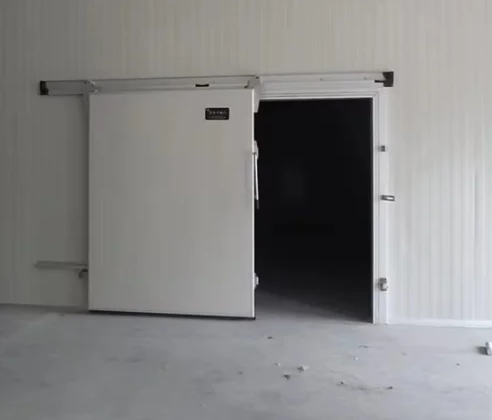
Single-leaf sliding doors for chiller, freezer and blast freezer applications — aluminium extrusion track with 3D movement geometry, four-side rubber sealing gasket, and 45° hermetic seal proven across decades of industrial cold storage service.
The Prime Coil single-leaf cold storage sliding door is engineered for cold room, chiller, freezer and blast freezer applications where reliable insulation, low maintenance, and cost-effective installation matter more than automated operation. Every cold storage sliding door we supply uses an aluminium extrusion overhead track with indentation for 3D door movement — ensuring complete hermetic sealing while closing, and eliminating the temperature drift that comes from poorly-sealed doors.
Why sliding doors are the industry standard for cold storage
Cold storage rooms present a specific engineering challenge — doors that open frequently must open easily, seal hermetically, and last for decades in continuously cold, humid environments where standard hinged doors sag, warp, and gradually stop sealing. Sliding doors solve all three problems:
Easy operation regardless of size. A 2-metre wide hinged door weighs 100+ kilos and requires significant force to open against room pressure differentials — hard on operators and hard on hinges. A sliding door of the same size glides on an overhead track with minimal effort, and can be operated by a single person even at large opening sizes.
Hermetic sealing at close. As the door slides to close, the four-side rubber sealing gasket compresses against the door frame in a specific 3D movement pattern — down and inward — producing a tight hermetic seal that a swing door cannot match. The 45° seal geometry is proven across decades of industrial cold storage service.
Structural stability over years of service. Sliding doors don’t hang from hinges that gradually deform under weight. The door panel is supported entirely by the overhead track, and the seal is compressed only when closed — not stressed continuously. Result: doors that still seal properly 20 years after installation, versus swing doors that need seal replacement every 3-5 years.
Hermetic 45° seal — the industry-proven design
Every cold storage sliding door in our range uses the 45° hermetic seal geometry that has been the industry standard since the 1970s. The seal design works through a specific closing sequence:
- The door slides horizontally on the overhead track toward the frame
- As it approaches the closed position, the track’s indentation profile guides it downward
- The door drops onto the sill seal and simultaneously compresses inward against the frame seals
- The four-side rubber gasket forms a continuous compression seal around the entire opening
This 3D movement pattern — horizontal, downward, inward — is what makes the seal hermetic rather than just physical closure. Standard sliding doors that only move horizontally leave gaps at the top and sides where warm air infiltrates and cold air escapes.
Aluminium extrusion track — quality signals matter
The overhead track is the single most important component of any cold storage sliding door — it carries the entire door weight, guides the closing sequence that produces the hermetic seal, and operates in humid conditions that corrode standard steel tracks within 3-5 years.
Our track is machined from high-quality aluminium extrusion with the indentation profile that produces correct 3D door movement during closing. Aluminium construction offers three critical advantages over cheaper steel tracks:
- Zero corrosion in cold, humid cold storage environments — 20+ year service life
- Precision profile — extrusion production maintains tighter tolerances than fabricated steel tracks, producing consistent seal engagement
- Low friction — smoother operation with less operator effort, less wear on rollers and bearings
Four-side rubber sealing gasket
The seal itself uses food-grade EPDM (ethylene propylene diene monomer) rubber gaskets on all four sides of the door frame — top, bottom, hinge side, and latch side. EPDM is the industry standard for cold storage sealing because it:
- Stays flexible in cold conditions down to -40°C — critical for freezer applications
- Resists compression set — recovers its shape after continuous compression
- Resists moisture and cleaning chemicals typical of food processing environments
- 10+ year seal life with routine visual inspection
The gasket profile is a specific double-lip design that produces both primary seal (initial contact) and secondary seal (backup) — redundancy against dust particles or minor debris that would compromise a single-lip design.
Manual or automatic operation
Standard configuration is manual operation — the operator pulls the door handle to open and close. This is the right choice for cold storage installations with moderate traffic (fewer than 50 opening cycles per day per door) where the capital cost of automation is not justified by operational savings.
Automatic operation is available as an upgrade — an electric motor drive with proximity sensor or push-button activation opens the door automatically when triggered. Automatic operation is worth considering when door traffic exceeds 100 cycles per day, or where hands-free operation is required for food safety or worker efficiency. For dedicated hands-free premium applications, our Automatic Sliding Door product is the better fit — it’s engineered specifically for high-cycle automatic duty.
Built to run, season after season.
Hermetic 45° seal geometry
Industry-standard 45° seal design has been the industrial cold storage benchmark since the 1970s. Door closes with a 3D movement pattern — horizontal, downward, inward — that compresses the sealing gasket against the frame on all four sides for hermetic closure that swing doors cannot match.
Aluminium extrusion overhead track
Track machined from high-quality aluminium extrusion with the indentation profile that produces correct 3D door closure. Aluminium construction provides zero corrosion in humid cold storage environments, precision profile from extrusion tolerances, and low-friction operation — 20+ year service life.
Four-side EPDM rubber gasket
Food-grade EPDM rubber sealing gaskets on all four door edges. EPDM stays flexible down to -40°C for freezer applications, resists compression set, and delivers 10+ year seal life. Double-lip profile provides primary and backup seals for redundancy.
Cooling loss reduction
Four-side hermetic seal reduces cooling loss through door openings by 60-80% compared to poorly-sealed alternatives. On a facility opening doors 100+ times per day, that seal quality translates to significant refrigeration energy savings over the operating year.
PUF-insulated door panel
Door panel filled with polyurethane foam insulation (typically 80-150 mm thickness depending on room temperature). PUF provides thermal isolation, structural rigidity, and dimensional stability — no warping over decades of cold-side operation.
Manual operation standard
Standard configuration is manual — operator pulls the door handle to open and close. Right choice for moderate-traffic installations (under 50 cycles per day per door) where automation capital cost is not justified by operational savings.
Automatic upgrade available
Optional electric motor drive with proximity sensor or push-button activation for hands-free opening. Recommended for door traffic above 100 cycles per day or applications requiring hands-free operation for food safety compliance.
Suitable for all cold storage temperatures
Same platform serves chiller rooms (0°C to +8°C), freezer rooms (-18°C to -25°C), and blast freezer applications (-30°C to -40°C). Insulation thickness and gasket material selected to match room temperature during specification.
20-year service life
Sliding doors don't hang from hinges that gradually deform under weight. The door panel is supported entirely by the overhead track, and the seal is compressed only when closed. Result: doors that still seal properly 20 years after installation.
Specifications
| Type | Single-leaf sliding door with 45° hermetic seal |
|---|---|
| Opening widths | 1,000 mm to 2,400 mm typical |
| Opening heights | 2,000 mm to 3,000 mm typical |
| Panel construction | PUF-insulated with steel skin |
| Panel thickness | 80 mm to 150 mm (temperature dependent) |
| Track material | Aluminium extrusion |
| Track profile | Indented for 3D closing movement |
| Sealing gasket | EPDM rubber, four-side |
| Gasket profile | Double-lip primary + secondary |
| Operating temperature | -40°C to +8°C (variant dependent) |
| Panel skin | Pre-painted galvanised steel |
| Interior finish | Food-grade (stainless steel option) |
| Operation — standard | Manual with handle |
| Operation — optional | Automatic with motor drive |
| Rollers | Precision bearings, stainless steel |
| Insulation | Polyurethane foam (PUF) |
| Service life | 20+ years typical |
| Custom sizes | Available on request |
Where it's used.
- Cold storage warehouses
- Chiller rooms (0°C to +8°C)
- Freezer rooms (-18°C to -25°C)
- Blast freezer applications
- Food processing facilities
- Dairy processing plants
- Meat & poultry storage
- Pharmaceutical cold rooms
- Fruit & vegetable cold rooms
- General industrial cold storage
Product questions, answered.
Why choose sliding over hinged doors for cold storage?
Three reasons. Sliding doors are easier to operate at large opening sizes — a 2-metre hinged door is heavy and hard to open, a 2-metre sliding door glides on its track effortlessly. Sliding doors seal better — the 3D closing movement compresses the gasket in a way swing doors cannot match. And sliding doors last longer — no hinges that deform under weight over years. For any opening wider than about 1.2 metres in cold storage, sliding is the standard choice.
What's the 45° hermetic seal and why does it matter?
The 45° seal refers to the closing geometry — as the door slides horizontally to close, the aluminium track's indentation profile guides it downward and inward simultaneously, so the sealing gasket compresses against the frame at approximately a 45-degree angle rather than just squashing flat. This 3D compression produces a tight, continuous hermetic seal around the entire door opening — critical for maintaining precise cold storage temperature and preventing cooling loss.
Should I choose manual or automatic operation?
Depends on your door traffic. Under 50 cycles per day per door — manual operation is fine and cheaper. Over 100 cycles per day — automation pays back through operator efficiency and reduced door damage from operators pulling hard on stuck doors. Hands-free requirements (food safety, cleanroom operations) require automation regardless of cycle count. Our engineers help decide during specification based on your operational profile.
What size doors can you supply?
Standard opening widths from 1,000 mm to 2,400 mm and heights from 2,000 mm to 3,000 mm. Custom sizes available for larger openings — up to approximately 3,500 mm width and 4,000 mm height in single-leaf configurations. For openings wider than 3,500 mm, our double-leaf sliding doors are the better choice. Send us your opening dimensions during quotation.
How do the doors handle freeze-stick problems in freezer applications?
Standard variant uses low-temperature EPDM gasket that resists freeze-stick at temperatures down to about -25°C. For blast freezer applications operating at -30°C or below, we offer optional heated seal frame — a low-wattage heating element around the frame perimeter that prevents gasket-to-frame ice formation. Recommended for doors seeing frequent opening cycles in blast freezer duty.
What insulation thickness do I need?
Depends on room temperature. Chiller rooms (0°C to +8°C) use 80-100 mm PUF thickness. Freezer rooms (-18°C to -25°C) use 120 mm typical. Blast freezer applications (-30°C to -40°C) use 150 mm. Thicker insulation reduces heat gain through the door but increases door weight and cost. Our engineers specify the right thickness during quotation based on your operating temperature.
How much cold air loss does the door prevent versus a cheap alternative?
A properly-sealed sliding door reduces cooling loss through door openings by 60-80% compared to poorly-sealed alternatives. On a facility opening doors 100+ times per day, that seal quality translates to 10-15% lower refrigeration energy consumption over the operating year. The premium door pays for itself within 2-3 years through energy savings alone, plus product quality benefits from stable temperature.
What's the typical delivery and installation timeline?
Standard sizes ship in 4-6 weeks from order confirmation. Custom sizes and blast freezer variants run 6-8 weeks. Installation typically takes 1-2 days per door for the mechanical assembly plus electrical work for automatic variants. Total project timeline from order to operational: 6-8 weeks for standard, 8-10 weeks for custom or blast freezer configurations.
Every Prime Coil cold storage sliding door is engineered against your specific opening and room conditions — the same aluminium track that seals a chiller room at +2°C works differently in a blast freezer at -40°C. Send us your specifications and we come back with the right model, delivered price, and installation timeline within one working day.
Capacities & model codes
Chiller Room Sliding Door
Configured for chiller room applications operating at 0°C to +8°C — the largest cold storage segment covering fresh produce, dairy, meat, and pharmaceutical cold rooms. Standard PUF insulation thickness (80-100 mm), standard EPDM gasket, standard aluminium track.
- Chiller room duty (0°C to +8°C)
- PUF insulation 80-100 mm thickness
- Standard EPDM gasket
- Aluminium extrusion track
- Manual operation standard
Freezer Room Sliding Door
Configured for freezer room applications operating at -18°C to -25°C. Increased PUF insulation thickness (120-150 mm), low-temperature EPDM gasket, low-friction track bearings for cold-side operation. Includes anti-freeze provisions for gasket compression zone.
- Freezer room duty (-18°C to -25°C)
- PUF insulation 120-150 mm thickness
- Low-temperature EPDM gasket
- Cold-rated track bearings
- Anti-freeze provisions
Blast Freezer Sliding Door
Heavy-duty configuration for blast freezer applications operating down to -40°C. Maximum PUF insulation thickness, specialised low-temperature gasket materials, heated seal frame (optional) to prevent gasket freeze-stick. Higher-spec construction for demanding blast-freezing operations.
- Blast freezer duty (down to -40°C)
- Maximum PUF insulation
- Specialised low-temperature gasket
- Heated seal frame optional
- Heavy-duty track and bearings
Automatic Motorised Upgrade
Standard sliding door with electric motor drive added — proximity sensor or push-button activation for hands-free opening. Available across all three temperature variants. For dedicated hands-free premium applications, see our Automatic Sliding Door product.
- Electric motor drive added
- Proximity sensor or push-button activation
- Available across all temperature variants
- Same door construction as manual variant
- Recommended for 100+ cycles/day traffic

Tell us your daily requirement.
Share your output target, product and ambient conditions — we'll specify the machine and the plant around it.