
Cold Room Hinged Door — Insulated Swing Door
Cost-effective insulated swing doors for smaller cold storage openings — pedestrian access, service entry, escape routes, and specialty rooms. Purpose-built cold storage hinges and full-perimeter EPDM sealing.
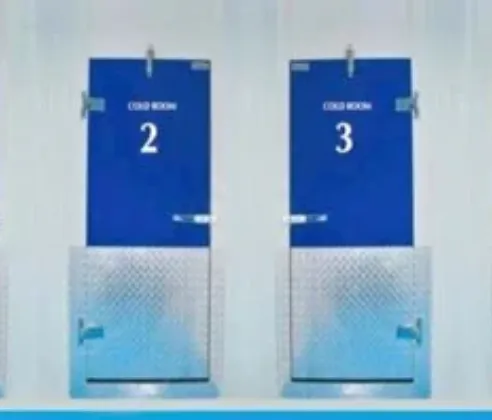
Cost-effective insulated swing doors for smaller cold storage openings — pedestrian access, service entry, escape routes, and specialty rooms. Purpose-built cold storage hinges and full-perimeter EPDM sealing.
The Prime Coil cold room hinged door is a PUF-insulated swing door engineered for smaller cold storage openings where sliding geometry is not required — pedestrian access, service entry, escape routes, and secondary access points to chiller and freezer rooms. Every cold room hinged door we supply combines heavy-duty cold-storage-rated hinges, a full-perimeter EPDM sealing gasket, and PUF core insulation into a cost-effective solution for openings under 1,200 mm width.
When hinged doors are the right choice
Sliding doors dominate cold storage for wide openings and heavy traffic, but hinged doors are the correct answer for a specific set of applications where sliding geometry is unnecessary and adds cost:
Pedestrian and service access. A cold room’s primary product-loading door needs to be wide and easy to operate — a sliding door is right. But every cold room also needs pedestrian access for staff, service access for maintenance, and often an escape route for safety compliance. For openings under 1,200 mm serving these functions, a hinged door is simpler, cheaper, and easier to install.
Small chambers and specialty rooms. Bulk milk cooler rooms, small chill chambers, ripening rooms, and specialty product storage often have single doors for both access and product handling. Sliding door hardware is over-specification for these applications; a well-engineered hinged door costs less and lasts as long.
Retrofit into existing openings. Existing buildings with pre-cut door openings often can’t accommodate the wall clearance a sliding door requires. Hinged doors work in the exact opening dimension without additional wall modifications.
Emergency egress routes. Fire safety codes require unlocked egress from every cold storage room. Hinged doors with panic-bar exit hardware satisfy egress requirements simply; sliding doors require more complex emergency mechanisms.
The critical engineering — hinges built for cold storage
Standard commercial door hinges fail predictably in cold storage service. The reasons matter:
Weight and thermal cycling. A PUF-insulated cold storage door weighs 60-100 kg — 3-4 times heavier than a commercial office door. Combined with continuous thermal cycling between cold interior and warm ambient, this weight causes standard hinges to sag within 12-18 months. Once hinges sag, the door no longer seals at the top, and the room loses temperature control.
Corrosion from continuous humidity. Cold storage environments are humid, and condensation forms on cold metal surfaces continuously. Standard steel hinges corrode visibly within 2-3 years and jam within 5. Cold storage hinges must use corrosion-resistant materials (stainless steel or hot-dip galvanised) or sealed bearing designs.
High cycle count on service doors. A pedestrian service door in a food processing plant sees 100+ opening cycles per day. Standard hinges are rated for far fewer cycles under load. Purpose-built cold storage hinges use bearing designs (rather than plain bushings) that handle high cycle counts without wear.
Every Prime Coil cold room hinged door uses heavy-duty cold-storage-rated hinges specified for these actual operating conditions — stainless steel construction, sealed bearings, and load ratings that account for door weight plus operator force.
Full-perimeter EPDM seal
The seal on any hinged door is only as good as its compression around the entire door frame — top, bottom, hinge side, and latch side. Cheap hinged doors use partial-perimeter seals that leak air continuously through the gaps. Our design uses a continuous full-perimeter EPDM gasket:
- Top and sides — gasket mounted on the door frame, compressed against the door panel edge when closed
- Bottom — automatic sill drop or continuous gasket depending on floor conditions
- Hinge side — special profile that accommodates the hinge protrusion without gap
- Latch side — compression seal that engages when door closes and latches
The EPDM material stays flexible at temperatures down to -40°C for freezer applications. Standard rubber gaskets stiffen at cold temperatures and leak; EPDM maintains sealing performance for 10+ years.
PUF core insulation
Door panel construction uses polyurethane foam (PUF) core with pre-painted galvanised steel skin on both sides. Insulation thickness matches room temperature:
- 80 mm PUF — chiller room applications (+0°C to +8°C)
- 100 mm PUF — freezer room applications (-18°C to -25°C)
- 120 mm PUF — deep freezer applications (-30°C)
Thicker insulation reduces heat gain through the door but adds weight and cost. Our engineers specify the correct thickness based on your operating temperature during quotation.
Cost-effective vs premium alternative
Our cold room hinged door is the standard-tier hinged product. For applications requiring the highest thermal performance and minimum condensation on the frame surface, we offer thermally-broken insulated hinged doors as a premium alternative — these use a thermal break in the frame to prevent heat transfer between warm and cold sides.
Standard hinged doors work well for most cold storage applications; premium thermally-broken doors are worth the upgrade for pharmaceutical facilities, high-precision cleanrooms, and extreme cold-side applications where any frame condensation is unacceptable.
Manual operation, optional latch and lock hardware
Standard configuration is manual operation with a push-pull handle. Additional hardware options:
- Panic bar exit — for emergency egress compliance
- Padlock hasp — for external locking during off-hours
- Interior thumb-turn — allows opening from inside even when locked outside
- Automatic closer — spring-loaded closer ensures door closes reliably after each use
- Kick plate — protects lower panel from forklift damage in traffic areas
Built to run, season after season.
Cold-storage-rated hinges
Heavy-duty hinges specified for cold storage service — stainless steel construction or hot-dip galvanised for corrosion resistance, sealed bearings for high cycle life, load rated for PUF-insulated door weight plus operator force. Standard commercial hinges fail within 12-18 months in cold storage service; ours last 20+ years.
Full-perimeter EPDM seal
Continuous EPDM gasket on all four sides of the frame — top, bottom, hinge side, latch side. Special profile at the hinge side accommodates hinge protrusion without leaving gaps. EPDM stays flexible down to -40°C, maintains sealing performance for 10+ years before replacement.
PUF core insulation
Polyurethane foam core with pre-painted galvanised steel skin on both sides. Insulation thickness matches room temperature — 80 mm for chiller rooms, 100 mm for freezer rooms, 120 mm for deep freezer applications. Excellent thermal performance without excess weight.
Cost-effective for small openings
For openings under 1,200 mm serving pedestrian and service access, hinged doors cost 30-40% less than equivalent sliding door installations — with equivalent seal performance and service life. Right-size product for the actual application.
Simple installation
Standard door frame installation matches typical building construction — no overhead track structure required, no wall clearance needed for open position. Retrofits into existing openings without wall modification. Complete installation typically 4-6 hours per door.
Automatic sill drop option
Optional automatic sill drop mechanism activates when door closes, sealing the bottom gap between door and floor. Prevents cold air escape at floor level — the most common leak point on cold storage hinged doors. Recommended for chill and freezer applications.
Emergency egress compatible
Panic bar exit hardware available for fire safety code compliance — allows one-motion emergency exit from cold storage rooms even when door is locked from outside. Meets NBC and IS 12458 egress requirements for industrial facilities.
Left or right hand configuration
Available in left-hand or right-hand swing configurations based on your opening layout and adjacent equipment. Hinge side specified during order — hardware assembly and gasket profile match the selected configuration.
20-year service life
Cold-storage-rated hinges resist corrosion and cycle wear, PUF panel maintains dimensional stability under thermal cycling, EPDM gasket delivers 10+ year sealing life before replacement. Total door service life 20+ years with routine maintenance — comparable to sliding door alternatives.
Specifications
| Type | Insulated hinged swing door |
|---|---|
| Opening widths | 700 mm to 1,200 mm |
| Opening heights | 1,800 mm to 2,400 mm typical |
| Panel construction | PUF-insulated with steel skin |
| Panel thickness | 80 mm to 120 mm (temperature dependent) |
| Panel skin | Pre-painted galvanised steel (stainless option) |
| Interior finish | Food-grade compatible |
| Hinges | Cold-storage-rated, stainless or galvanised |
| Hinge bearings | Sealed for high cycle life |
| Gasket | EPDM rubber, full-perimeter |
| Bottom seal | Continuous gasket or automatic sill drop |
| Operation | Manual, push-pull handle |
| Handle | Cold-storage-rated stainless steel |
| Hardware options | Panic bar, padlock hasp, closer, kick plate |
| Swing direction | Left hand or right hand (specified at order) |
| Operating temperature | -30°C to +8°C (variant dependent) |
| Service life | 20+ years typical |
| Custom sizes | Available on request |
Where it's used.
- Pedestrian cold room access
- Service door for cold storage
- Emergency egress from cold rooms
- Small chill chambers
- Ripening rooms
- Bulk milk cooler rooms
- Retrofit installations
- Specialty product storage
- Secondary access to main cold storage
- Small dairy processing rooms
Product questions, answered.
When should I choose a hinged door instead of a sliding door for cold storage?
For openings under 1,200 mm serving pedestrian access, service entry, or emergency egress, hinged doors are the correct choice — simpler, cheaper, easier to install, and equivalent sealing performance for the small openings they serve. Sliding doors are the right answer for wider openings (over 1,500 mm), high-traffic corridors, and applications where the door swing arc would obstruct facility traffic. Most cold storage facilities need both — sliding for main product access, hinged for secondary access points.
Do cheap commercial hinges work for cold storage?
No — this is one of the most common cold storage door failure modes. Standard commercial hinges are rated for far lower door weight, don't handle continuous thermal cycling between warm and cold sides, and corrode within 2-3 years in the humid environment. Sagging hinges cause the door to no longer seal at the top, and the room loses temperature control. Purpose-built cold-storage-rated hinges (stainless steel construction, sealed bearings, load rated for actual PUF door weight) are essential — the ₹2,000-3,000 hardware premium prevents ₹50,000+ door replacement in year 3.
What size opening does a hinged door handle?
Standard opening widths from 700 mm to 1,200 mm and heights from 1,800 mm to 2,400 mm. Openings smaller than 700 mm are impractical for cold storage service access; openings larger than 1,200 mm become too heavy for reliable hinge operation over years of service. For openings above 1,200 mm, our single-leaf sliding doors are the better choice — the sliding geometry handles wider openings more effectively than any hinge design.
Do I need automatic sill drop for freezer applications?
Strongly recommended for freezer rooms. The bottom of a hinged door is the most common leak point — the small gap between door bottom and floor allows cold air to escape at floor level continuously. Automatic sill drop mechanisms activate a compression seal when the door closes, eliminating this gap. On freezer applications operating at -20°C or below, sill drop pays back within 12 months in refrigeration energy savings.
What's the difference between your standard hinged door and thermally-broken insulated hinged doors?
Standard hinged doors use continuous metal frame construction — the frame is one piece of metal spanning warm and cold sides. Thermally-broken insulated hinged doors use a frame design with an insulating layer between the warm-side and cold-side frame surfaces, preventing heat transfer through the frame itself. This eliminates condensation on the warm-side frame surface (a common issue at high-humidity ambient conditions) and improves overall thermal performance. Standard hinged doors work well for most cold storage applications; thermally-broken doors are worth the premium for pharmaceutical facilities, cleanrooms, and extreme cold-side applications.
Can I retrofit a hinged door into an existing opening?
Yes — this is one of the most common retrofit scenarios for hinged doors. Existing openings that were originally cut for commercial doors can be adapted for cold storage hinged doors by removing existing frames and installing our cold-storage frame with appropriate wall seal. Total retrofit time is typically 6-8 hours per door with minimal impact on facility operation.
Do the doors require regular maintenance?
Minimal maintenance for well-engineered cold storage hinged doors. Standard maintenance: visual inspection of EPDM gasket every 6 months (replace when compression damage visible), hinge lubrication annually (stainless hinges don't corrode, but bearings benefit from periodic grease), automatic sill drop mechanism functional test every 6 months, and hardware inspection annually (handles, latches, panic bar if fitted). Total annual maintenance overhead is minor.
What's the typical delivery and installation timeline?
Standard sizes ship in 3-4 weeks from order confirmation. Custom sizes and special hardware configurations run 5-6 weeks. Installation typically takes 4-6 hours per door for standard hinged doors. Total project timeline from order to operational: 4-5 weeks for standard installations, 6-7 weeks for custom configurations.
Every Prime Coil cold room hinged door is engineered against your specific opening dimensions and operating conditions — because the same cold storage that destroys commercial hinged doors in 2-3 years leaves properly-engineered doors serving reliably for 20 years. Send us your specifications and we come back with the right model, delivered price, and installation timeline within one working day.
Capacities & model codes
Chiller Room Hinged Door
Configured for chiller room applications operating at 0°C to +8°C. Standard 80 mm PUF insulation, standard EPDM gasket, cold-storage-rated hinges. Most common configuration covering fresh produce, dairy, and general chill applications.
- Chiller room duty (0°C to +8°C)
- 80 mm PUF insulation
- Standard EPDM gasket
- Cold-storage-rated hinges (stainless steel)
- Manual operation with push-pull handle
Freezer Room Hinged Door
Configured for freezer room applications operating at -18°C to -25°C. Increased 100 mm PUF insulation, low-temperature EPDM gasket, cold-rated hinges with sealed bearings. Standard for pedestrian and service access to freezer rooms.
- Freezer room duty (-18°C to -25°C)
- 100 mm PUF insulation
- Low-temperature EPDM gasket
- Sealed-bearing hinges
- Automatic sill drop standard
Deep Freezer Hinged Door
Heavy-duty configuration for deep freezer applications operating at -25°C to -30°C. Maximum 120 mm PUF insulation, specialised low-temperature gasket, heavy-duty hinges with cold-rated bearings.
- Deep freezer duty (-25°C to -30°C)
- 120 mm PUF insulation
- Specialised low-temperature gasket
- Heavy-duty cold-rated hinges
- Enhanced sill seal for cold-side operation
Emergency Egress Hinged Door
Configured for emergency egress from cold storage rooms with panic bar exit hardware. Standard PUF insulation and sealing; primary distinction is emergency exit hardware meeting NBC and IS 12458 requirements. Available in all temperature configurations.
- Panic bar exit hardware
- One-motion emergency exit
- Meets NBC and IS 12458 requirements
- External locking with internal escape
- Available in all temperature variants
Tell us your daily requirement.
Share your output target, product and ambient conditions — we'll specify the machine and the plant around it.