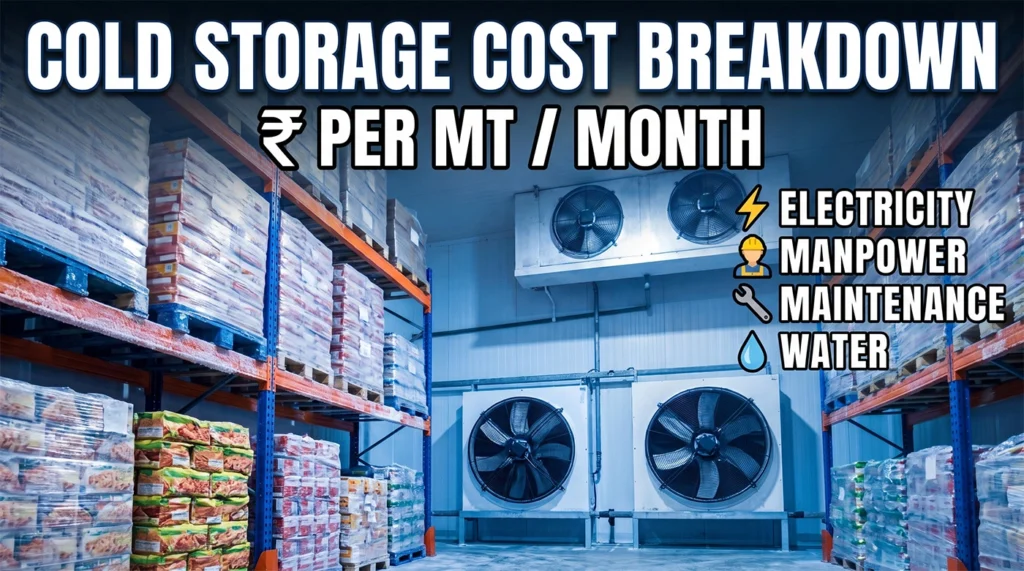
Cold Storage Running Cost Per MT Per Month
Ask three cold store operators what it costs them to hold a tonne of product for a month and you will get three answers that do not overlap. One will quote you his electricity bill divided by capacity. One will include manpower but forget the demand charge. The third will give you a number that sounds impossibly low because his store is only half full and he is dividing by installed capacity rather than loaded tonnage.
None of them are lying. They are just measuring different things.
This article breaks the running cost of an Indian cold store into its actual line items, gives a defensible number for each, and ends with a worked example for a 5,000 MT multi-commodity facility. The figures come from published benchmarks where they exist and from our own commissioning and service experience where they do not. Where a number is a range rather than a point, we have said so instead of picking the middle and pretending it is precise.
The short answer by facility type
Running cost per MT per month varies by a factor of three across facility types, and the single biggest driver is not temperature — it is throughput. A bulk seasonal store where product goes in once and comes out once costs a fraction of a distribution hub where the doors open forty times a day.
| Facility type | Typical temperature | Electricity intensity | All-in running cost |
|---|---|---|---|
| Bulk seasonal store (potato, onion) | +2°C to +4°C | 70–80 kWh/MT-year | ₹85–130 per MT/month |
| Multi-commodity store, moderate throughput | +2°C to −5°C | 120–140 kWh/MT-year | ₹140–200 per MT/month |
| Distribution hub, high throughput | Mixed chambers | 150–200 kWh/MT-year | ₹190–280 per MT/month |
| Frozen storage | −18°C to −25°C | 180–240 kWh/MT-year | ₹220–320 per MT/month |
The electricity intensity figures for bulk and hub facilities follow the National Centre for Cold Chain Development’s indicative ranges. The mid-range number is corroborated by cluster data from the Kundli cold storage profile in Haryana, where surveyed facilities in the 2,500–5,000 MT band consumed an average of roughly 488,000 kWh a year against an average capacity of about 3,710 MT — approximately 132 kWh per MT per year.
Two things about this table before you use it. First, these are per loaded tonne, not per tonne of installed capacity. A 5,000 MT store running at 60% occupancy has a higher cost per stored tonne than the table suggests, because most of the load is envelope heat gain that does not care whether the chamber is full. Second, “all-in” means electricity, manpower, water, maintenance, insurance and statutory compliance. It excludes finance cost, land, depreciation and your own salary.
Electricity is 60–75% of it, and the split matters
In a cold store, refrigeration typically accounts for over 70% of total electricity consumption. The rest is lighting, dock equipment, office load and the material handling fleet if it is electric.
But the electricity bill itself has two halves, and operators consistently budget for one and get surprised by the other.
Energy charge — the part everyone budgets
This is consumption multiplied by the per-unit rate. HT industrial tariffs sit around ₹6 to ₹7 per kWh across most states, with wide variation and frequent revision. Take your facility type from the table above, multiply by capacity, multiply by your state’s rate.
A 5,000 MT multi-commodity store at 130 kWh/MT-year:
- 5,000 × 130 = 650,000 kWh per year
- × ₹6.50 = ₹42.3 lakh per year
- ÷ 5,000 ÷ 12 = ₹70 per MT per month
Demand charge — the part that catches people
HT consumers pay a fixed monthly charge against contract demand in kVA, whether or not the plant runs. Depending on the state this sits somewhere between ₹300 and ₹500 per kVA per month, and it is billed on your contracted or recorded maximum demand — not your average.
For the same 5,000 MT store with a contract demand around 375 kVA:
- 375 kVA × ₹400 = ₹1.5 lakh per month
- ÷ 5,000 = ₹30 per MT per month
That is roughly 30% of your energy charge, paid regardless of occupancy. It is the reason a half-empty store bleeds so badly: consumption drops with load, demand charge does not. It is also the reason soft starters, staged compressor loading and avoiding simultaneous pull-down across chambers pay back faster than most operators expect. If your pull-down schedule stacks three chambers at once because that is when the trucks arrived, you set a demand peak that you will pay for every month of that billing cycle.
We cover the control-side levers in more detail in five ways to cut energy cost in an ammonia plant room — floating head pressure and condenser fan control in particular move the energy charge, while load staging moves the demand charge.
Manpower — ₹30 to ₹55 per MT per month
A 5,000 MT facility running three shifts typically carries eight to twelve people: one plant operator per shift, a rotating supervisor or plant engineer, loading and housekeeping staff, security across shifts, and one administrative person handling gate entries and stock records.
At a loaded cost of ₹18,000 to ₹25,000 per head per month, ten people works out to roughly ₹2 lakh a month, or ₹40 per MT per month at full occupancy.
This line scales badly downward. A 1,000 MT store still needs an operator on every shift and still needs security. Manpower per MT at 1,000 MT can be two to three times what it is at 5,000 MT, which is a large part of why small stores struggle on unit economics regardless of how efficiently the plant runs.
It scales well upward, though. A 10,000 MT store does not need double the staff of a 5,000 MT store — it needs perhaps 40% more.
Water and treatment — ₹3 to ₹8 per MT per month
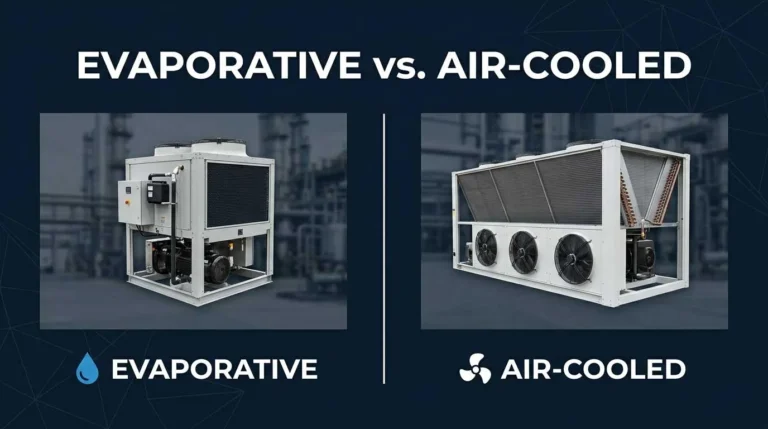
If your plant uses evaporative condensers, you are consuming water continuously through evaporation and blowdown. For a 150–200 TR plant running 16–18 hours a day, expect somewhere in the region of 8,000 to 12,000 m³ a year including blowdown.
Raw water is usually cheap or borewell-sourced. The cost that matters is treatment: scale inhibitor, biocide, dispersant, and the labour to dose and test it. Budget ₹2 to ₹4 lakh a year for a facility this size — call it ₹4 to ₹6 per MT per month.
Skipping water treatment is the single most common false economy we see in the field. Scale on the condenser coil raises condensing temperature, and every degree of condensing temperature costs roughly 2 to 3% in compressor power. A store that saves ₹2 lakh a year on chemicals and gives up 4°C of condensing approach through scaling is spending an extra ₹4 to ₹5 lakh a year on electricity to do it. The chemicals were never the expensive part.
Maintenance and spares — ₹10 to ₹18 per MT per month
Plan on 1.5% to 2.5% of refrigeration equipment capital cost per year, weighted toward the higher end after year five.
For a 5,000 MT store where refrigeration and insulation equipment ran ₹3.5 to ₹4.5 crore, 2% is ₹8 lakh a year — about ₹13 per MT per month. That covers compressor oil changes and oil filters, suction and discharge valve plate service, condenser fan bearings and belts, evaporator fan motors, contactor and relay replacement, and the consumables around defrost systems.
It does not cover a compressor overhaul. Screw compressors need a bearing overhaul somewhere around 30,000 to 40,000 running hours; reciprocating units need top-end work sooner. On an 18-hour duty that is roughly a five to seven year event, and it is a ₹4 to ₹12 lakh line depending on frame size. Sensible operators provision for it annually rather than discovering it as a capital request.
Insurance, statutory and compliance — ₹4 to ₹8 per MT per month
The smallest line, and the one most likely to be missing from a spreadsheet entirely.
- Asset and stock insurance — typically 0.15% to 0.3% of insured value annually. On a ₹6.5 crore facility that is ₹1 to ₹2 lakh a year, before stock cover.
- PESO licence renewal — for ammonia installations above threshold quantities, with periodic inspection.
- Pressure vessel testing — receivers, accumulators and separators need periodic hydrostatic testing and documented inspection under the applicable rules.
- Electrical inspectorate — HT installation inspection and certification, renewed on the state’s cycle.
- FSSAI licence — for food-grade facilities, plus any buyer-mandated audits.
- Calibration — temperature and humidity sensors need annual calibration if you are serving pharma or export customers, and the certificates get asked for.
Together this typically lands at ₹3 to ₹5 lakh a year for a mid-size facility.
Worked example: 5,000 MT multi-commodity store
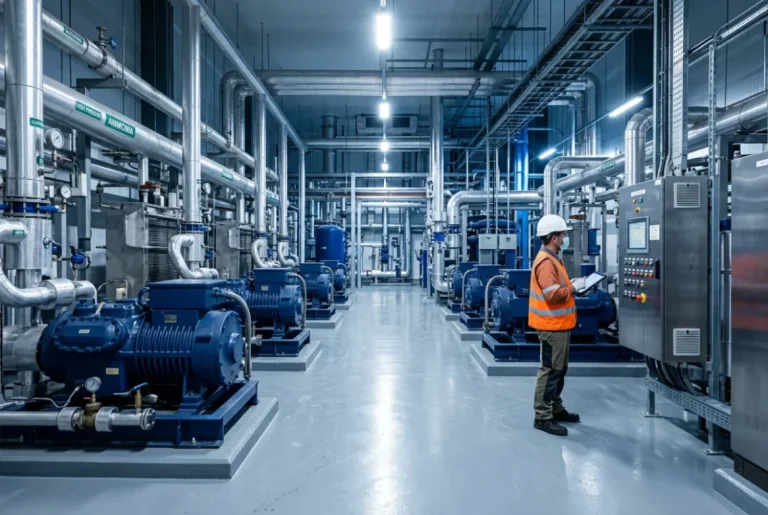
North India, mixed chambers between +4°C and −18°C, ammonia plant with evaporative condensers, 18-hour average duty, HT supply at ₹6.50 per unit with ₹400 per kVA demand charge, running at 85% average occupancy.
| Line item | Annual | Per MT/month | Share |
|---|---|---|---|
| Electricity — energy charge | ₹42.3 lakh | ₹70 | 44% |
| Electricity — demand charge | ₹18.0 lakh | ₹30 | 19% |
| Manpower | ₹24.0 lakh | ₹40 | 25% |
| Maintenance and spares | ₹8.0 lakh | ₹13 | 8% |
| Water and treatment | ₹3.0 lakh | ₹5 | 3% |
| Insurance and statutory | ₹3.5 lakh | ₹6 | 4% |
| Total | ₹98.8 lakh | ₹164 | 100% |
At 85% occupancy the same total spreads over 4,250 loaded tonnes rather than 5,000, which pushes the real figure to about ₹194 per loaded MT per month. That gap between nameplate and loaded is where most business plans go wrong.
None of this includes loan servicing, land lease, depreciation or promoter salary. Those are real costs, but they belong in a project financial model rather than an operating cost benchmark.
What separates a ₹140 store from a ₹220 store
Two facilities of identical capacity in the same district, storing similar product, can differ by 50% on running cost. In our experience the gap is almost never one big thing. It is six or seven small ones compounding.
- Insulation specified to capex rather than duty. Running 80 mm PUF panels on a −18°C chamber that needed 120 mm adds heat gain every hour for twenty years to save a few lakh once.
- Condenser undersized for peak ambient. A condenser selected at 38°C ambient in a location that sees 45°C spends the summer running at elevated head pressure, which is when your bill is already highest.
- Defrost on a fixed timer. Timer defrost either defrosts a clean coil or leaves a blocked one. Demand or pressure-initiated defrost costs a little more to instrument and saves continuously.
- No door discipline. Infiltration through an open dock door at −18°C is a very large load. Fast-acting doors and air curtains pay back in months on a busy dock, not years.
- No sub-metering. If you cannot see chamber-wise or plant-wise consumption, you cannot find the drift. A store with monitoring finds a failed evaporator fan in a day; a store without it finds out at the month-end bill.
- Fixed head pressure control. Holding condensing pressure at a summer setpoint through a Delhi winter throws away the cheapest efficiency available to any plant.
What we do not recommend cutting
Some running costs look optional and are not. If your operating budget is tight, cut elsewhere.
Water treatment. Covered above. The arithmetic is not close.
Compressor oil analysis. A few thousand rupees a year of sampling catches bearing wear and acid formation before they become an overhaul. Skipping it does not save money, it defers a much larger bill and removes your warning.
Sensor calibration. A chamber sensor reading 1.5°C low means you are holding the room 1.5°C colder than you need to, permanently, and paying 4 to 5% more in compressor power for the privilege. It also means your temperature log is wrong, which is a commercial problem the day a customer disputes a consignment.
The third shift operator. Some operators run the night shift unmanned with an alarm dialler. It works until the night a liquid line valve passes or a fan trips, and the difference between a two-hour excursion and an eight-hour one is the difference between a nuisance and a claim.
How to sanity-check a supplier’s opex claim
Every refrigeration supplier will tell you their plant is efficient. Four questions separate the ones who have done the calculation from the ones who have not.
- “What kWh per MT per year does this design deliver, and at what ambient?” A supplier who cannot state a number and the ambient it assumes has not modelled it. The ambient matters as much as the number.
- “What contract demand in kVA should I book?” This tells you whether they have thought about the demand charge at all. If the answer is just the connected load with no diversity factor applied, you will over-contract and pay for it monthly.
- “What is the condensing approach at design ambient, and what happens at 45°C?” This is where summer bills are decided.
- “What is the defrost strategy and what does it cost in kWh per year?” Defrost is a surprisingly large line in low-temperature rooms, and hot-gas defrost against electric is often worth several lakh a year on a frozen facility.
If you are still at the capital planning stage, the companion piece to this article is our breakdown of what an industrial cold storage costs to build in India. Capex and opex decisions are not separable — several of the lines above are set permanently on the day the equipment is selected.
The refrigerant choice also moves this number. Ammonia plants generally run 10 to 20% lower on energy than equivalent HFC systems at industrial scale, which on the facility above is worth ₹4 to ₹8 lakh a year — but they carry compliance and manning obligations that a Freon plant does not. We work through that trade-off in ammonia or Freon.