
Ammonia Oil Separators
Strip entrained oil from compressor discharge gas — protect heat transfer surfaces, maintain plant COP, and return recovered oil to the crankcase automatically.
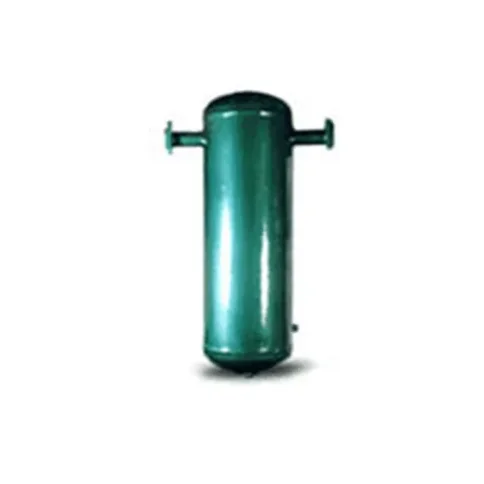
Strip entrained oil from compressor discharge gas — protect heat transfer surfaces, maintain plant COP, and return recovered oil to the crankcase automatically.
Prime Coil ammonia oil separators are engineered to strip entrained compressor lubricating oil from the hot discharge gas before it reaches the condenser — protecting evaporator heat transfer, maintaining plant COP, and returning the recovered oil back to the compressor crankcase automatically.
In any ammonia refrigeration plant, some oil inevitably escapes past the compressor’s internal seals and enters the discharge line as a fine mist. Left in the system, this oil coats the inside of condensers and evaporators, drops heat transfer coefficients, raises pressure drops, and eventually accumulates in low-pressure vessels where operators have to bleed it out manually. A properly sized oil separator on the discharge line stops that problem at source — recovering 95%+ of entrained oil and cycling it back into use.
Our surge-type separators are vertical scrubber vessels engineered for compressor discharge duty across commercial and industrial refrigeration systems. The gas enters near the top, decelerates as it hits the enlarged vessel cross-section, and drops its oil droplets by combined impingement and gravity. An automatic float valve at the base returns the collected oil to the compressor crankcase, closing the lube loop with zero manual intervention.
Built to run, season after season.
Surge / scrubber type design
Vertical vessel with enlarged internal cross-section slows the discharge gas velocity dramatically at the inlet, causing entrained oil droplets to drop out by gravity and impinge on internal baffles. Simple, robust, and highly effective across a wide range of operating conditions.
85-95% oil separation efficiency
Correctly sized surge separators deliver 85-95% oil separation on typical ammonia discharge conditions — enough to keep downstream heat exchangers clean and protect long-term plant COP. Efficiency stays consistent across the compressor's operating envelope, not just at nameplate conditions.
Automatic oil return
A float-operated needle valve at the base of the vessel opens when oil accumulates to preset level, returning it to the compressor crankcase through a small-bore line. No operator intervention, no manual draining, no oil disposal cost — the lubricant stays in service.
Vertical mounting on discharge line
Compact vertical footprint installs directly on the compressor discharge line with minimal floor space. Standard NPT or flanged inlet/outlet connections match your existing piping. Plant room layouts stay clean without long horizontal separator vessels.
Carbon steel / LT steel construction
Shell and dished ends fabricated from certified pressure vessel plate. Standard carbon steel for typical duty, low-temperature steel for cold-climate installations and screw compressor systems with lower discharge temperatures. Material selected per your MDMT requirement.
Precision fabrication standards
Shells up to 300 mm diameter fabricated from seamless or welded pipe; above 300 mm rolled from certified plate. Longitudinal and circumferential welds executed to WPS/PQR-approved procedures with 100% radiography on request.
Pressure tested & certified
Every separator hydro-tested at 1.5x design pressure before dispatch. Pneumatic leak-tested on all welds. Ships with material test certificates, welder qualification records, and hydraulic test reports. PESO and IBR certification available on request.
Complete fitting package
Standard supply includes: internal impingement baffles, float valve with strainer, oil sight glass, isolation valves on inlet/outlet, dual safety relief valves, drain valve, and pressure gauge. Ready for direct installation into your plant.
Wide compressor compatibility
Sized to match any reciprocating or screw compressor capacity — from small backup plant units to industrial multi-cylinder machines. Correct sizing is critical to separation efficiency; our engineers calculate based on your compressor's displacement and discharge conditions.
Specifications
| Type | Surge (scrubber) type |
|---|---|
| Mounting | Vertical, in-line on discharge |
| Diameter range | 250 mm (10") to 600 mm (24") |
| Length range | 1.0 m to 1.8 m (3'-6') |
| Shell material | Carbon steel / Low-temperature steel |
| Dished end material | Carbon steel / Low-temperature steel |
| Design pressure | 25 bar (typical high side) |
| Design temperature | Up to 150°C discharge gas |
| Separation efficiency | 85-95% typical, load dependent |
| Oil return method | Automatic float valve to crankcase |
| Design code | ASME Section VIII Div 1 / IS 2825 |
| Hydraulic test | 1.5x design pressure, 100% units |
| Fittings | Float valve, sight glass, safety valves, isolation valves |
| Connections | NPT (250-300 mm), flanged (400 mm+) |
| Certification | PESO, IBR, third-party inspection on request |
| Compressor compatibility | Reciprocating and screw types |
Where it's used.
- Industrial ammonia refrigeration
- Reciprocating compressor systems
- Screw compressor packages
- Cold storage plant rooms
- Ice manufacturing plants
- Food processing refrigeration
- Turnkey ammonia plant supply
- Retrofit oil management
- Marine refrigeration
Product questions, answered.
Why does an ammonia system need an oil separator?
Unlike some HFC systems where oil dissolves into the refrigerant, ammonia and mineral oil are essentially immiscible. Whatever oil escapes past the compressor's internal seals rides along the discharge line as fine droplets, then settles into whatever cold vessel it reaches — typically the evaporator or the low-pressure receiver. Once there, it coats heat transfer surfaces and drops the plant's COP. An oil separator stops that at source, saving both energy and manual oil-drainage labour.
What separation efficiency should I expect?
Correctly sized surge-type separators deliver 85-95% separation efficiency in typical ammonia service. Efficiency depends on gas velocity through the vessel — too fast and droplets get carried through; too slow and small mist particles don't drop out at all. Our sizing calculations target the optimal velocity band based on your compressor's discharge flow, ensuring efficiency stays in the top of that range across normal operation.
Where does the recovered oil go?
Straight back to the compressor crankcase. A float-operated needle valve at the base of the separator opens automatically when oil accumulates to a preset level, allowing oil to flow through a small-bore return line into the crankcase. The compressor's lubrication system then puts it back into service. No manual intervention, no oil disposal — the lube stays in the plant.
How is the correct size selected?
Based on your compressor's discharge gas flow rate (usually expressed as mass flow of ammonia in kg/hr or displacement in m³/hr), your discharge pressure, and gas temperature. We size the separator vessel so gas velocity through the internal cross-section stays in the 0.3-1.0 m/s range — that's the sweet spot where droplets drop out efficiently without pressure penalty. Send us your compressor model or spec sheet and we'll size the separator correctly.
Does the separator work with screw compressors as well as reciprocating?
Yes to both. Some screw compressor packages come with an integral coalescing oil separator, which is fine for that package — but if you're building a plant from selected components, or upgrading an old plant, a discharge-line surge separator is standard practice. Screw discharge temperatures are typically lower than reciprocating, so the oil viscosity is different, but the separation physics work the same way.
What if I want higher separation efficiency than 95%?
For applications requiring 99%+ efficiency — typically very large plants where even small oil carryover causes evaporator problems — we can supply coalescing-filter oil separators as an alternative or supplement. These use fiberglass or metal-mesh media to catch fine mist that surge-type vessels miss. Discuss your requirements during specification; the additional cost is worth it only for specific duty profiles.
What certifications ship with the separator?
Every unit ships with material test certificates (mill certs), welding procedure and welder qualification records, hydraulic test report at 1.5x design pressure, and radiography reports where full RT was specified. PESO SMPV certification standard for Indian projects. Third-party inspection (Lloyd's, TÜV, DNV, SGS) available on request.
Can I retrofit a separator into an existing plant?
Yes — this is one of the most common retrofits we do. If your existing plant is showing evaporator oil accumulation, degraded COP, or frequent manual oil drainage, adding a properly sized discharge-line separator often pays for itself in energy savings within 12-18 months. Installation involves cutting the discharge line and welding in the separator with isolation valves — typically a one-day plant shutdown for a competent contractor.
An oil separator that never runs out of separation capacity is worth more than a chiller upgrade — it protects every downstream heat exchanger in your plant. Send us your compressor spec and we will size the vessel correctly, first time.

Tell us your daily requirement.
Share your output target, product and ambient conditions — we'll specify the machine and the plant around it.