About this range
Pump & Overfeed System.
In a direct expansion system, an expansion valve meters just enough liquid to fully evaporate by the coil outlet. In practice that means part of every coil is running dry, oil collects where the liquid ran out, and the valve spends its life chasing a load that keeps moving.
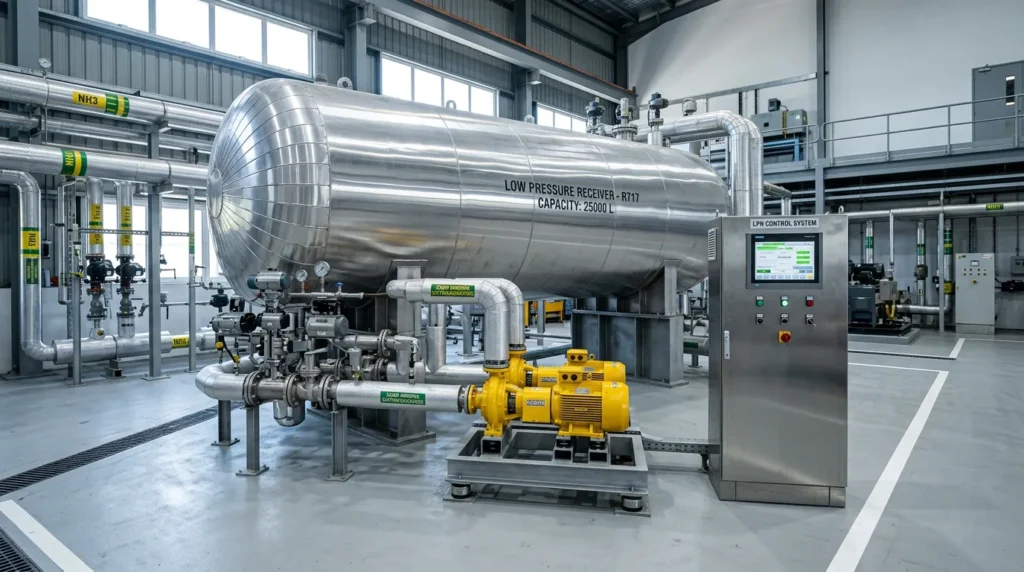
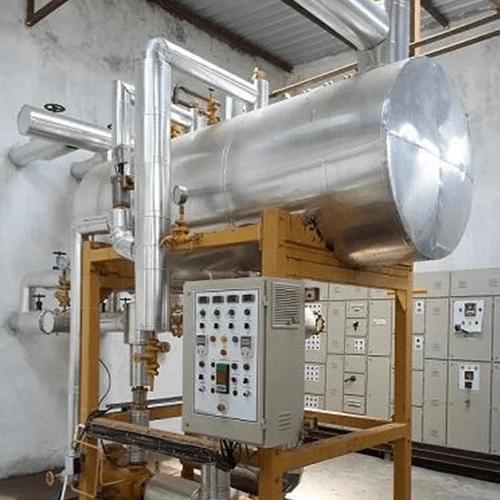
An overfeed system takes the opposite approach. It deliberately pumps three to four times more liquid through the evaporator than will evaporate, so the entire heat transfer surface stays wet. The excess liquid and vapour return to a low-pressure receiver, where they separate and the liquid is pumped round again.
Prime Coil supplies the complete recirculation package — hermetic liquid ammonia pumps, low-pressure receiver, controls and interconnecting pipework — engineered as one system rather than assembled from parts.
Why overfeed outperforms DX at scale
A wet evaporator surface transfers heat better than a dry one. Because overfeed keeps every circuit flooded, the coil delivers its rated capacity across the whole surface instead of losing the last section to superheat. On a large plant that difference is worth real money every hour it runs.
Circulating more liquid than evaporates also solves the oil problem. In an ammonia DX system, oil collects in the evaporator because ammonia and oil do not mix and the gas velocity is not always enough to carry it back. In an overfeed system the returning liquid sweeps oil back to the receiver continuously, where it can be drained from one place.
The third gain is compressor protection. Liquid returning from the evaporators separates in the low-pressure receiver, so only dry vapour reaches the compressor suction. Liquid slugging — the failure mode that ends compressors — is designed out rather than guarded against.
The liquid ammonia pump
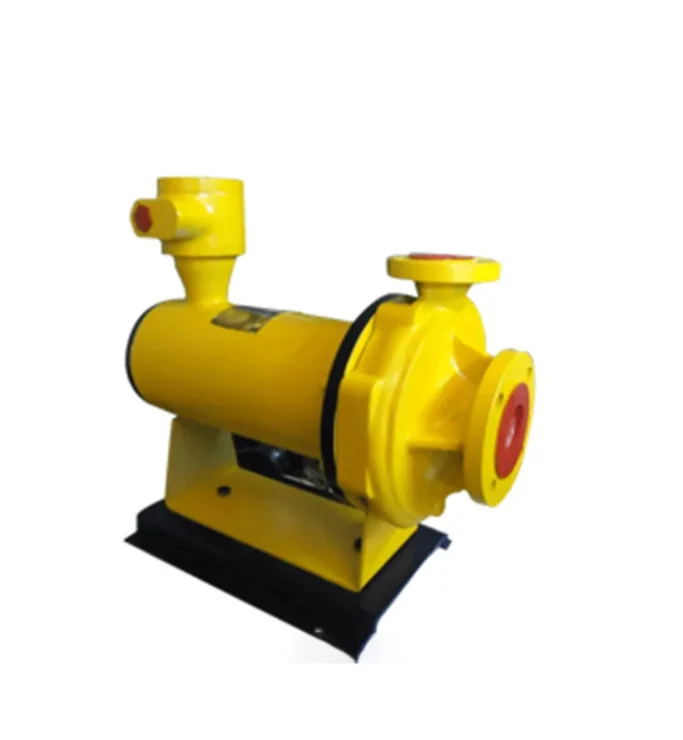
The pump is the heart of the system and the component that decides whether it runs trouble-free for twenty years. Ours are hermetic: motor and pump are a single sealed unit with no shaft seal, no mechanical seal and no gland packing, so there is no wearing seal to leak.
- No leakage design — suited to toxic, flammable and hazardous fluids, which is exactly what ammonia is.
- Airtight construction — handles vacuum service, which matters because low-stage ammonia runs sub-atmospheric below −33°C.
- No external lubrication — the pumped ammonia itself cools and lubricates the motor and bearings, so there is no oil system to maintain and no oil to contaminate the charge.
- Compact — one unit, so no coupling alignment and no elaborate foundation.
- Motor ratings — 2, 3, 5, 7.5 and 10 HP.
Where overfeed is the right choice
Overfeed earns its extra pumps, receiver and controls when the plant is large enough and runs long enough for the efficiency gain to pay for them. It suits multi-evaporator cold stores, blast freezers, IQF lines and any plant where evaporators sit a long way from the machine room.
It suits low-temperature duty particularly well. As evaporating temperature falls, DX performance degrades faster than overfeed does, and the oil return problem gets worse — so the colder the plant, the stronger the case.
Where we would not recommend it: small single-evaporator plants, and anywhere the duty is intermittent enough that the pump would spend most of its life idle. On those, DX is simpler and the capital difference is not recoverable.
Design points that decide performance
Circulation rate. Typically three to four times the evaporation rate for ammonia. Too low and the far end of the coil starves; too high and pumping power eats the efficiency gain.
Receiver sizing. The low-pressure receiver has to hold the surge volume returning from the evaporators during defrost and pull-down, with freeboard above it for separation. This is where overfeed plants are most often undersized.
Pump NPSH. Liquid ammonia at the receiver is saturated, so available NPSH comes from static head alone. Receiver height above the pump is a design decision, not a layout convenience.
Hot gas defrost. An overfeed system already has the pressure differential and the pipework to make hot gas defrost straightforward, which is a meaningful running-cost advantage on any low-temperature plant.
The receiver, pump and separators are covered in our ammonia pressure vessels range, and the efficiency argument is worked through in more detail in five ways to cut energy cost in an ammonia plant room.