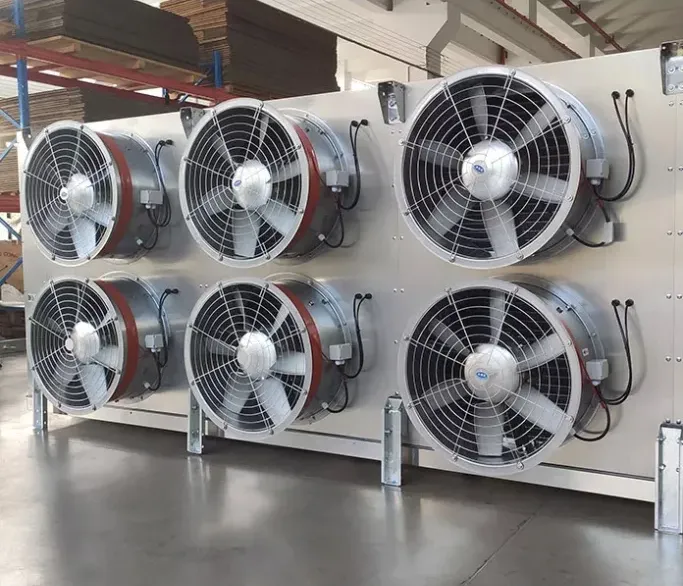
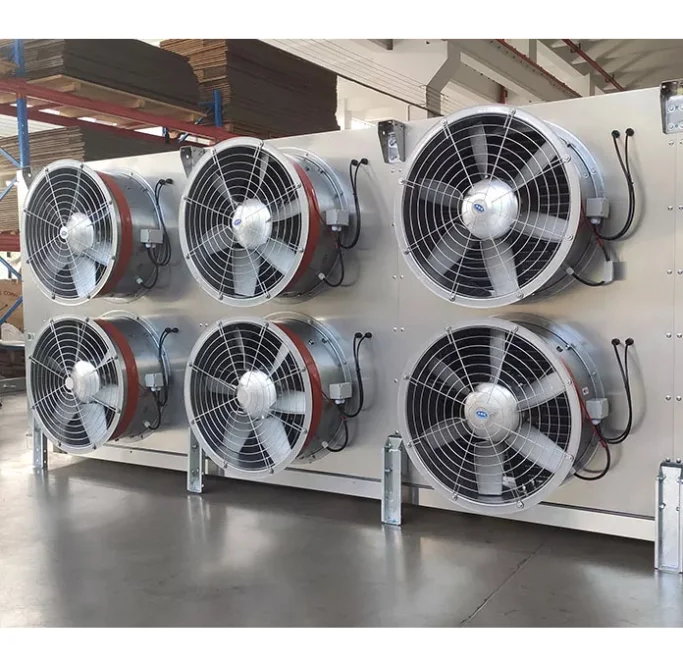
Blast freezer and chiller evaporator units
Built for extreme cold. The evaporator unit sits inside the freezer or chiller room and handles the air side — pulling warm air across the coil, rejecting it at target temperature, and managing the frost that builds up continuously on a low-temperature surface.
- Fan configurations — 2, 4, 6 and 8 fan models
- Fin spacing — 2 mm to 12 mm
- Chiller capacity — 25 to 120 kW
- Freezer capacity — 23 to 100 kW
- Temperature range — −5°C to −45°C
- Fan diameter — 630 to 800 mm
- Mounting — floor or ceiling
- Casing — GI powder coated
- Fin type — corrugated, low pressure drop
- Fan type — wing and multi-wing
Applications: curd, ice cream, meat and poultry, dairy, chocolates, IQF lines, and any process requiring rapid pull-down to holding temperature.
Fin spacing on a blast freezer is not the same decision as on a cold room
A cold room evaporator rarely goes below 4 mm spacing. A blast freezer coil can go to 2 mm because it runs in short, intense cycles with a full defrost between each charge — unlike a cold room coil that runs continuously and has to tolerate frost accumulation over hours.
Wider spacing (8 to 12 mm) suits freezers with very wet product or frequent door openings, where frost builds faster than the cycle accounts for. Getting this wrong costs throughput: a bridged coil forces an unscheduled defrost and halts the line.
Floor or ceiling — why it matters more than installation cost
Ceiling-mounted units keep the floor clear for trolleys and forklifts, which is right for a distribution freezer. Floor-mounted units throw air upward through stacked product, which gives a more direct path on a blast freezer tunnel where trolleys are loaded in and left stationary.
The structural question is real: an 8-fan unit with a frosted coil is heavy, and ceiling suspension in an insulated room needs to be designed into the building, not discovered at installation. Specify the mounting at enquiry stage so the GA drawing accounts for it.
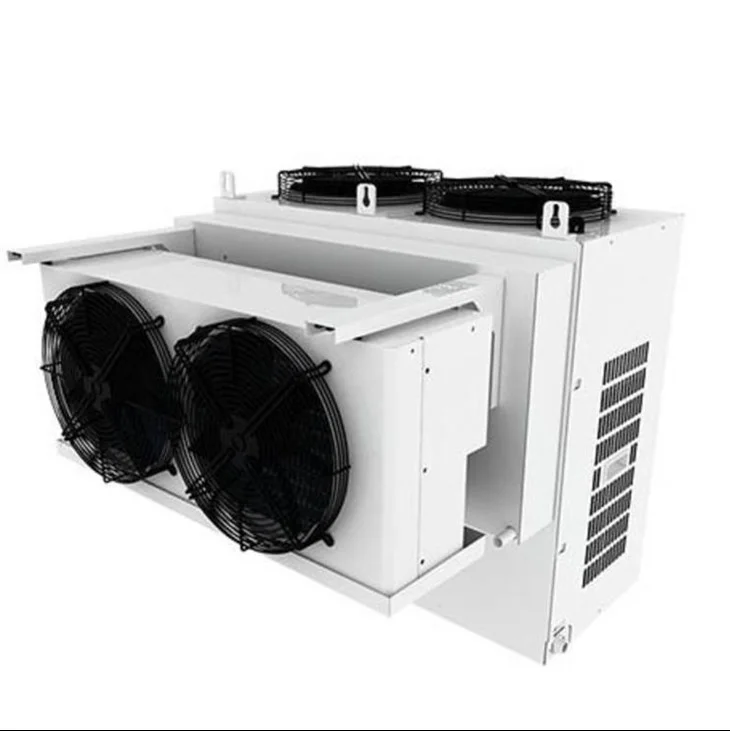
Monoblock units
A monoblock is a complete refrigeration system in one housing — evaporator, compressor and condenser, factory-wired and charged, ready to mount through the wall of a cold room. No outdoor condenser, no refrigerant pipework between components, no field brazing.
- Temperature range — +5°C to −25°C
- Heat exchanger — copper
- Casing — AlMg coated and SS-304
- Defrost — air and electric
- Testing — temperature tested complete (not just factory assembled)
Applications: ice cream, meat and poultry, dairy, fruits and vegetables, seafood, chocolate, flowers, pharma.
When a monoblock is the right call
Choose a monoblock when the room is small enough for self-contained capacity, when there is no space or no permission for an outdoor condenser, or when the installation needs to be fast and reversible — a leased space, a temporary facility, or a room that may move.
A monoblock will not match a split system on efficiency at larger duties, because the condenser rejects heat into the space immediately around the unit rather than to outdoor air. But on a 15 m² cold room that needs to be operational in a day, it is the practical answer.
The testing line that matters
The brochure says "completely temperature tested, not just factory assembled". That distinction is worth understanding. Many suppliers assemble the unit, run the compressor to confirm it starts, and ship it. We run the unit to target temperature and hold it there under load to confirm it actually reaches and maintains it — which is a different test and a more expensive one, and it is why a unit does not arrive on site only to discover it cannot hold −25°C.
Choosing between these and the ammonia equivalent
Below about −30°C, ammonia blast freezers become a serious alternative on efficiency grounds. The trade-off — two-stage compression, sub-atmospheric operation, a compliant plant room — is covered in detail in choosing a refrigerant for a blast freezer.
Above −25°C and below about 50 TR, these Freon units are almost always the right answer. The ammonia case has to justify its own engineering overhead, and at moderate temperatures it usually cannot.