Cut Ammonia Plant Room Energy Cost — 5 Levers
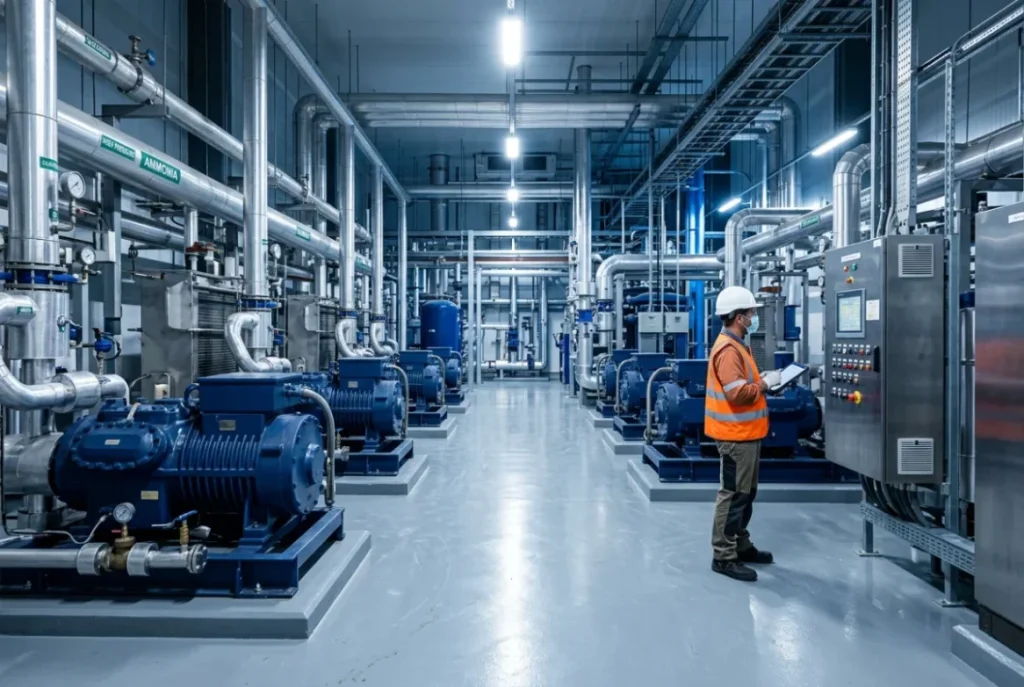
Electricity is the single biggest operating cost in almost every ammonia refrigeration plant we’ve engineered. On a 500 TR system running around the clock at ₹8/kWh, energy alone can hit ₹1.5 crore a year — several times the cost of refrigerant, service contracts and labour combined.
The good news: most plants we audit are running 15-30% higher than they need to. The reasons are consistent, and the fixes rarely require replacing major equipment.
Here are the five levers we reach for first when a client asks how to reduce running cost, in the order of typical payback.
1. Float head pressure — do not hold it high
Older ammonia plants often run at a fixed condensing pressure that assumes the hottest day of the year, all year round. That is a mistake with a very predictable cost.
Condensing at 38°C in December, when ambient is 12°C, wastes compressor work every single hour. A properly configured floating head pressure setup will:
- Let condensing temperature track ambient down to a floor set by your expansion device
- Cut compressor power draw by 2-3% for every degree the condensing temperature drops
- Give you 15-25% annual energy savings in most Indian climate zones
The floor matters. Drop condensing too low and thermostatic expansion valves lose authority, evaporator superheat gets sloppy, and reliability suffers. We typically set the floor 8-10°C above the coldest evaporator saturated suction — enough head to keep valves working through winter.
This is the single highest-payback change on most retrofits. Payback is often measured in months, not years.
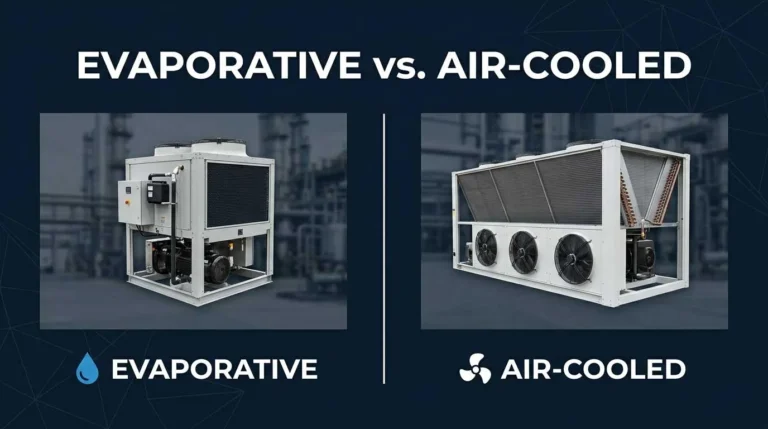
2. Match condenser capacity to load — VFDs on condenser fans
Evaporative condenser fans running full-speed on a mild day are burning cash. So are constantly-cycling fans on hot days.
Variable frequency drives (VFDs) on condenser fan motors do two things:
- On cool days — fans slow down to hold condensing pressure at the floor set above. Power draw drops with the cube of speed, so a fan at 70% speed uses about 34% of full power.
- On hot days — fans modulate smoothly instead of cycling on/off. That eliminates start-current spikes, reduces contactor wear, and holds head pressure much closer to setpoint.
Realistic savings: 10-15% on condenser energy, which is 20-30% of total plant power on most sites. Payback under 3 years even at Indian electricity tariffs, faster with DISCOM incentives.
Water spray control on evaporative condensers deserves the same treatment. Constant-run pumps and full-flow bleed lines waste both water and power. Sequence the spray with load; you’ll cut water use by 30-40% too.
3. Defrost strategy — hot-gas over electric, always
Frost on evaporator coils is inevitable in cold storage and freezer duty. How you get it off matters enormously for operating cost.
Electric defrost is the default in packaged units for one reason: simplicity. It’s also the most expensive way to defrost, by a wide margin. Every kilowatt-hour of heat you put into the coil ends up in the box, which the refrigeration system then has to remove — you pay for the same energy twice.
Hot-gas defrost uses the discharge from the compressors as the heat source. The net cost to the plant is essentially the additional compressor work, which is a fraction of equivalent electric heat. On a large freezer facility, switching from electric to hot-gas defrost typically cuts total plant power by 5-10%.
The second question is when to defrost, not just how. Time-clock defrost (every 6 hours whether the coil needs it or not) wastes energy every cycle you didn’t actually need. Demand defrost — using coil pressure drop, discharge line temperature, or a hot-gas sensor — only initiates when frost has actually built up. Savings: another 3-5% on top of the fuel switch.
4. Design for part-load, not just peak
Most ammonia plants spend 70-80% of the year at 60% load or less. Yet compressor selection is almost always dominated by the peak load case.
The trap: a single large screw compressor running at 40% capacity is significantly less efficient per kW of cooling than the same compressor at 90% capacity. Screw compressor part-load performance drops off sharply below 60%.
Three strategies help:
- Multiple smaller compressors instead of one big machine. Sequence them so at any given load, whichever machines are running are close to their sweet spot.
- VFD on the lead compressor — a variable-speed screw compressor holds efficient part-load performance down to about 25% of rated capacity, versus a slide-valve unit that starts wasting energy below 50%.
- Reciprocating machines as trim — small piston compressors handle the last 10-15% of load efficiently, so the big screws can operate near their design point.
This is a design decision, not a retrofit — but for new plants and major expansions, part-load efficiency compounds to bigger savings than any single control tweak.
5. Instrument, then improve
You cannot optimise what you do not measure.
The single most useful investment we recommend on any operating ammonia plant is a proper energy monitoring system:
- Sub-metering by compressor, condenser bank, and pumps
- Refrigeration load calculated from mass flow and enthalpies
- Coefficient of performance (COP) trended continuously
- Alerts on anomalies — a compressor drawing 15% more power for the same load is telling you something
Most plants operate on gut feel. The plants that consistently run efficient are the ones where someone looks at daily kWh/tonne numbers and asks why they changed. A ₹5 lakh monitoring system on a ₹1.5 crore/year energy bill finds problems that pay it back many times over in the first year.
What we do not recommend chasing
Two things buyers often ask about that we generally do not push:
Waste heat recovery. Great physics, real ROI in some cases (hot water for CIP, boiler preheat), but a lot of installations we’ve inspected end up bypassed within a year because the process didn’t actually need the heat, or the maintenance overhead exceeded the savings. Study the specific application carefully before capital committing.
Ammonia-specific “premium” high-efficiency compressors with proprietary controls. Marginal COP improvement over standard machines, at 30-40% higher capital cost. The math rarely works out over the equipment lifetime. Better to spend the same money on floating head pressure, VFDs and monitoring — three levers that compound.