
Humidity Temperature Sensor for Cold Storage — RH/T Transmitter
Accurate humidity and temperature monitoring for cold storage, CA storage, and pharmaceutical facilities — IP67 construction, CE-certified, and backed by a 2-year replacement warranty.
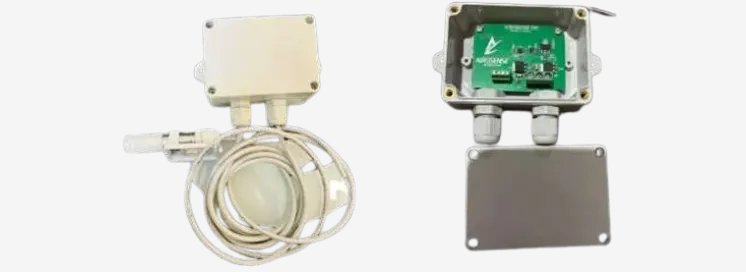
Accurate humidity and temperature monitoring for cold storage, CA storage, and pharmaceutical facilities — IP67 construction, CE-certified, and backed by a 2-year replacement warranty.
The Prime Coil humidity temperature sensor for cold storage is an indigenously developed, CE-certified RH/T transmitter engineered for the wet, corrosive, and thermally-cycling conditions inside industrial cold storage rooms. Every humidity temperature sensor we supply combines RH and temperature measurement in a single compact IP67 enclosure, backed by a 2-year replacement warranty and designed for 10+ years of continuous service where commercial-grade sensors fail within months.
Why cold storage humidity and temperature monitoring matters
Product quality in cold storage is as sensitive to humidity as it is to temperature — often more so. Refrigeration systems inherently dehumidify the air as they cool it, and without active management, storage rooms drift toward humidity levels that damage product:
- Too dry — fruit shrivels and loses saleable weight (a 2% weight loss on ₹100/kg produce is significant across a season), meat surface dehydrates and darkens, pharmaceutical tablets crack or delaminate, leafy vegetables wilt within days
- Too wet — condensation forms on cold surfaces and drips onto packaging, cardboard loses structural integrity, mould grows on product surfaces, biological loading increases across the facility
The right target RH depends on your product: 90-95% for leafy greens and freshly-cut vegetables, 85-90% for apples and pears, 75-85% for cheese and dairy, 55-65% for pharmaceutical products, 60-70% for grains and packaged products. Holding any of these targets across ambient variation, load changes, and defrost cycles requires accurate measurement — which is what a properly-engineered humidity temperature sensor for cold storage provides.
Temperature monitoring at the room level (as opposed to at the refrigeration coil) is equally critical. Coil temperature tells you what the refrigeration is doing; room temperature tells you what your product is actually experiencing. The two can differ by 3-5°C during load transients or defrost cycles — a difference that matters for temperature-sensitive products.
Combined RH and temperature in one sensor
Every Prime Coil humidity temperature sensor for cold storage measures both RH and temperature at the same sample point. This matters because RH and temperature are physically linked — a 1°C temperature drop can raise RH by 5-6 percentage points. Sensors that measure only one and estimate the other produce systematically wrong readings during transient conditions.
Combined measurement in a single sensor also simplifies installation — one mounting location, one wiring run, one calibration cycle. For facilities with dense sensor deployment (large CA storage or multi-chamber pharmaceutical facilities), this halves the field labour compared to separate RH and temperature sensor installations.
IP67 enclosure for cold storage duty
Our humidity temperature sensor for cold storage carries IP67 protection rating — significantly higher than the IP30 or IP54 rating of typical commercial HVAC sensors. IP67 means the sensor is protected against dust ingress and can withstand temporary immersion in water without failing. That protection matters in cold storage because:
- Defrost cycles produce brief but intense wet conditions on nearby surfaces
- Sanitation washing at end of storage cycles floods walls and equipment surfaces
- Condensation during temperature transients wets sensor housings repeatedly over the year
- High-humidity operation (90-95% RH) means the sensor sees near-saturated air continuously
Commercial-grade sensors with IP30 or IP54 rating fail predictably in these conditions — internal circuitry corrodes, calibration drifts, and eventually the sensor stops reading. IP67 construction prevents that failure mode.
Made in India, CE-certified for local support
Every humidity temperature sensor for cold storage in our range is designed and manufactured in India, then CE-certified to European electromagnetic and safety standards. This combination delivers three specific advantages:
Local support and calibration. Replacement units and calibration services come from within India — no international shipping delays, no import duties on service calls. When a sensor needs replacement in year 5 of operation, it’s available.
CE certification confirms performance. Testing against European electromagnetic compatibility, safety, and performance standards — the same certification European industrial sensors carry. Made-in-India construction does not compromise measurement performance.
Significant cost advantage. Typically 30-50% less than imported European equivalents at equivalent measurement performance and warranty backing.
Standard 4-20 mA output for universal integration
The humidity temperature sensor for cold storage uses standard 4-20 mA analog outputs — the industrial standard for sensor signal transmission over distance. 4-20 mA integrates with any Siemens PLC (including our own PLC Control Panels), commercial building management system, refrigeration controller, or standalone data logger with analog input channels.
Why 4-20 mA rather than voltage output? Voltage signals degrade over long cable runs typical in cold storage facilities; 4-20 mA current loops maintain accuracy across hundreds of metres of cabling. In practice, this means the sensor near the back of a large warehouse produces the same signal accuracy as one next to the control panel.
Compact 80 × 50 × 35 mm form factor
Physical size matters when you’re mounting sensors inside operational cold storage rooms. Our humidity temperature sensor for cold storage measures 80 × 50 × 35 mm — small enough for discrete wall-mounted installation, out of the path of forklift traffic, and easy to clean during routine sanitation cycles. The IP67 enclosure eliminates concerns about condensation ingress during operation or water intrusion during washdowns.
Built to run, season after season.
Combined RH + Temperature
Both humidity and temperature measured at the same sample point in a single sensor housing. RH and temperature are physically linked — combined measurement produces accurate readings during transient conditions where single-parameter sensors introduce systematic errors.
Full RH range 0-100%
Covers the full humidity operating envelope of cold storage — from dry pharmaceutical rooms at 55-65% RH to leafy vegetable storage at 90-95% RH. Same sensor platform serves all application types, simplifying spare parts inventory across facilities with mixed storage duties.
IP67 protection rating
Significantly higher protection than typical commercial HVAC sensors — protects against dust ingress and temporary water immersion. Critical for cold storage service where defrost cycles, sanitation washing, and continuous high-humidity operation quickly destroy IP30 or IP54 rated sensors.
Made in India, CE-certified
Indigenously developed and manufactured in India, then CE-certified to European electromagnetic compatibility and safety standards. Local support and calibration services with 30-50% cost advantage over imported European equivalents at equivalent measurement performance.
10-year service life
Documented 10+ year service life under normal cold storage operating conditions. Capacitive humidity sensor technology has stable long-term drift characteristics; PT100 or PT1000 temperature elements are essentially permanent. Warranty replacement covers early failures.
2-year replacement warranty
Standard 2-year replacement warranty on every unit. Unconditional replacement for measurement drift, output signal failure, or physical component failures during normal operation. Simple warranty policy without lengthy calibration procedure verification.
Standard 4-20 mA output
Industrial-standard current loop signals for both RH and temperature outputs. 4-20 mA maintains accuracy across hundreds of metres of cabling — critical for large cold storage warehouses where sensors are far from the control panel. Direct integration with any PLC, BMS, or data logger.
Compact 80 × 50 × 35 mm form factor
Small enough for discrete wall-mounted installation inside operational cold storage rooms. Out of the path of forklift traffic, easy to clean during routine sanitation cycles, and unobtrusive to daily operations.
Rapid response time
T90 response within 60 seconds for temperature and 90 seconds for humidity — fast enough to track meaningful conditions in cold storage rooms without producing noisy readings during minor air movement. Balances measurement accuracy against control system responsiveness.
Standard Cold Storage Sensor
Configured for typical cold storage duty covering fruit, vegetable, meat, and dairy facilities. RH 0-100% and temperature -10°C to +50°C ranges cover essentially all commercial cold storage applications. IP67 enclosure and 4-20 mA outputs standard.
Specifications
| Measurement parameters | RH + Temperature combined |
|---|---|
| RH range | 0-100% (non-condensing) |
| RH accuracy | ±3% typical (±2% pharmaceutical grade) |
| Temperature range | -10°C to +50°C standard (-30°C extended) |
| Temperature accuracy | ±0.5°C typical (±0.3°C pharmaceutical) |
| Output signal | 4-20 mA (both parameters) |
| Power supply | 24 VDC (loop-powered available) |
| Enclosure | ABS vented, IP67 |
| Dimensions | 80 × 50 × 35 mm |
| Mounting | Wall-mounted, screw fixings included |
| Response time (T90) | 60 seconds (temperature), 90 seconds (RH) |
| Calibration stability | <2% RH drift per year, <0.1°C temperature drift |
| Certification | CE (EMC + LVD) |
| Manufacturing | Made in India |
| Warranty | 2 years replacement |
| Service life | 10+ years typical |
| Signal cable | Shielded, 4-core (2 pairs) recommended |
| Compatible systems | Any PLC/BMS with 4-20 mA inputs |
Where it's used.
- Cold storage warehouses
- Controlled atmosphere (CA) storage
- Fruit & vegetable cold rooms
- Meat & poultry storage
- Dairy & cheese storage
- Pharmaceutical cold rooms
- Mushroom cultivation chambers
- Bakery ingredient storage
- Research & test chambers
- Blast freezer monitoring
Product questions, answered.
Why measure both humidity and temperature in the same sensor?
Because they're physically linked. A 1°C temperature drop typically raises RH by 5-6 percentage points at the same absolute humidity. Sensors that measure only one parameter and estimate the other produce systematically wrong readings during transient conditions — after a defrost cycle, during load changes, or during startup. Combined measurement at the same sample point gives you accurate readings of both parameters at all times, which is what your control system actually needs.
Why is IP67 protection important — most commercial sensors are only IP30?
Commercial HVAC sensors are designed for building interiors where humidity stays below 60% and dust is the only real threat. Cold storage is a fundamentally different environment — defrost cycles produce brief but intense wet conditions, sanitation washing floods walls periodically, condensation wets sensor housings during temperature transients, and continuous operation at 85-95% RH means near-saturated air constantly contacting the sensor. IP30 sensors fail within 6-18 months in this environment. IP67 construction survives cold storage duty for 10+ years.
What RH accuracy do I need for my application?
Depends on your product and regulatory environment. General cold storage (fruit, vegetables, meat) works well with ±3% RH accuracy. Controlled atmosphere storage benefits from tighter accuracy but ±3% is usually adequate. Pharmaceutical cold storage under GDP regulations typically requires ±2% or better, and NABL-traceable calibration certificates. Our standard variant covers commercial cold storage; pharmaceutical grade variant handles regulated applications.
Why 4-20 mA output instead of voltage or digital?
4-20 mA current loop signals maintain accuracy across hundreds of metres of cabling — critical for large cold storage warehouses where sensors are far from the control panel. Voltage signals (0-5V or 0-10V) degrade with cable length and are susceptible to electrical noise. Digital signals (RS-485, Modbus) work well but require more complex integration. 4-20 mA is the industrial standard for a reason: it works reliably in every field condition without special integration effort.
How often does the sensor need calibration?
Annual calibration is standard practice for cold storage sensors in critical applications, more frequent (6-monthly) for pharmaceutical facilities. Our units drift less than 2% RH and 0.1°C per year under normal operating conditions, so calibration is more about compliance verification than actual correction. Calibration uses reference standards traceable to national metrology institutes and takes 30-45 minutes per sensor. Field service available from Prime Coil, or your on-site engineers can perform it with basic reference equipment.
How is a Made-in-India sensor different from an imported European sensor?
Measurement performance is equivalent — CE certification confirms the sensor meets the same electromagnetic compatibility, safety, and performance standards as European sensors. The differences that matter are local support (replacement units available in India without international shipping), calibration service (local field engineers rather than shipping to Europe), and cost (typically 30-50% less than imported equivalents at equivalent performance).
How many sensors do I need in each storage room?
Depends on room size, product mix, and regulatory requirements. Small cold storage rooms (up to 200 m²) typically use 1-2 sensors — one near the entrance, one at the back. Medium rooms (200-1,000 m²) use 3-5 sensors distributed across the room. Large rooms and controlled atmosphere storage typically need one sensor per approximately 200 m² of storage volume. Pharmaceutical facilities have specific mapping requirements — our engineers help lay out sensor deployment during specification.
What's covered under the 2-year warranty?
Unconditional replacement of sensor units that fail during normal operation within 24 months of dispatch. Coverage includes measurement drift beyond specification, output signal failure, and physical component failures. Not covered: physical damage from mishandling, tampering with internal electronics, and calibration drift induced by extreme conditions (temperatures below rating, chemical exposure).
Every Prime Coil humidity temperature sensor for cold storage is calibrated against traceable reference standards at our facility before dispatch and ships with a calibration certificate. When you need atmospheric monitoring that works reliably in cold storage conditions for 10+ years, indigenous manufacturing plus CE certification delivers the right combination of performance, cost, and support.
Capacities & model codes
Standard Cold Storage Sensor
Configured for typical cold storage duty covering fruit, vegetable, meat, and dairy facilities. RH 0-100% and temperature -10°C to +50°C ranges cover essentially all commercial cold storage applications. IP67 enclosure and 4-20 mA outputs standard.
- RH 0-100%, Temperature -10°C to +50°C
- IP67 wall-mounted enclosure
- 4-20 mA output for both parameters
- Standard 24 VDC power supply
- Best-value configuration for commercial cold storage
Extended Range Sensor (Freezer/Blast)
Configured for lower temperature operation including freezer rooms and blast freezer areas. Extended temperature range to -30°C with materials selected for cold-side reliability. Same RH range and output signals as standard variant.
- RH 0-100%, Temperature -30°C to +50°C
- Cold-rated sensor element and cabling
- IP67 enclosure with cold-service seals
- 4-20 mA output for both parameters
- Ideal for freezer rooms and blast freezing
Pharmaceutical Grade Sensor
Enhanced accuracy specification for GDP-compliant pharmaceutical cold storage. Tighter measurement tolerance, calibration certificate with NABL-traceable reference standards, and extended documentation package. Same physical form factor as standard variant.
- Enhanced accuracy ±2% RH, ±0.3°C
- NABL-traceable calibration certificate
- GDP-compliant documentation
- Extended audit trail for regulatory inspection
- Best for pharmaceutical facilities
Tell us your daily requirement.
Share your output target, product and ambient conditions — we'll specify the machine and the plant around it.