
Ultrasonic Humidifier for Cold Storage — SS-304
Vibrating-disc ultrasonic humidifiers producing fine cool mist to prevent weight loss in high-value produce — SS-304 food-grade construction, trusted by MNCs including PepsiCo and ITC.
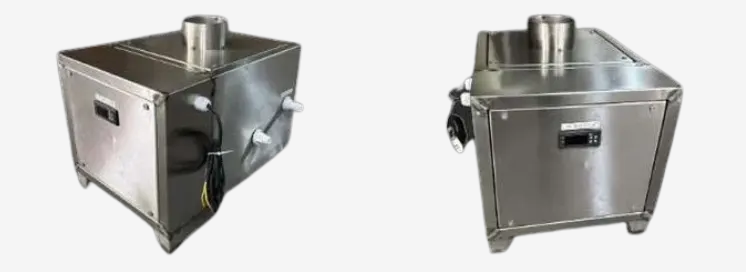
Vibrating-disc ultrasonic humidifiers producing fine cool mist to prevent weight loss in high-value produce — SS-304 food-grade construction, trusted by MNCs including PepsiCo and ITC.
Ultrasonic Humidifier Cold Storage — SS-304 — Prime Coil is an SS-304 vibrating-disc humidification system engineered to prevent weight loss in high-value produce, cure product surface dehydration, and hold humidity setpoints across the wide operating range that cold storage refrigeration inherently disrupts. Every ultrasonic humidifier we supply is trusted by MNCs including PepsiCo and ITC for their premium cold-chain operations — a track record built on food-grade construction, fine mist particle size, and reliable continuous operation.
Why cold storage needs active humidification
Refrigeration systems dehumidify air as they cool it — evaporator coils condense moisture out of the room atmosphere continuously. Without active humidification to replace that lost moisture, cold storage rooms drift toward humidity levels that damage product:
Weight loss on fresh produce. A 2% weight loss on ₹100/kg produce is ₹2 per kilogram of unsaleable inventory — across a season of storage, this can wipe out margin on high-value crops. Apples, pears, leafy vegetables, cut flowers, and mushrooms all lose weight measurably when RH drops below optimal targets. An ultrasonic humidifier for cold storage prevents that weight loss by holding humidity at the target setpoint.
Surface dehydration on meat and poultry. Chilled meat products lose surface moisture rapidly at low RH, developing dark surface layers that reduce visual appeal and sale price. Weight loss on meat also directly impacts margins in a way retailers actively track.
Product formulation stability in pharmaceuticals. Many pharmaceutical products require specific humidity ranges for stability — tablet coatings crack in dry conditions, capsules soften in wet conditions. Storage compliance with GDP requires holding these targets consistently.
Dust and static in dry-goods facilities. Grains, powders, and packaged products in dry cold rooms accumulate static charge and airborne dust when RH drops below 40%. Ultrasonic humidification suppresses both problems without wetting product surfaces.
Vibrating-disc ultrasonic technology
The Prime Coil ultrasonic humidifier for cold storage uses vibrating-disc (piezoelectric transducer) technology — the same approach used in premium medical and cleanroom humidifiers. A high-frequency oscillating disc submerged in a water reservoir generates ultrasonic vibrations that break water into extremely fine droplets (under 5 microns diameter) at the surface. The droplets rise as a cool, fine mist that evaporates completely before contacting product surfaces or building materials.
This is fundamentally different from steam humidification (which requires energy-intensive water heating and produces droplets that can wet surfaces) or spray humidification (which produces larger droplets that fall out of the air before evaporating). Ultrasonic humidification is:
- Cool — no heat added to the room, no additional refrigeration load
- Fine — droplets small enough to evaporate completely in air, no surface wetting
- Efficient — low electrical power (typically 40 W per litre-per-hour output)
- Silent — no fan noise, no compressor noise, essentially inaudible operation
SS-304 food-grade construction
Every ultrasonic humidifier for cold storage in our range is built with an SS-304 stainless steel body — the food-grade material specified for direct product-contact equipment in food processing plants. This matters because:
Regulatory compliance. SS-304 meets FSSAI and FDA food-grade requirements for equipment installed in food processing and food storage environments. Non-food-grade materials are not compliant, regardless of whether they contact product directly.
Long service life in humid environments. SS-304 resists corrosion from continuous water contact, humidity cycling, and cleaning chemical exposure. Standard cold-rolled steel or aluminium humidifiers corrode visibly within 12-18 months in cold storage operation.
Hygienic cleaning. Smooth SS-304 surfaces allow proper cleaning between production cycles — critical for facilities operating under FSSAI, FDA, or export audit requirements.
Fine mist under 5 microns
Particle size determines whether an ultrasonic humidifier for cold storage actually humidifies the air (fine droplets evaporate) or wets nearby surfaces (larger droplets fall). Our units produce mist under 5 microns diameter — small enough that droplets rise on ambient air currents, evaporate within seconds of leaving the humidifier, and never wet cardboard packaging, product surfaces, or building materials.
This particle size is the industry benchmark for cold-storage-suitable humidification. Cheaper humidifiers producing 10-20 micron droplets create constant condensation and dripping problems that ultimately damage more product than they save.
Trusted by MNC cold-chain operators
Our ultrasonic humidifier for cold storage is installed in cold storage facilities operated by MNCs including PepsiCo and ITC. These operators evaluate humidification equipment against specific criteria — food safety compliance, documented humidity control performance, reliability across multi-shift operations, and low operating cost. Reference installations across food processing, produce storage, and beverage warehousing anchor our product credibility.
Built to run, season after season.
SS-304 food-grade construction
Body fabricated from SS-304 stainless steel — the food-grade material specified for direct product-contact equipment in food processing. Meets FSSAI and FDA food-grade requirements. Resists corrosion from continuous humid environment, extends service life beyond 5+ years.
Vibrating-disc ultrasonic technology
Piezoelectric transducer generates ultrasonic vibrations that break water into extremely fine droplets at the reservoir surface. Same technology used in premium medical and cleanroom humidifiers. Cool operation, silent running, low electrical power consumption.
Fine mist under 5 microns
Particle size under 5 microns diameter — small enough that droplets rise on ambient air currents, evaporate within seconds of leaving the humidifier, and never wet product surfaces or packaging. Industry benchmark for cold-storage-suitable humidification.
Prevents produce weight loss
A 2% weight loss on ₹100/kg produce equals ₹2 per kg unsaleable inventory. Correctly-set humidification prevents that loss across the storage season. On a facility storing 500 tonnes of high-value produce, humidity control routinely saves ₹5-10 lakh per season in weight loss alone.
Misting capacity 5-40 LPH
Available in output capacities from 5 to 40 litres per hour, matching room volume and target humidity setpoint. Multiple units serve larger rooms; single unit handles small chambers. Our engineers calculate correct capacity based on room volume and hygrometric load.
Cool mist — no thermal load
Unlike steam humidifiers that add heat to the room and increase refrigeration load, ultrasonic humidification is cool operation. No compressor works harder, no refrigeration capacity consumed to remove humidification heat. Efficiency wins on every metric.
PLC-integrated modulation
Standard on/off control for basic installations; modulating control via 4-20 mA input for facilities with PLC control panels. Integrates directly with our PLC Control Panels for coordinated setpoint control across multiple chambers.
Trusted by PepsiCo, ITC
Installed in cold storage facilities operated by MNCs including PepsiCo and ITC. Reference installations across food processing, produce storage, and beverage warehousing. These operators evaluate humidification equipment against strict food safety, performance, and reliability criteria.
5,000-hour service life
Documented 5,000 working hours service life on the ultrasonic transducer — the primary wear component in ultrasonic humidifiers. Simple replacement procedure, standard spare parts availability. Real-world service life often exceeds specification with proper water quality.
Specifications
| Type | Vibrating-disc ultrasonic humidifier |
|---|---|
| Misting capacity | 5 to 40 litres per hour |
| Particle size | Less than 5 microns |
| Body material | SS-304 stainless steel |
| Power supply | 220 VAC, single-phase |
| Power consumption | ~40 W per LPH output |
| Water supply | Filtered water, 15°C to 30°C |
| Water quality | RO or softened water recommended |
| Control | On/off or 4-20 mA modulating |
| Mounting | Wall-mounted or trolley-mounted |
| Reservoir capacity | 5-30 litres depending on model |
| Sound level | Essentially silent operation |
| Operating temperature | 0°C to +40°C ambient |
| Certification | Compliant with food-grade equipment standards |
| Warranty | 1 year (with 5,000-hour transducer life) |
| Service life | 5,000+ working hours on transducer |
| Applications | Cold storage, food processing, pharma |
| Cleaning | Removable reservoir for periodic cleaning |
Where it's used.
- Cold storage warehouses
- Fresh produce storage
- Fruit & vegetable cold rooms
- Meat & poultry storage
- Cheese & dairy storage
- Mushroom cultivation chambers
- Pharmaceutical cold rooms
- Cut flower & bouquet storage
- Beverage warehousing
- Food processing facilities
Product questions, answered.
Why does cold storage need active humidification?
Refrigeration systems inherently dehumidify air as they cool it — evaporator coils condense moisture out of the room atmosphere continuously. Without active humidification to replace lost moisture, storage rooms drift toward dry conditions that damage product. On fresh produce, a 2% weight loss can wipe out margin on high-value crops. On meat and poultry, surface dehydration reduces visual appeal and sale price. Active humidification with a properly-sized ultrasonic humidifier holds humidity at target setpoints across the storage cycle.
Why ultrasonic instead of steam or spray humidification?
Three reasons. First, ultrasonic humidification is cool — it adds no heat to the room and creates no additional refrigeration load, unlike steam humidifiers. Second, particle size is fine (under 5 microns) so mist evaporates before contacting product surfaces, unlike spray humidifiers that produce larger droplets and wet surfaces. Third, power consumption is low (about 40 W per litre-per-hour of output) compared to steam humidification which requires energy-intensive water heating.
How much humidification does my facility need?
Depends on room volume, target humidity setpoint, ambient conditions, and how much dry outside air enters through ventilation and door openings. Rough guide: 1 LPH per 25-50 m³ of room volume for typical cold storage conditions, more for high-target-RH applications (leafy vegetables at 95%) or high-ventilation facilities. Our engineers calculate precise requirements during quotation based on your specific room specifications and product mix.
What water quality does the humidifier need?
RO (reverse osmosis) or softened water is strongly recommended. Hard water leaves mineral deposits on the ultrasonic transducer that reduce output and shorten service life. RO water maintains full transducer performance for the 5,000-hour service life. If RO is not practical, softened water with periodic descaling maintenance is the second-best option. Regular tap water reduces transducer service life significantly.
Can it integrate with my PLC control panel for setpoint control?
Yes — modulating variant accepts 4-20 mA signal for output modulation, integrating with any PLC or BMS. Our own PLC Control Panels handle this integration natively with pre-configured setpoint control logic. For basic installations without PLC, on/off control from a humidistat also works — the humidifier turns on when RH drops below target, off when RH reaches setpoint.
What products actually benefit from ultrasonic humidification?
Fresh produce (fruit, vegetables, mushrooms, cut flowers), fresh meat and poultry (surface hydration), fresh cheese and dairy (surface quality), pharmaceutical tablets and capsules (formulation stability), and dry-goods storage (static and dust suppression). Frozen products in blast freezers typically don't benefit — humidity is already low and adding moisture could cause frost buildup. Consult with our engineers on suitability for your specific product mix.
How much maintenance does the humidifier require?
Minimal for units running on RO water. Standard maintenance: reservoir cleaning every 2-4 weeks, transducer descaling every 3-6 months if using softened water instead of RO, and transducer replacement every 5,000 hours (typically 12-18 months of continuous operation). All maintenance tasks are simple procedures that on-site technicians can perform without specialised training.
What's the total operating cost — electricity and maintenance?
Electricity: approximately 40 W per LPH output. A 20 LPH unit running continuously consumes 800 W or roughly 6-7 kWh per day (₹50-60 per day at commercial tariffs). Water: RO water at typical consumption rates costs ₹100-200 per day for a 20 LPH unit. Maintenance: transducer replacement approximately ₹5,000-8,000 per year. Total operating cost is typically less than 5% of the weight-loss savings the humidifier delivers.
Every Prime Coil ultrasonic humidifier for cold storage is sized against your specific room volume and product humidity requirements. The equipment pays for itself in weight-loss prevention alone on typical produce operations — send us your facility details and we'll come back with the model, delivered price, and expected payback within one working day.
Tell us your daily requirement.
Share your output target, product and ambient conditions — we'll specify the machine and the plant around it.