Blast Freezer Refrigerant Selection — NH3 or HFC
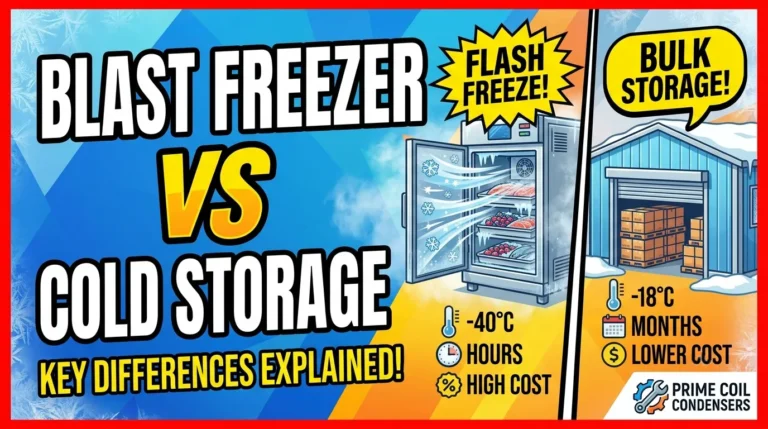
Most refrigerant comparisons are written about cold storage and then quietly applied to blast freezing, as though the two were the same problem at different setpoints. They are not. A cold store holds a stable load at a stable temperature and rewards steady-state efficiency. A blast freezer absorbs an enormous load in a few hours, then sits idle, then does it again — at an evaporating temperature 25 to 30 degrees lower.
That difference changes the answer. Refrigerants that look marginal at −10°C look very different at −40°C, and design decisions that barely matter in a cold room become the whole cost of the project in a blast freezer.
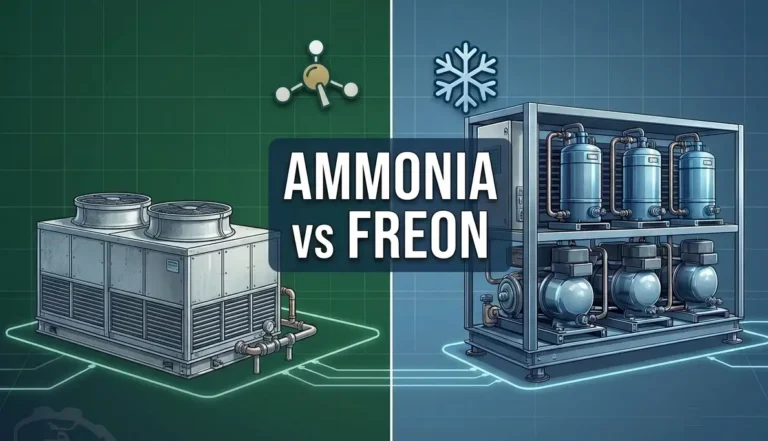
This article is only about blast freezing. If you are choosing a refrigerant for a facility as a whole, start with our broader guide to choosing between ammonia and Freon and come back here for the freezing tunnel.
Choose ammonia for large-scale, high-capacity industrial blast freezers requiring maximum energy efficiency and lowest running costs. Choose Freon (synthetic HFC/HFO blends) for smaller commercial setups, tight urban spaces where toxic gas rules restrict ammonia, or easier plug-and-play automatic operations
Why blast freezing is a different question
A blast freezer has one job: move product core temperature from around +5°C down to −18°C fast enough that ice crystals stay small. Crystal size is what determines drip loss on thaw, and drip loss is what your customer sees.
To do that, you need air at −30°C to −40°C moving across the product at 3 to 6 m/s. Air at −35°C needs a coil running at −40°C to −45°C saturated suction temperature. That number — SST, not room temperature — is what your refrigerant has to deliver, and it is where the physics starts to bite.
Three consequences follow, and each one costs money:
- The pressure ratio goes past what a single compression stage can handle.
- The load arrives in batches, with a peak at charge-in that can be three to five times the average.
- Frost accumulates fast, because warm wet product is walking into a −35°C room several times a day.
The evaporating temperature problem — and where ammonia goes sub-atmospheric
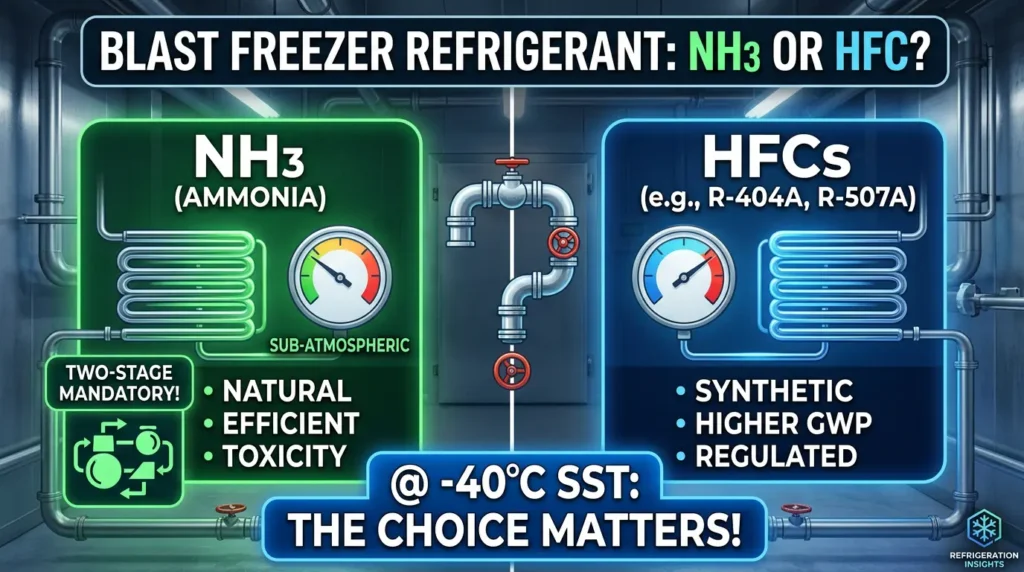
At −40°C, ammonia’s saturation pressure is roughly 0.72 bar absolute. Atmospheric pressure is 1.013 bar. Ammonia crosses below atmospheric at about −33°C, which means every blast freezer running ammonia has a low-pressure side operating under vacuum.
This is not a safety problem — a leak on a vacuum line draws air in rather than pushing ammonia out. It is an efficiency and maintenance problem, and it is consistently underestimated.
Air that gets into the system does not condense. It collects in the condenser and receiver, raises discharge pressure above what the condensing temperature alone would produce, and every additional degree of apparent condensing temperature costs 2 to 3% in compressor power. Moisture that comes in with the air reacts with the oil and eventually shows up as sludge in the oil separator and acidity in the oil analysis.
The fix is not complicated — an automatic air purger, properly specified shaft seals, and vacuum-rated gaskets on the low side — but it has to be in the scope from the start. We have seen plenty of ammonia blast freezers running 8 to 10% above design power because nobody fitted a purger and the plant had been accumulating non-condensables for three seasons.
R-404A and R-507 stay above atmospheric down to about −46°C. That is a genuine and frequently unmentioned advantage in this specific application.
Two-stage is not optional below −30°C
At −40°C SST and +35°C condensing, the pressure ratio for ammonia is roughly 18:1. Single-stage reciprocating compressors are comfortable to about 8:1 and struggle badly beyond 10:1. Screws will run higher ratios, but volumetric efficiency and discharge temperature both deteriorate.
Ammonia’s problem here is discharge temperature specifically. It has a steep saturation curve and a high isentropic exponent, and single-stage compression from −40°C to +35°C would put discharge temperature somewhere near 180–200°C. Mineral and PAO oils begin to break down well before that. The system either gets two-stage compression with intermediate cooling, or it destroys its own oil charge.
So an ammonia blast freezer means:
- Two-stage or compound compression, or a screw with liquid injection and an economiser
- An intercooler or gas–liquid cooler between stages
- Higher plant room footprint and more instrumentation
R-404A runs much cooler on discharge — typically 70 to 90°C in the same duty — which is why single-stage Freon blast freezers exist at all. They are still inefficient at that ratio, and two-stage or economised Freon systems are common on serious duties, but the failure mode is lost capacity rather than a coked compressor.
This is the honest summary: ammonia demands more engineering to survive the duty, and pays you back in running cost. Freon tolerates a simpler plant and charges you for it monthly.
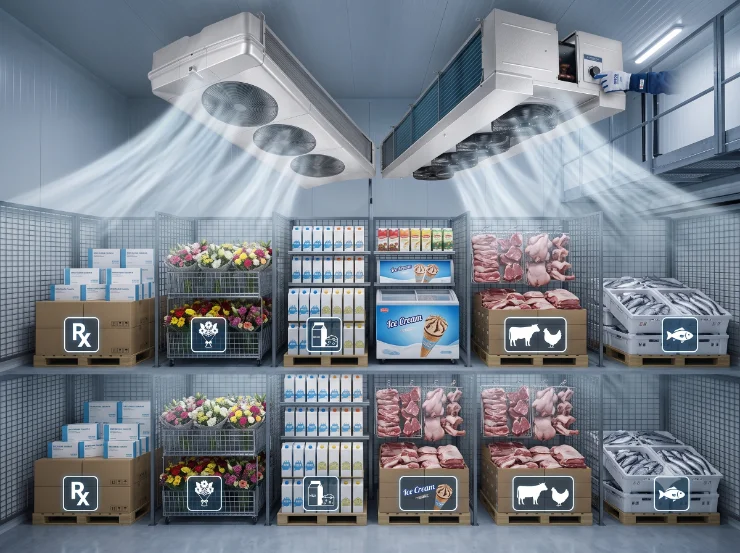
What the energy difference is actually worth
At −40°C SST and +35°C condensing, a well-executed two-stage ammonia plant typically reaches a COP around 1.5 to 1.7. An equivalent R-404A system lands closer to 1.2 to 1.35. Call it a 15 to 25% advantage to ammonia.
Put a number on it. A 10 MT per day blast freezer handling cartoned product from +5°C to −18°C:
- Product load over a 20-hour cycle: roughly 41 kW
- Plus evaporator fans, envelope gain and defrost recovery: total refrigeration duty around 65 kW
- Ammonia at COP 1.6 → about 41 kW absorbed
- R-404A at COP 1.3 → about 50 kW absorbed
- Difference: 9.4 kW, over 6,000 running hours a year = 56,400 kWh
- At ₹6.50 per unit: ₹3.7 lakh a year
Note the fan load in that calculation. Blast freezer fans are large and they run continuously through the cycle, and every watt they put into the air is a watt the refrigeration plant has to remove again. On a tunnel of this size fans can be 25 to 35% of total load, and that fraction is identical whichever refrigerant you choose. Chasing refrigerant efficiency while specifying cheap fan motors is the wrong order of operations.
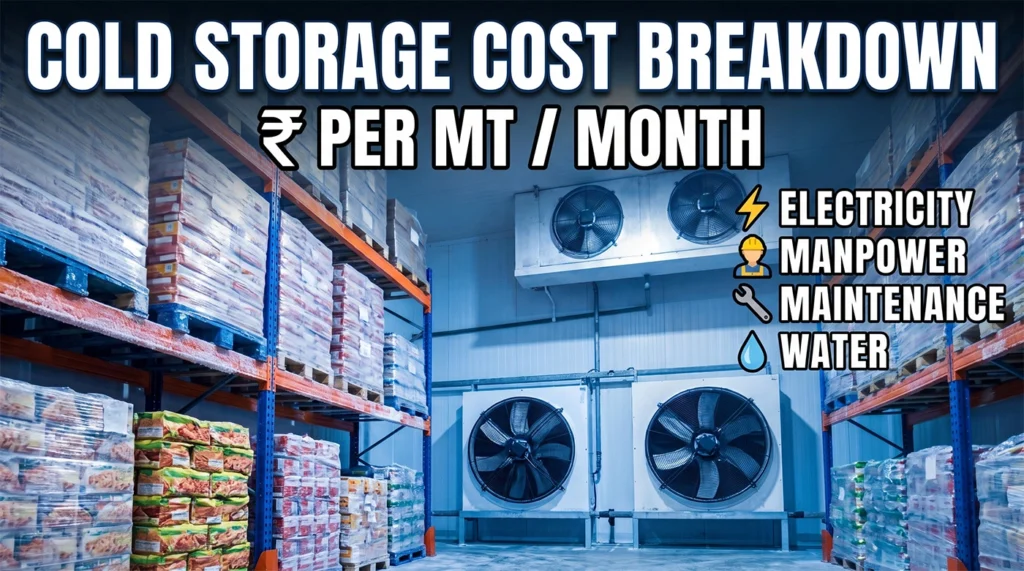
For the wider operating picture, our breakdown of cold storage running cost per MT per month covers the demand charge, manpower and maintenance lines that sit alongside this.
The batch load profile nobody sizes for
This is where blast freezer projects go wrong more often than on refrigerant choice.
Charge-in load is not average load. When a trolley of +5°C product enters a −35°C tunnel, the instantaneous heat load spikes, suction pressure rises, and the plant either has the capacity to hold SST or it does not. If SST drifts up from −40°C to −32°C during the first two hours, the freezing rate drops, crystals grow, and you get drip loss — with a plant that is nominally the right size on paper.
What this means in practice:
- Size on peak, not average. Averaging the daily load across 24 hours produces a plant that cannot hold temperature during pull-down.
- Multiple smaller compressors beat one large one. A single screw at 30% part load is far less efficient than two smaller machines with one shut down, and blast freezing spends a lot of its life at part load.
- Stagger your charge-in. Loading three tunnels simultaneously because the shift changed at 6 pm sets a demand peak you pay for all month.
Refrigerant choice interacts with this. Ammonia’s higher latent heat means lower mass flow for the same duty, which makes pumped liquid overfeed practical and gives good evaporator wetting under swinging load. Freon systems on DX depend on expansion valve response, and a TXV chasing a load that changes by a factor of four is not at its best.
Defrost is a throughput decision, not a maintenance one
Product entering a blast freezer is warm and wet. That moisture ends up on the coil. A blast freezer coil frosts far faster than a cold room coil, and a frosted coil loses capacity precisely when you need it.
Electric defrost on a blast freezer is a poor choice at scale. Every kW of defrost heat you put into a −35°C room is a kW the plant has to remove afterwards, and you pay for it twice. Hot gas defrost uses heat the system has already produced and rejects it more cleanly.
Ammonia hot gas defrost is mature and well understood, and the pressure differential available makes it fast. Freon hot gas defrost works but the gas is cooler, so cycles run longer. On a facility running three or four defrosts a day across multiple tunnels, that difference compounds into real lost throughput.
Whichever you choose, initiate defrost on demand — coil differential pressure or air-side temperature difference — rather than on a fixed timer. A timer either defrosts a clean coil or leaves a blocked one, and both cost you.
Where the plant sits usually decides more than the physics
Everything above argues for ammonia on efficiency. Here is the argument that most often wins the other way.
Blast freezers are usually inside the processing building, adjacent to areas where people work. Ammonia is toxic at concentrations well below what a leak in an enclosed space produces, and IS 660 requirements for machine room ventilation, detection and emergency provisions are not negotiable. A dedicated plant room, gas detection, emergency ventilation, trained operators on every shift, and PESO compliance are all real obligations with real recurring costs.
Choose ammonia when:
- The plant room can be genuinely separated from occupied production areas
- Duty is above roughly 50 TR, where the efficiency gain justifies the engineering
- You already run ammonia elsewhere on site and have the operators
- Load is continuous or near-continuous rather than a few hours a week
Choose Freon when:
- The freezer is inside an occupied building with no room for a compliant plant room
- Duty is small — below about 30 TR the ammonia efficiency gain rarely covers the added engineering, instrumentation and manning
- The unit needs to be packaged, skid-mounted or relocatable
- You have no ammonia-trained staff and no plan to acquire any
Our Freon blast freezer evaporator units exist for exactly the second case, and we build the ammonia equivalent for the first. We do not have a preference we are trying to sell you into.
One line item that gets forgotten in both cases: blast freezer doors. A tunnel door that seals badly at −35°C admits an infiltration load that will embarrass any refrigerant comparison you have made. Heater-traced frames and properly specified gaskets are not an accessory.
The 2032 question
If you are buying a blast freezer today, it will still be running in the 2040s. That makes the HFC phase-down a specification question, not a policy footnote.
India ratified the Kigali Amendment in September 2021 as an A5 Group 2 party. The baseline is the average HFC consumption over 2024–2026 plus 65% of the HCFC baseline. That baseline freezes on 1 January 2028, and reduction begins from 2032 in four steps — 10% in 2032, 20% in 2037, 30% in 2042, and 85% in 2047.
This does not ban anything on a date. It constrains supply, and constrained supply prices high-GWP refrigerants out first. R-404A is the obvious casualty: it is a blend of about 52% HFC-143a, 44% HFC-125 and 4% HFC-134a, with a GWP near 3,900. Any phase-down mechanism that weights by GWP hits R-404A hardest and earliest.
What that means in practice for a plant you commission this year:
- Do not specify R-404A for a new blast freezer. The service refrigerant will get expensive well before 2032, and topping up a leaky system in 2035 will be an unpleasant conversation.
- R-449A and R-448A are the usual lower-GWP HFC/HFO replacements — around 1,300–1,400 GWP, workable in blast freezing, with some capacity and glide penalties to design around.
- Ammonia has GWP zero and ODP zero. It is outside the phase-down entirely. On a twenty-year asset that is worth something real, independent of the energy argument.
- Design for the refrigerant you will run in 2040, not the one that is cheapest to charge today. Component selection — particularly evaporator circuiting and expansion device sizing — is not trivially retrofittable.
What we do not recommend
Single-stage ammonia below −33°C. It can be made to run. It should not be. Discharge temperature will shorten oil life and eventually the compressor’s.
Ammonia inside an occupied building without a compliant plant room. Not because it cannot be engineered, but because the compliance and manning obligations do not shrink to fit a small installation. If you cannot staff it properly, do not install it.
R-404A on anything new. Covered above. Even setting the phase-down aside, R-449A performs comparably and positions you better.
Sizing on average daily throughput. The most common specification error we see in enquiries. Ask for the peak charge-in load, not the tonnage per day.
Cheap doors on an expensive tunnel. An infiltration load you designed out is worth more than a COP point you argued over.