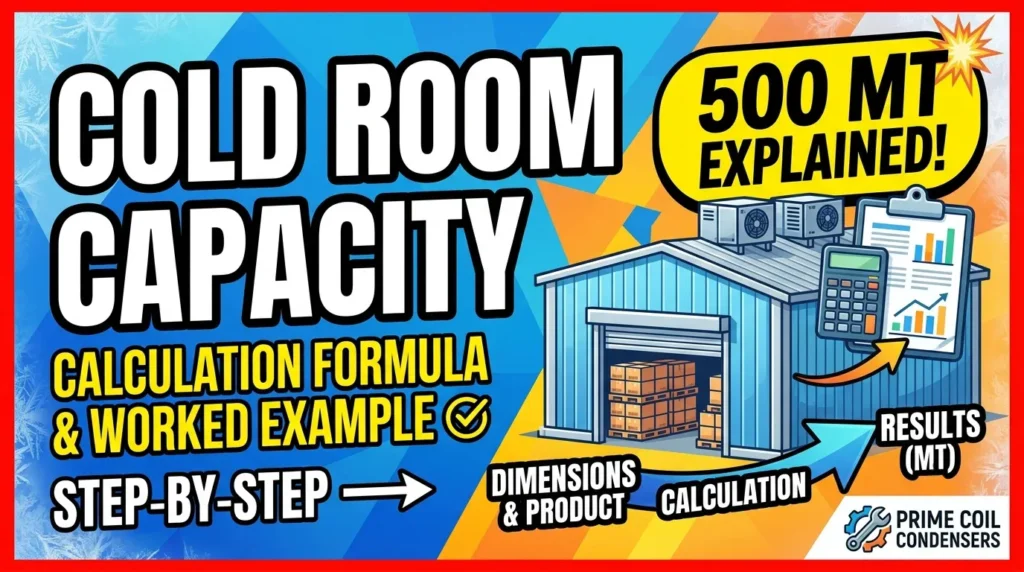
Getting cold room capacity wrong is one of the most expensive mistakes in a cold chain project. Undersize it and you turn away product every peak season; oversize it and you’re paying to refrigerate empty air for the next 20 years. This guide walks through the exact cold room capacity calculation formula our engineers use on every project — the same math that goes into a 50 MT walk-in and a 5,000 MT bulk cold store.
By the end, you’ll be able to convert any set of room dimensions into a storage figure in metric tonnes, size the refrigeration plant that goes with it, and avoid the three or four errors that show up on almost every DPR we review.
Storage capacity vs refrigeration capacity — don’t confuse them
Before touching a formula, separate two numbers that get mixed up constantly:
- Storage capacity is how much product (in MT) the room can physically hold. It’s a function of internal volume, how you stack, and what you’re storing.
- Refrigeration capacity is how much heat the plant must remove per hour, measured in TR (tons of refrigeration) or kW. It’s a function of room size, insulation, ambient temperature, product pull-down load, air changes, and internal heat sources.
You need both. Storage capacity tells you how big to build the room. Refrigeration capacity tells you what compressor, condensing unit, and evaporator to install. This article covers storage capacity in depth and gives you a reliable rule-of-thumb for the refrigeration side.
The cold room capacity formula
The core formula is straightforward:
Storage Capacity (MT) = Internal Volume (m³) × Volume Utilization Factor × Product Density (t/m³)
Three inputs, three steps. Get any one of them wrong and your final number is off by 30–50%.
Step 1: Calculate internal volume
Internal volume is the inside dimensions of the cold room — the space bounded by the insulated PUF panels, not the external building footprint. The difference matters because a 100mm panel eats 200mm off both length and width once you finish two opposing walls.
Formula:
Internal Volume (m³) = Internal Length × Internal Width × Internal Height
For a room measuring 10m × 8m × 5m externally with 100mm panels on all sides, the internal dimensions become approximately 9.8m × 7.8m × 4.9m, giving an internal volume of ~375 m³ — not 400 m³. Always measure or calculate on internal dimensions.
A common shortcut: for panel thicknesses of 80–150mm, subtract twice the panel thickness from each linear dimension.
Step 2: Apply the volume utilization factor
You cannot pack product wall-to-wall, floor-to-ceiling. Real cold rooms need:
- Aisles for forklifts, pallet trucks, or manual handling
- Air-circulation clearance (typically 300–500mm above stacks and along walls)
- Space around the evaporator unit for airflow and service
- Distance from the door for loading/unloading
This is captured in the volume utilization factor — the fraction of internal volume actually available for product. Typical values:
| Storage method | Utilization factor |
|---|---|
| Palletized storage, forklift access | 0.40 – 0.50 |
| Racking system, narrow-aisle forklift | 0.50 – 0.60 |
| Bulk stacking (bags, crates, drums) | 0.55 – 0.65 |
| Small walk-in rooms (< 50 m³) | 0.30 – 0.40 |
| Hanging carcass storage (meat) | 0.25 – 0.35 |
For most Indian potato and multi-commodity cold stores using bulk stacking of gunny bags or plastic crates, 0.55 is a safe design number. Palletized pharma or e-commerce stores usually work with 0.45.
Step 3: Multiply by product density
Product density is where most calculations quietly go wrong — people use the density of the raw product instead of the packed bulk density, which accounts for the packaging, air gaps, and stacking pattern. A bag of potatoes doesn’t stack like a solid block of potato.
Use these bulk densities for stacked, packaged product:
| Product | Bulk density (kg/m³) | Typical storage temp |
|---|---|---|
| Potatoes (gunny bags) | 650 | 2–4°C |
| Onions (mesh bags) | 550 | 0–2°C |
| Apples (CFB boxes) | 300 | -1 to 2°C |
| Bananas (cartons) | 280 | 13–14°C |
| Oranges (crates) | 350 | 3–8°C |
| Grapes (punnets) | 350 | -1 to 1°C |
| Mangoes (CFB boxes) | 550 | 10–13°C |
| Tomatoes (crates) | 380 | 10–13°C |
| Carrots (bags) | 550 | 0–2°C |
| Cabbage (bulk) | 250 | 0–2°C |
| Fish, frozen (boxed) | 450 | -18 to -25°C |
| Meat, frozen (boxed) | 400 | -18 to -25°C |
| Poultry, frozen (boxed) | 550 | -18 to -25°C |
| Butter / dairy (cartons) | 700 | 2–4°C |
| Ice cream (tubs, boxed) | 550 | -23 to -25°C |
| Frozen vegetables (bagged) | 400 | -18°C |
For multi-commodity stores, use a weighted average based on your expected product mix — or size to the highest-density commodity if the room may store a single product for stretches.
Worked example: 500 MT potato cold storage
A client in Uttar Pradesh wants to build a 500 MT potato cold storage. Let’s back-calculate the room size.
Target: 500 MT storage capacity
Product: Potatoes in gunny bags, bulk stacked
Density: 650 kg/m³ = 0.65 t/m³
Utilization factor: 0.55 (bulk stacking)
Rearranging the formula:
Internal Volume = Storage Capacity ÷ (Utilization × Density)
Internal Volume = 500 ÷ (0.55 × 0.65) = 1,399 m³
Now translate volume into physical dimensions. For potato storage, we typically use a ceiling height of 5.5–6 m to allow high stacking with proper air circulation. Taking 5.5 m as usable internal height:
Floor area needed = 1,399 ÷ 5.5 = ~255 m²
That works out to roughly a 17m × 15m internal room, or about 17.5m × 15.5m external including 100mm PUF panels. Add anti-room / staging area, plant room, and utility corridor, and your building footprint lands around 22m × 18m (~400 m²) on plot.
Sanity check: 1,399 m³ ÷ 500 MT = 2.8 m³ per MT, which matches the industry rule-of-thumb of 2.5–3.5 m³/MT for bulk-stacked potato cold storage. If your calculation lands outside that range, one of your inputs is wrong.
How much refrigeration capacity do you need?
Once storage capacity and volume are locked, size the refrigeration plant. A full heat load calculation considers transmission load through walls, product pull-down load, air infiltration through doors, and internal loads (lights, fans, people, forklifts). For a first-pass estimate, use these rules of thumb per m³ of internal volume in Indian conditions (35–45°C ambient):
| Room type | Temperature | Cooling load (kcal/hr per m³) |
|---|---|---|
| Chill room (fruit, vegetables, dairy) | 0 to 4°C | 40 – 60 |
| Cold store (multi-commodity) | -2 to 0°C | 50 – 70 |
| Frozen storage | -18 to -25°C | 80 – 120 |
| Blast freezer | -35 to -40°C | 150 – 250 |
Convert to TR: 1 TR = 3,024 kcal/hr.
For our 500 MT potato example (1,399 m³, chill room at 2–4°C, use 50 kcal/hr/m³):
Total load = 1,399 × 50 = 69,950 kcal/hr → ~23 TR
You’d typically install two condensing units of ~15 TR each (running duty + standby with 30% margin) rather than a single 23 TR unit. Redundancy matters — a single-plant failure during peak season can spoil a full room of product.
Common mistakes to avoid
- Using external dimensions. Adds 5–8% phantom capacity to your calculation.
- Ignoring the utilization factor. “Volume × density” alone overstates capacity by roughly 2×.
- Using product density instead of bulk (packed) density. Fresh apples aren’t 800 kg/m³ when they’re in CFB boxes stacked on pallets.
- Under-sizing ceiling height. A 3.5 m room forces low stacks; 5.5–6 m nearly doubles capacity on the same footprint at marginal extra cost.
- Skipping the refrigeration side. A perfectly-sized room with an undersized plant will never hold set-point during summer peaks.
- Not designing for future growth. Extending a cold room later costs 3–4× per m³ vs building larger upfront.
Frequently asked questions
How many cubic meters equal one metric tonne of cold storage?
For bulk-stacked commodities like potatoes and onions, plan on 2.5–3.5 m³ per MT of internal volume. For palletized mixed cargo, 4–5 m³ per MT is realistic. For hanging carcass meat storage, 6–8 m³ per MT.
What is the volume utilization factor in cold storage?
It’s the fraction of internal room volume actually filled with product after allowing for aisles, air-circulation clearance, and evaporator space. Ranges from 0.30 for small rooms to 0.65 for well-designed bulk-stacked stores.
How do I calculate cold storage capacity in tonnes?
Multiply internal volume in m³ by the volume utilization factor (typically 0.45–0.55) and the bulk density of your product in t/m³. Example: 1,000 m³ × 0.55 × 0.65 t/m³ = 358 MT.
What TR is needed for 1,000 MT cold storage?
Depends on temperature and construction, but for a well-insulated 1,000 MT chill store in Indian conditions, expect ~45–55 TR of refrigeration capacity. Frozen storage of the same tonnage needs 75–100 TR.
Does cold room capacity include the anti-room and dock?
No. Storage capacity refers only to the temperature-controlled product-storage area. Anti-rooms, docks, and staging zones are separate and typically add 15–20% to overall building footprint.
Get sizing right the first time
A correctly-sized cold room saves lakhs in wasted capex, decades of unnecessary energy bills, and prevents the operational headache of always running out of space at peak. The formula above will give you a defensible design number — but for any project above 200 MT, a full heat-load calculation and refrigerant selection matters just as much as the storage math.
Prime Coil Condensers designs and manufactures the full cold room package — insulated PUF panels, modular cold rooms, ammonia refrigeration systems, and condensing units — for projects from 50 MT walk-ins to 10,000 MT bulk stores. For a sized-and-costed proposal specific to your product, temperature, and location, get in touch with our engineering team.
Related reading: Industrial cold storage cost in India · Cold storage running cost per MT · Ammonia or Freon: choosing the right refrigerant