Every serious cold storage project starts with the same question: what is this actually going to cost? Fair question, and one every builder in the market has a confident answer to. The confident answers are usually wrong.
We’ve been engineering ammonia and Freon refrigeration systems for cold storage projects across India for over 25 years. The numbers in this article come from actual quotes and completed projects, not from marketing brochures. They are directional — every site is different — but they are honest.
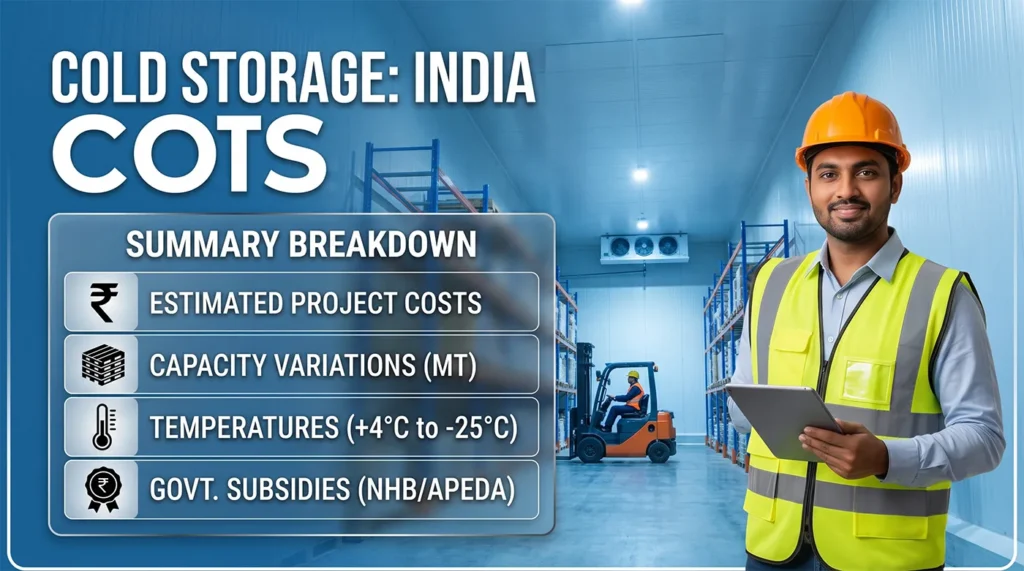
Here is what an industrial cold storage costs in India in 2026, why the range is so wide, and where the money actually goes.
The honest answer, up front
For 2026, the realistic cost range for a turnkey industrial cold storage in India — excluding land — sits between:
- ₹0.30 to ₹0.80 lakh per metric tonne of storage capacity
- ₹2,500 to ₹5,000 per square foot of built area
- ₹1.5 crore to ₹5 crore for a typical 1,000 MT multi-commodity facility
The reason this range spans nearly 3x is that “industrial cold storage” describes very different products. A potato cold storage running at +2°C to +4°C is engineered nothing like a seafood freezer running at −25°C. The four things that move a quote are, in order of impact:
- Operating temperature — the single biggest cost driver
- Storage capacity — larger facilities benefit from economies of scale
- Product type and process — pharma and CA storage add compliance cost
- Regional variation — ambient conditions, water availability, power tariff
Everything else is noise. If a supplier gives you a firm number before understanding these four, they are either quoting cheap to win and change later, or they have a template facility they build regardless of your requirement.
Cost by capacity — how scale changes the numbers
Cold storage economics improve significantly with size. A 100 MT facility can cost ₹1.5 lakh per MT because the refrigeration plant serves a small volume; a 5,000 MT facility can bring that down to ₹35,000 per MT because the same core equipment amortises across more storage.
Here is a realistic 2026 cost range by capacity for a multi-commodity facility operating between 0°C and +8°C:
| Capacity | Total cost range | Per MT | Typical use case |
|---|---|---|---|
| 50-100 MT | ₹15-25 lakh | ₹15,000-25,000 | Small pharmaceutical, boutique dairy, farm-gate storage |
| 500 MT | ₹75 lakh-₹1.2 crore | ₹15,000-24,000 | Medium regional cold storage, small food processor |
| 1,000 MT | ₹1.4-1.8 crore | ₹14,000-18,000 | Standard multi-commodity warehouse |
| 2,000 MT | ₹2.5-3.2 crore | ₹12,500-16,000 | Larger regional facility |
| 5,000 MT | ₹4-6 crore | ₹8,000-12,000 | Large distribution centre |
| 10,000+ MT | ₹7-15 crore+ | ₹7,000-11,000 | Major distribution hubs |
These numbers assume standard construction and multi-commodity duty. Frozen and blast freezing facilities cost 40-80% more; pharmaceutical facilities cost 60-100% more. See the temperature breakdown below.
Land is excluded from every number in this table. Land cost is site-specific and separately negotiated; in industrial land near urban markets, it can equal or exceed the built facility cost.
Cost by temperature — where the biggest variation lives
Same 1,000 MT facility, four different operating temperatures. Watch the numbers move:
| Facility type | Temperature | Cost per MT | 1,000 MT total |
|---|---|---|---|
| Potato / onion storage | +2°C to +4°C | ₹8,000-12,000 | ₹80 lakh-₹1.2 crore |
| Multi-commodity chill | 0°C to +8°C | ₹14,000-18,000 | ₹1.4-1.8 crore |
| Frozen food storage | -18°C to -25°C | ₹20,000-30,000 | ₹2-3 crore |
| Blast freezing chamber | -30°C to -40°C | ₹30,000-45,000 | ₹3-4.5 crore |
| Controlled atmosphere (apple, kiwi) | -1°C to +2°C, sealed | ₹22,000-32,000 | ₹2.2-3.2 crore |
| Pharmaceutical cold storage | +2°C to +8°C, validated | ₹25,000-40,000 | ₹2.5-4 crore |
Three practical takeaways:
Every degree colder adds cost. Insulation gets thicker (150-200 mm PUF for blast freezer vs 60-80 mm for chill), refrigeration systems get more complex (multi-stage compression, lower suction pressures), doors get purpose-built (heated frames to prevent freeze-stick), and everything has to be rated for the operating condition. There are no shortcuts here.
Sealed atmospheres cost more than they look. Controlled atmosphere storage needs gas-tight construction, atmosphere sensors, nitrogen generators, and continuous monitoring on top of standard cold storage. The temperature is not the driver — the sealing and monitoring are.
Pharmaceutical is compliance-driven, not capacity-driven. A validated pharma cold storage at +2°C to +8°C costs more per MT than a −20°C freezer of the same size, because the money goes into documentation, validation, backup systems, and continuous monitoring — not into refrigeration.
Where the money actually goes
For a typical multi-commodity industrial cold storage in the ₹1.5 to ₹3 crore range, the capital cost breaks down roughly like this:
| Component | Share of budget | What it covers |
|---|---|---|
| Refrigeration equipment | 35-40% | Compressors, condensers, evaporators, receivers, piping, controls, commissioning |
| Insulated panels (envelope) | 15-20% | PUF/PIR wall, ceiling, floor panels; joint hardware; cove trim |
| Civil works | 15-20% | Foundation, floor slab, structural steel, dock levellers, ancillary rooms |
| Electrical infrastructure | 8-12% | Transformer, switchgear, DG set, cabling, distribution panels |
| Doors and access | 5-8% | Sliding, hinged, automatic, blast freezer, high-speed rolling doors |
| Controls and automation | 3-5% | PLC panels, sensors, monitoring systems, remote access |
| Contingency and commissioning | 5-10% | Testing, adjustment, operator training, buffer for surprises |
Two observations that surprise most first-time buyers:
Refrigeration is the single largest line item — always. If a quote shows refrigeration at less than 30% of the total, one of three things is happening: the equipment is under-specified, the civil work is over-priced, or something is missing from the scope entirely. All three cause problems downstream.
Doors are cheap on paper, expensive in operating cost. A 5-8% share of capital sounds reasonable, until you realise that poor doors leak refrigeration energy every hour of operation. On a facility opening doors 100+ times per day, cheap doors add 10-15% to annual electricity bills. The saved capital pays for itself in wasted electricity within 24-36 months. See our detailed cold storage door selection guide for what to actually specify.
The hidden costs that trip up first-time buyers
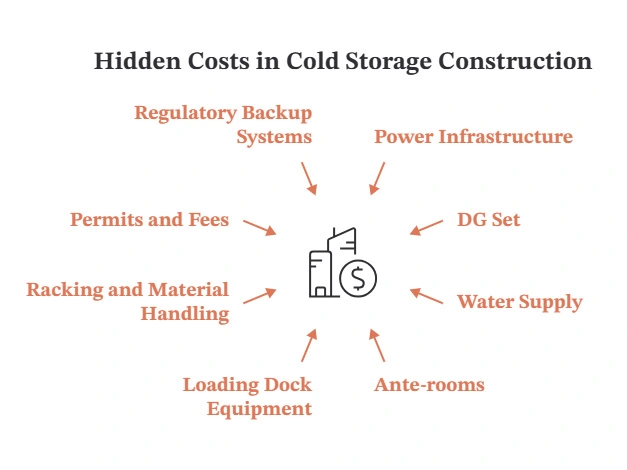
The construction quote you receive rarely includes everything you need. These are the costs that consistently show up outside the initial number:
Power infrastructure and transformer. A 1,000 MT cold storage typically needs a 250 kVA transformer with associated switchgear, cabling, and utility connection charges. Depending on your state DISCOM’s connection charge structure, this can add ₹8-15 lakh that quotes rarely include. For remote sites, HT connection upgrades can be significantly higher.
DG set (diesel generator). Cold storage cannot afford grid failures — even a 4-hour outage in summer can damage inventory. A 250 kVA DG set with AMF panel, fuel tank, and canopy adds ₹10-15 lakh. For frozen and blast freezer facilities, DG sizing has to match the full refrigeration load, not just critical circuits.
Water supply and treatment. Evaporative condensers consume significant water — a 100 TR system uses roughly 400-600 litres per hour continuously. If your site does not have adequate water supply, borewell installation, storage tanks, and softening/filtration can add ₹3-8 lakh.
Ante-rooms and dispatch areas. The room where forklifts stage product before moving into cold storage. Often forgotten in initial quotes. Adds 10-15% to the built area at approximately 60% of cold storage cost per sq ft.
Loading dock equipment. Dock levellers, dock seals, and dock shelters — critical for reducing air infiltration during loading. A single dock bay with proper equipment adds ₹2.5-5 lakh.
Racking and material handling. Storage racks, pallet trucks, and forklifts. Not part of the facility build but essential for operation. Budget ₹8-15 lakh for a 1,000 MT facility.
Permits, no-objection certificates, and consultant fees. Fire NOC, pollution control clearance, factory registration, PESO certification for ammonia systems, and architectural/engineering consultancy fees typically total 2-3% of project cost.
Regulatory backup systems. For pharmaceutical facilities, redundant refrigeration systems, backup DG, uninterrupted power for controls, and continuous monitoring add 20-30% on top of standard cold storage cost. This is not optional — GDP compliance requires it.
For a project budgeted at ₹1.5 crore, the honest all-in number after these additions typically runs ₹1.8-2.2 crore. Any supplier who claims their initial number is comprehensive is either padding contingency heavily, or they will come back for change orders after commitment.
What you should never cut to save money
Refrigeration is one of those industries where cheap capital decisions cost you every month for the next 20 years. Here are the false economies we watch clients almost make, and why they should not:
Cheap insulation panels. Panels are 15-20% of your capital cost — cutting them by 20% saves ₹4-6 lakh on a ₹1.5 crore project. That saving pays for itself with ₹1.5-2 lakh per year in additional refrigeration electricity. Two-year payback for saving nothing over 20 years.
Under-specified doors. A ₹40,000 residential-style door instead of a ₹1.2 lakh purpose-built cold storage door saves ₹80,000 up front. That door leaks refrigeration every hour of operation, warps within 18 months, and needs replacement in year 3. Three cycles of replacement cost more than one properly-specified door installed once.
Skipping automatic condensate management. Manual condensate drainage on evaporators means someone is walking through your cold storage twice daily to check drain pans. Automatic hot-gas defrost with condensate heaters costs 8-12% more upfront and eliminates a permanent labour cost.
Rated-for-ideal-conditions equipment. Compressors rated for 32°C ambient work fine in Bengaluru; they struggle in Chennai and fail regularly in Ahmedabad summer. Insist on equipment rated for your actual peak ambient — usually +5°C above the highest recorded summer temperature. See our detailed guide on reducing ammonia plant room energy cost for why oversized/undersized equipment costs the same problem differently.
No monitoring system. A ₹3-5 lakh monitoring system on a ₹1.5 crore facility feels expensive until the first year, when it identifies compressors drawing 15% more power for the same load, valves cycling too often, and defrost cycles happening on coils that have no frost. Most operating problems are found before they become failures. Without monitoring, they become failures.
The refrigerant choice — a hidden cost lever
Whether your cold storage runs on ammonia (R-717), synthetic HFC refrigerants, or CO₂ significantly affects both capital and operating cost.
Ammonia is the cost-effective choice for facilities above 200 TR of refrigeration capacity. Ammonia refrigeration equipment costs roughly the same as Freon equipment for equivalent capacity, but ammonia’s thermodynamic properties are 15-20% better — meaning less compressor work for the same cooling. Operating cost advantage compounds over 15-20 year facility life. Safety infrastructure (PESO compliance, ventilation, sensors) adds capital cost.
Synthetic HFC refrigerants (R-404A, R-134a, R-410A) are simpler to install and don’t require PESO certification. They cost more per operating hour due to lower efficiency, and future HFC phase-down regulations create uncertainty about long-term availability of specific refrigerants. Best for facilities below 100 TR where ammonia infrastructure is not justified.
CO₂ (R-744) is emerging in Indian industrial refrigeration for its zero ODP and negligible GWP. Capital cost is 15-25% higher than ammonia at similar capacities, but regulatory positioning is excellent. Currently better suited to specific applications (secondary loops, low-temperature stages of cascade systems) than as a primary refrigerant.
The complete refrigerant selection framework is covered in our guide on choosing between ammonia and Freon. For most industrial cold storage projects above 500 MT in India, ammonia delivers the lowest total cost of ownership by a meaningful margin.
Government subsidies — the realistic view
The Indian government supports cold chain infrastructure through multiple schemes. In practice, the significant ones for cold storage projects are:
MIDH (Mission for Integrated Development of Horticulture) — up to 35% of eligible project cost as back-ended subsidy, 50% for SC/ST, women entrepreneurs, and Northeast states.
PMKSY (Pradhan Mantri Kisan Sampada Yojana) — grant-in-aid up to 35-50% of project cost depending on facility type and location.
NHB (National Horticulture Board) — credit-linked back-ended subsidy up to 40% for general category, 55% for hilly and scheduled areas, capped at ₹8 crore for cold storage projects.
NCDC (National Cooperative Development Corporation) — loans and subsidies for cooperative cold storage projects.
Three practical realities that industry guides gloss over:
Subsidies apply to eligible cost norms, not to whatever you spend. If MIDH’s eligible cost norm for a 1,000 MT multi-commodity cold storage is ₹1.4 crore and your actual project costs ₹1.8 crore, the 35% subsidy is calculated on ₹1.4 crore (₹49 lakh), not on your ₹1.8 crore actual cost.
Back-ended means you pay first. You finance and complete the project at full cost, then apply for subsidy disbursement after commissioning verification. Working capital planning has to assume you receive nothing from subsidies during construction.
Documentation is significant work. Subsidy applications require detailed project reports, quantity surveys, certified equipment lists, and post-commissioning inspection. Budget ₹1.5-3 lakh for consultant fees to prepare a professional subsidy application. Poor documentation is the leading cause of subsidy rejection or reduction.
Subsidies are real and worth pursuing. They are not, however, a substitute for careful project cost management. A well-managed project with 35% subsidy delivers better economics than a padded project with 50% subsidy.
Timeline and how it affects cost
Cold storage projects in India typically follow this timeline:
| Phase | Duration | What happens |
|---|---|---|
| Design and approvals | 1-2 months | DPR, permits, subsidy application, vendor selection |
| Civil works | 3-4 months | Foundation, structural steel, roofing, floor slab |
| Insulated panel installation | 3-4 weeks | Wall, ceiling, floor panels; joint sealing |
| Refrigeration equipment | 2-4 weeks | Delivery, installation, piping, commissioning |
| Electrical and controls | 2-3 weeks | Transformer connection, DG set, PLC, sensors |
| Testing and handover | 2-3 weeks | Pull-down testing, calibration, operator training |
| Total | 6-8 months | From order to operational |
Faster is possible, but expensive. Every month cut from the 6-8 month baseline typically adds 8-15% to total cost through:
- Overtime labour on civil works
- Premium delivery on long-lead equipment
- Multiple concurrent contractors requiring more coordination
- Air freight vs sea freight for imported components
Slower is possible, but also expensive. Delays beyond baseline typically add:
- Escalation on material costs
- Extended overhead on consultants and site staff
- Financing cost on project loan
- Deferred revenue from operational start
For most projects, 6-8 months delivers the best cost-time trade-off. Faster commissioning is worth paying for only if delayed operations cost more than the acceleration premium.
What we don’t include in our quotes
We think buyers should know exactly what a “turnkey” quote actually covers, and what typically doesn’t. When Prime Coil quotes a facility, our scope includes:
Included:
- Refrigeration equipment (compressors, condensers, evaporators, receivers, piping, valves, controls)
- Insulated panels for envelope construction
- Cold storage doors (sliding, hinged, automatic, blast freezer, or specialty per requirement)
- PLC-based automation with sensors and remote monitoring
- Site installation, testing, commissioning, and operator training
- Complete documentation, wiring schematics, and warranty
Typically excluded (client scope or separately quoted):
- Civil works (foundation, structural steel, floor slab, roofing)
- Electrical infrastructure upstream of the main plant panel (transformer, HT/LT connection)
- DG set
- Water supply and treatment
- Racking, material handling equipment (forklifts, pallets)
- Loading dock equipment
- Consulting fees, permits, subsidy documentation
We think this scope split is honest. Buyers know exactly what they are paying us for and what remaining scope they need to arrange separately. Suppliers who “include everything” typically padding at 15-20% margins on scope they subcontract; buyers pay more for less transparency.
What to ask suppliers before you commit
Whatever supplier you are evaluating, these six questions separate serious partners from opportunistic ones:
- “What ambient conditions are your equipment rated for?” — If they don’t ask you back about your site’s summer peak, they don’t understand your problem. Insist on equipment rated for your actual conditions plus 5°C.
- “Show me a similar facility you’ve commissioned in the last 3 years.” — Referrals from real operating installations reveal more than any datasheet. Visit if possible.
- “What refrigerant are you specifying, and why?” — If they can’t articulate the ammonia vs Freon vs CO₂ trade-off for your specific capacity and application, they’re going with what’s easy for them, not right for you.
- “What’s your commissioning process?” — Serious suppliers walk through pull-down testing, load matching, control tuning, and formal handover. Cheaper suppliers skip most of this and disappear after installation.
- “What warranty do you provide, and what’s your service response time?” — Cold storage cannot afford extended breakdowns. Confirm response commitments in writing.
- “What happens if you don’t hit the specified temperature?” — The answer separates confident suppliers from ones who plan to blame something else. Look for specific corrective commitments, not vague reassurances.
The bottom line
An industrial cold storage in India costs what it needs to cost — no more, and no less if you’re serious about a 20-year facility. The projects that go over budget usually do so because the initial number ignored realities that reappear later. The projects that operate profitably do so because the money was spent on equipment and construction that keeps performing after commissioning.
If you’re planning an industrial cold storage project — whether 100 MT or 10,000 MT — we would rather talk through your specific requirement than quote from a template. Send us your capacity target, operating temperatures, and site conditions. We come back with a realistic engineering scope, honest cost estimate, and a clear split between what we supply and what you’ll need separately.
The best cold storage projects are the ones where nobody is surprised by the final invoice.