Ask ten cold chain buyers to explain the difference between a blast freezer vs cold storage and you’ll get eight versions of “one is colder than the other.” Technically true, commercially misleading. The two do fundamentally different jobs, cost very different money, and installing the wrong one is one of the more expensive mistakes in food processing.
This guide walks through what each system actually does, the temperature and time specifications that matter, why you often need both, and how to know which your operation should invest in first.
The one-line difference
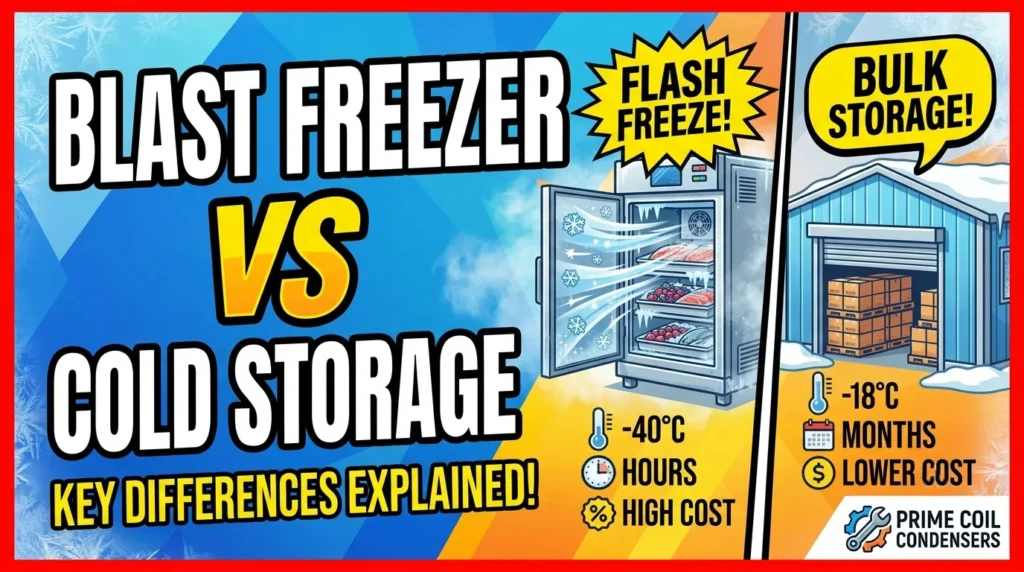
A cold storage holds product that is already at its target temperature. A blast freezer takes product from warm or ambient temperature down to frozen — fast — and then hands it off to cold storage for long-term holding.
Cold storage maintains. Blast freezer transforms. Confusing the two is like confusing an oven with a warming drawer.
Temperature ranges compared
| Parameter | Cold Storage (Frozen) | Blast Freezer |
|---|---|---|
| Room temperature | -18 to -25°C | -35 to -40°C |
| Air velocity over product | 0.3 – 0.5 m/s | 3 – 6 m/s |
| Purpose | Maintain frozen state | Freeze product rapidly |
| Product entry temperature | Already frozen (-18°C) | Warm / ambient (up to +40°C) |
| Cycle time | Continuous (days to months) | 2 – 24 hours per batch |
| Typical batch size | Full room (100s of MT) | 500 kg – 5,000 kg per cycle |
A frozen cold store running at -20°C isn’t going to freeze fresh mutton — it’ll take days, and by the time the core reaches -18°C, the surface has been in the danger zone long enough to compromise quality and shelf life. A blast freezer at -35°C with 5 m/s air velocity does the same job in 4–8 hours.
Why freezing speed matters
When water inside food freezes slowly, it forms large ice crystals. These crystals rupture cell walls. When the product thaws, cellular fluid leaks out — you see it as drip loss, and the customer sees it as tough, dry, discolored meat or mushy vegetables.
Fast freezing forms small ice crystals that don’t damage cell structure. The product thaws back to something close to its original texture, color, and weight. This is why:
- Meat processors lose 3–8% product weight to drip loss with slow freezing vs 0.5–1.5% with blast freezing
- Seafood exporters can’t sell to premium markets (Japan, EU) without IQF or blast-frozen product
- Ready-meal manufacturers need blast freezing to lock in sauce texture and prevent ice-crystal formation on sauces during storage
- Ice cream producers use blast freezing (hardening tunnels) to prevent grainy texture
The industry benchmark: product should pass through the critical zone of -1°C to -5°C in under 4 hours. This is the range where ~80% of water freezes and where ice crystal size is determined. A blast freezer is built to blow through this zone fast; a cold store isn’t.
How the equipment differs
Refrigeration capacity per m³
A frozen cold store in Indian conditions needs roughly 80–120 kcal/hr per m³ of internal volume. A blast freezer needs 150–250 kcal/hr per m³ — roughly 2–3× the refrigeration plant per unit of room volume, because you’re actively removing heat from product, not just holding losses.
Evaporator design
Cold storage evaporators are sized for low air velocity — you don’t want to dry out product sitting for months. Blast freezer evaporators are the opposite: oversized fans, tight fin spacing (but with defrost provisions), and ducting or trolley arrangements that force high-velocity cold air across every surface of the product.
Doors and insulation
Blast freezers use specialized blast freezer doors with heater cables to prevent frost sealing them shut, and typically 150–200mm PUF panel thickness (vs 100–150mm for standard frozen storage). Loading/unloading is frequent, and every door opening at -35°C hits the plant hard.
Compressor selection
Blast freezers usually run two-stage compression or booster + high-stage arrangements because single-stage compression from -40°C evaporating temperature to +45°C condensing is thermodynamically punishing. Cold storage at -20°C can often run single-stage.
Cost comparison
Approximate installed costs in India, 2026 pricing:
| Type | Cost per MT capacity | Cost per TR of refrigeration |
|---|---|---|
| Chilled cold storage (2–4°C) | ₹15,000 – 25,000 | ₹1.2 – 1.8 lakh |
| Frozen cold storage (-18 to -25°C) | ₹25,000 – 40,000 | ₹1.8 – 2.5 lakh |
| Blast freezer | Not measured per MT (batch equipment) | ₹3.5 – 5 lakh |
Blast freezers cost 3–4× per TR because everything is heavier duty — bigger compressors, oversized evaporators, thicker insulation, specialized doors, two-stage refrigeration, and often ammonia refrigeration systems for large-throughput plants.
When you need a blast freezer
You need a blast freezer if any of these apply:
- You’re freezing product on-site from fresh or warm state — meat, poultry, seafood, ice cream, ready meals, bakery, dairy
- You need to preserve premium texture — IQF vegetables, prawns, fish fillets, berries
- You export to markets that specify freezing rate on documentation (EU, Japan, Middle East)
- Regulatory compliance — FSSAI, HACCP, and BRC standards specify time-temperature freezing profiles for many product categories
- You need product turnaround within 24 hours of processing
When cold storage alone is enough
Cold storage without a blast freezer works fine if:
- You’re a distributor or 3PL holding already-frozen product from suppliers
- You store chilled fruit, vegetables, dairy, or pharma (never freezing anything)
- You handle potatoes, onions, apples, spices — the classic Indian cold chain use case
- Your incoming product is already at target temperature — from a supplier’s blast freezer, an IQF tunnel, or a reefer container
For these operations, a well-designed modular cold room with the right insulation, evaporator sizing, and refrigeration plant handles everything. Adding a blast freezer would be capex you don’t need.
The most common setup: both, in sequence
Most food processing plants run blast freezer + frozen cold storage in series. Fresh product enters the blast freezer, spends 4–24 hours getting frozen to core, then transfers to the cold storage for long-term holding until dispatch.
Sizing rule of thumb: your blast freezer capacity per cycle should equal your daily processing throughput. Your cold storage should hold 2–4 weeks of frozen output, depending on your dispatch cycle and safety stock policy. For a plant processing 5 MT/day of fish, that’s typically a 5 MT blast freezer feeding a 100–150 MT frozen cold store.
Blast freezer types
Not all blast freezers look the same. The four common configurations:
- Air blast (batch room) — product on trolleys is rolled into a room; simple, flexible, most common in India. Best for varied products and small-to-medium volumes.
- Tunnel freezer — continuous belt or trolley system; higher throughput, standardized product. Common for shrimp, fish fillets, ready meals.
- IQF (Individually Quick Frozen) — spiral or fluidized bed; product frozen as individual pieces, not blocks. Standard for peas, corn, berries, prawns.
- Plate freezer — product pressed between refrigerated plates; fastest freezing per kg, used for uniform block products like fish blocks, meat portions.
Common mistakes to avoid
- Trying to freeze product in a cold store. The plant will run continuously trying to hold set-point, freezing will take 3–5× longer than a blast freezer, and quality will suffer. Also damages the compressor from constant high load.
- Undersizing the blast freezer. A blast freezer sized for average throughput will bottleneck at peak season. Size for peak, not average.
- Skimping on door specifications. Standard cold room doors on a blast freezer will frost, seal, and eventually fail. Use purpose-built blast freezer doors.
- Wrong evaporator selection. Cold-storage-spec evaporators in a blast freezer application will underperform badly. Fin spacing, fan power, and defrost design are all different.
- Ignoring load calculation for product pull-down. Blast freezer heat load is 60–70% product pull-down (removing heat from the product itself). Miss this and the plant will never hit set-point.
Frequently asked questions
What temperature is a blast freezer vs a cold storage?
Blast freezers operate at -35 to -40°C to freeze product rapidly. Frozen cold storage operates at -18 to -25°C to maintain already-frozen product. Chilled cold storage runs at 0 to 4°C for fresh product.
Can I use a cold storage as a blast freezer?
No. A cold storage lacks the refrigeration capacity, air velocity, and evaporator design to freeze product quickly. Attempting it results in poor product quality, extended freezing times of 3–5 days instead of hours, and severe stress on the refrigeration plant.
How long does blast freezing take?
Depends on product thickness, packaging, and starting temperature. Typical times: fish fillets 2–4 hours, meat blocks 8–12 hours, poultry carcasses 12–18 hours, ready meals 3–6 hours. Rule: the product core must pass -1°C to -5°C in under 4 hours to qualify as blast frozen.
Do I need a blast freezer or an IQF freezer?
IQF is a type of blast freezing where each piece is frozen individually rather than as a block. If your product is small, uniform, and needs to remain free-flowing (peas, prawns, berries), you need IQF. For blocks, cartons, or hanging carcasses, a standard air-blast freezer works.
How much does a blast freezer cost in India?
For a 2 MT/cycle blast freezer with condensing unit, evaporator, doors, and panels, expect ₹18–30 lakh installed. A 5 MT/cycle unit runs ₹40–65 lakh. Ammonia-based systems for large plants (10+ MT/cycle) start around ₹80 lakh and go up. Costs vary with insulation grade, refrigerant choice, and site conditions.
Is a blast chiller the same as a blast freezer?
No. Blast chillers cool cooked food from +70°C to +3°C in under 90 minutes to preserve safety and quality — they don’t freeze. Blast freezers take product from ambient or warm state down to -18°C or lower. Different equipment, different applications.
Choose the right equipment for your operation
The wrong choice between blast freezer and cold storage costs lakhs in capex you didn’t need — or worse, forces you to add equipment retroactively while your existing plant limps along. Get the process flow right first (what temperature does product arrive at, and what temperature does it need to leave at), size for peak throughput, and specify equipment purpose-built for each stage.
Prime Coil Condensers manufactures the full range for both applications — blast freezer evaporators, blast freezer doors, modular cold rooms, ammonia refrigeration systems, and freon condensing units. For a sized and quoted proposal specific to your product, throughput, and location, talk to our engineering team.
Related reading: Cold room capacity calculation · Industrial cold storage cost in India · Ammonia or Freon: choosing the right refrigerant